museums

Youth Movement: Barbara Johns in the U.S. Capitol

Indeed, children are citizens! Beyond nationality and arbitrary political borders, children are world citizens and have the capacity to both inspire and make change. While they initially experience the environs adults have brought them into, they too can also shape the world. A new statue inside the U.S. Capitol commemorates one of those moments. 

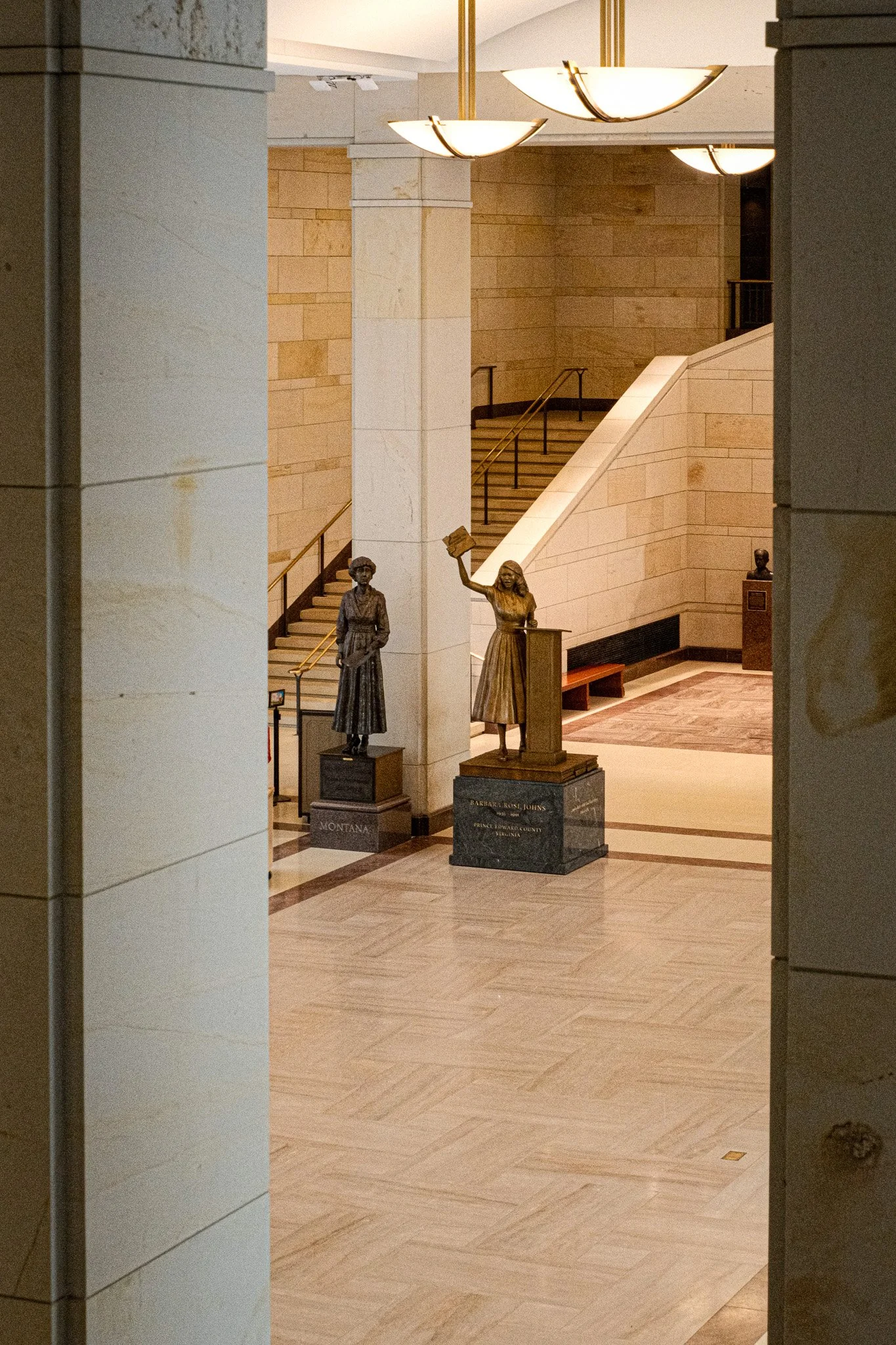
Barbara Johns was just sixteen years old in 1951 when she organized a strike amongst students in Prince Edward County, Virginia. Born in the South, but having lived in New York for some time, Johns was keenly aware of the discrepancies and unequal treatment she and her Black classmates & teachers were living with attending the racially segregated Robert Russa Moton High School. Severely diminished classrooms, a school building with inadequate heating, old & outdated textbooks, no proper labs for the sciences, no gymnasium, no cafeteria; the blatant subpar school experience was clear. Originally the strike was meant to spur action in the school system – build an equally operational school for Black students. But it grew into a much loftier effort that changed education and schooling nationwide. 

Having seen adults previously being rebuffed by the school superintendent, Johns organized a walkout and student strike – as a sixteen year old. 450 students protested for two weeks. When further student-parent conversations with the superintendent resulted in no effort towards change, the NAACP Richmond chapter joined, including lawyer Oliver Hill.

Hill and other NAACP lawyers agreed to challenge the school system if and only if the students agreed to fight on constitutional grounds -- against the separate but equal edict; as opposed to demanding a newer, nicer, but still segregated school for Black students. The students and parents agreed, and the student strike ended, while the legal fight began.  “Separate but equal” segregation was established U.S. doctrine since 1896. Barabra Johns’ protest for true quality started the upending of precedent set in that 1896 case, Plessy v. Ferguson.

Author’s note: As an aside, I grew up in Richmond, Virginia and witnessed Hill receive a number of commemorations in the city. Upon his death, he laid inside the Executive Mansion for public viewing under then governor Tim Kaine.

After the strike, the case that ended up going through the system was Dorothy E. Davis, et. al. v. County Schoolboard of Prince Edward County. While Johns was one of over 100 students to sign an official petition against the school board, Dorothy Davis was the first to sign, therefore her name came to define the case. Davis v. Board was later consolidated with a few other cases before eventually being heard in front of the Supreme Court: Briggs v. Elliott (South Carolina), , Gebhart v. Belton (Delaware), and Bolling v. Sharpe (District of Columbia), and Brown v. Board of Education of Topeka (Kansas). Joined by the others, Brown v. Board became the seminal Supreme Court case that partially overturned the 60 year old Plessy v. Ferguson decision and made segregationist separate but equal provisions unconstitutional.

One moment of protest led to a generation change in how we operate as a society in the United States. 

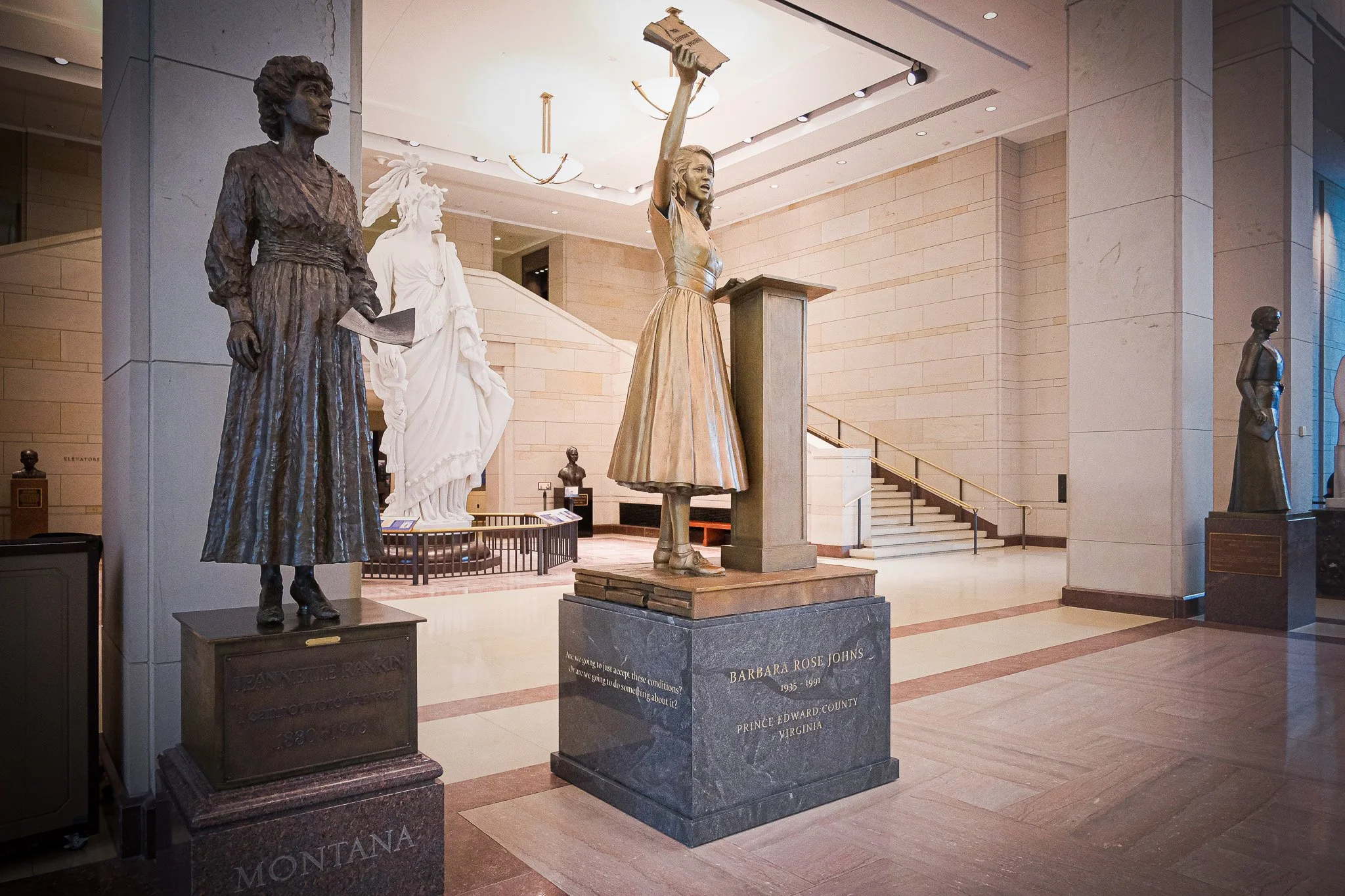
The Barbara Johns statue was offered to Congress to be placed in the Capitol by the Commonwealth of Virginia. Each  of the 50 United States are able to produce and gift two statues to the Capitol National Statuary Collection. Typically these are people important to state's history or U.S. history. Unsurprisingly, one of Virginia’s statues is George Washington. Virginia’s second statue was of Robert E. Lee. Lee’s statue was removed in 2020 and Barbara Johns has come to replace it as of this month. 

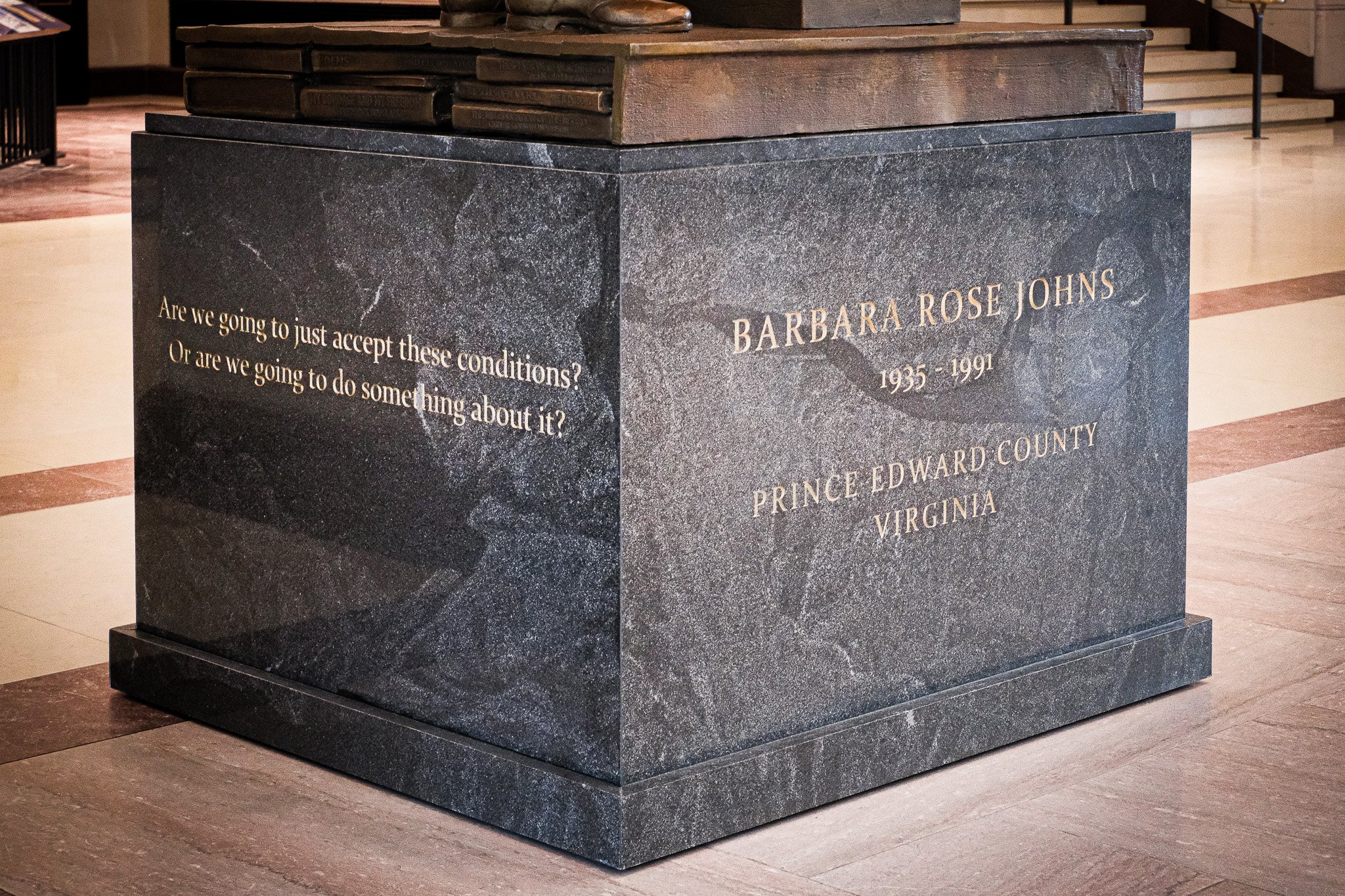
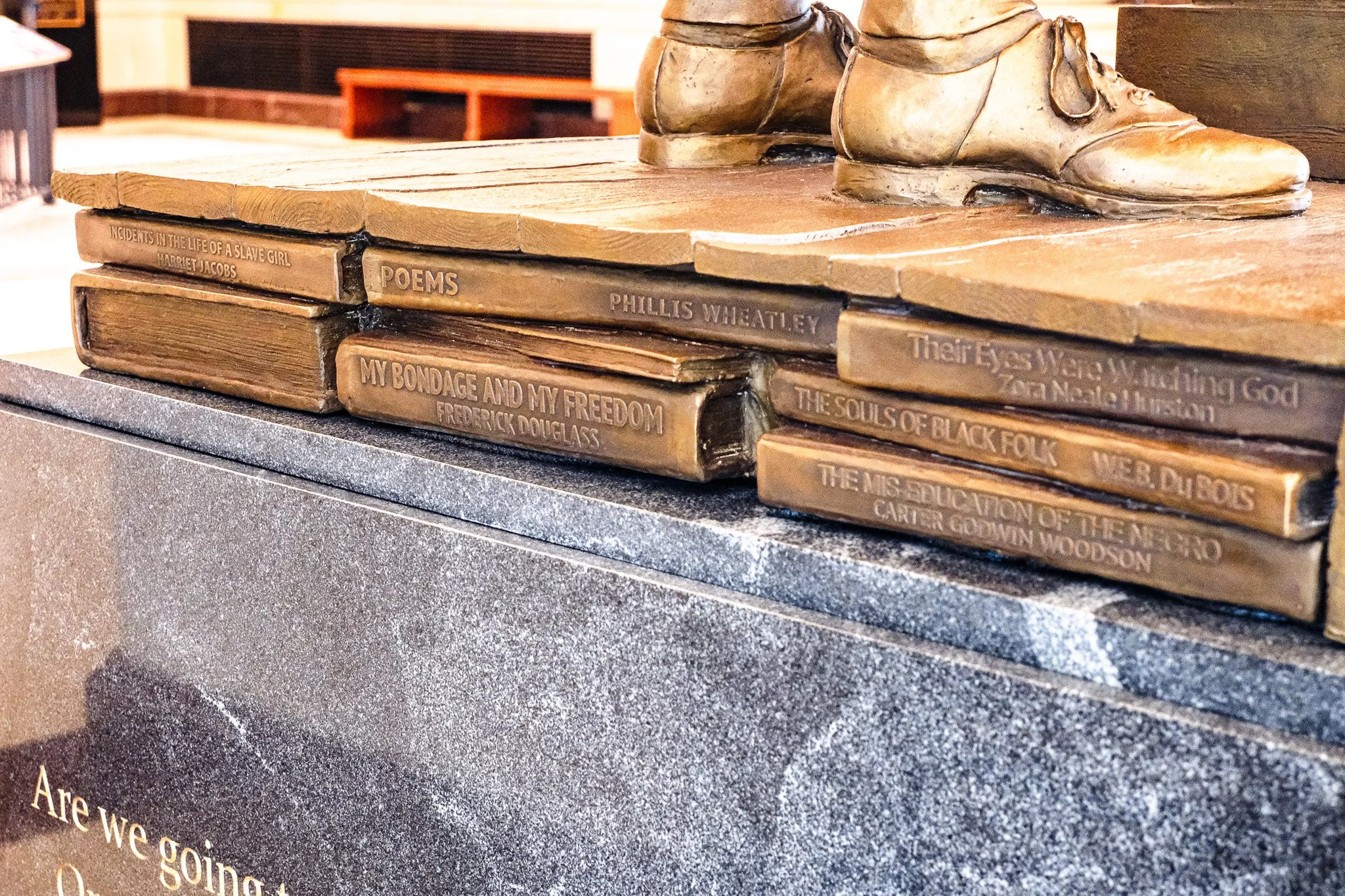
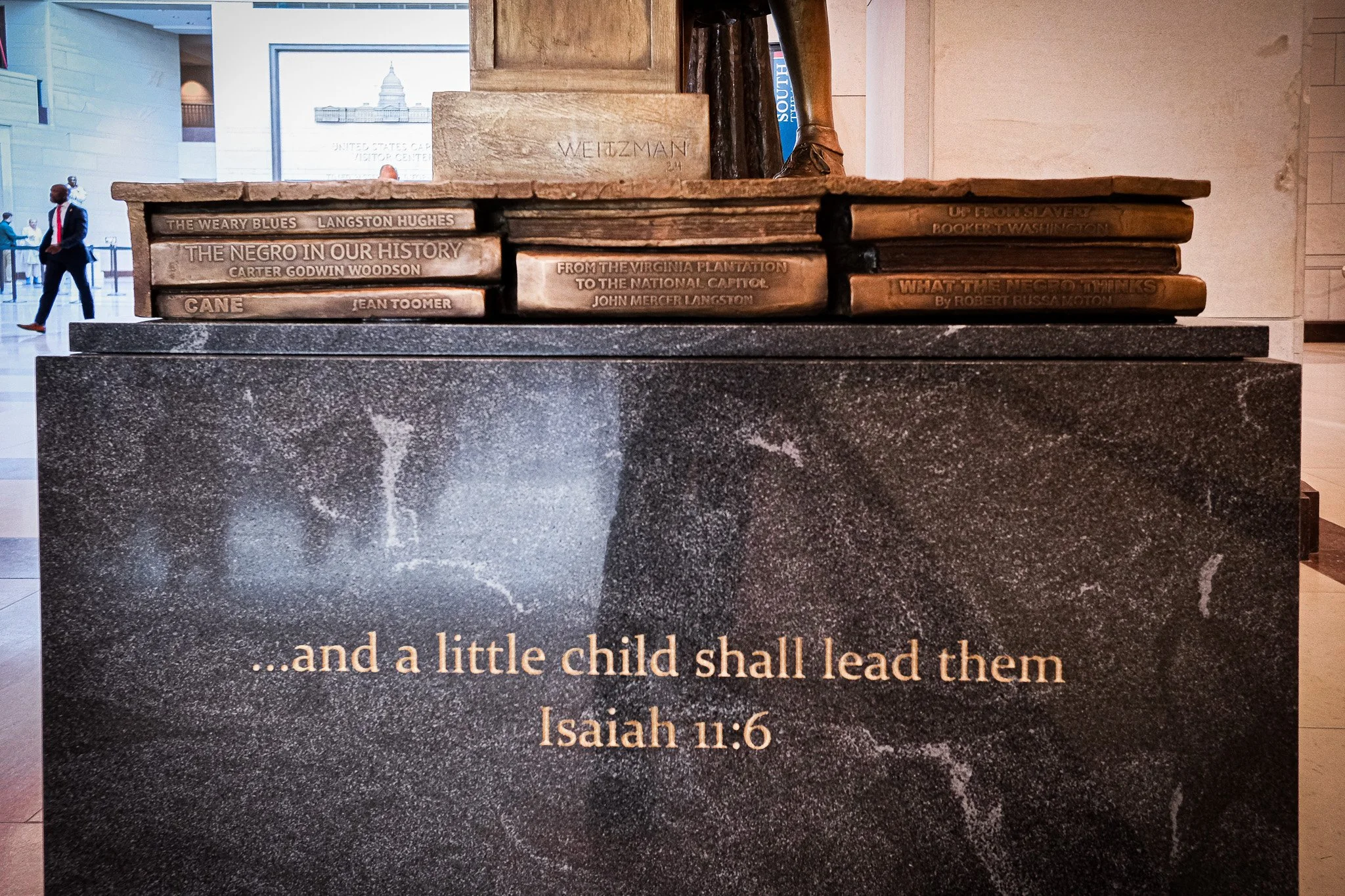
Johns’ statue is of her from the time of the student strike, aged 16 years old. She is depicted rallying other students while holding a textbook, “The History of Virginia.” The book is old and tattered; a used hand-me-down. It’s indicative of what she may have encountered at a school forced to utilize sub-par, second hand materials. Her clothes are typical of what a teen would have worn at the time, including saddle shoes, cuffed socks, and a puffed skirt. Under those shoes: floorboards with books underneath. The sculptor chose to represent Black artists and seminal works that the students at Johns' school may not have had access to, but nevertheless contributed to the through-line of striving for equality and justice. The books underfoot are: 

Incidents in the Life of a Slave Girl by Harriet Jacobs

Poems of Phillis Wheatley

My Bondage and My Freedom by Frederick Douglass

Their Eyes Were Watching God by Zora Neale Hurston

The Souls of Black Folk, The Talented Tenth, and Black Reconstruction in America by W.E.B. Du Bois

The Mis-Education of the Negro and The Negro in Our History by Carter Godwin Woodson

The Weary Blues by Langston Hughes

Cane by Jean Toomer

From the Virginia Plantation to the National Capitol by John Mercer Langston

Up from Slavery by Booker T. Washington

What the Negro Thinks by Robert Russa Moton

Native Son by Richard Wright

Below the books one side of the statue, an apt quote of Barbara Johns: “Are we going to just accept these conditions? Or are we going to do something about it?”

I’m so pleased that we honor Johns as an agent for change and honor her in the moment of change, as a teenaged person. While the statue was briefly in the U.S. Capitol Visitor’s Center, it has been moved to its permanent home, the Capitol Crypt, a vaulted space in the center of the Capitol under the Rotunda. This is typically the first area explored on the official U.S. Capitol tour, which is the best and easiest way to see the statue.

Consider joining the Attucks Adams Patreon where we have continued this conversation, looking at a number of other DC area commemorations featuring young people.

The American Story: Exhibition Spotlight

The National Archives serves an outsized role in our country at this moment. As we grapple as a nation with how and what values drive policy, sentiment, laws, mores, behaviors, and citizen expectations, the documents that are foundational to life in the U.S. are still on display for public scrutiny. 

The Archives calls the collective documents including the Declaration of Independence, Constitution, and Bill of Rights the “Charters of Freedom.” Those three documents are the literal centerpiece of the main Archives building here in Washington, DC. The entire Rotunda and balance of remaining programming & exhibitions in the building –all the way down to ticketing, entrance, and egress–  have been built around access to the Charters of Freedom. But there is so much more to the Archives, especially to the average, non-researching visitor.

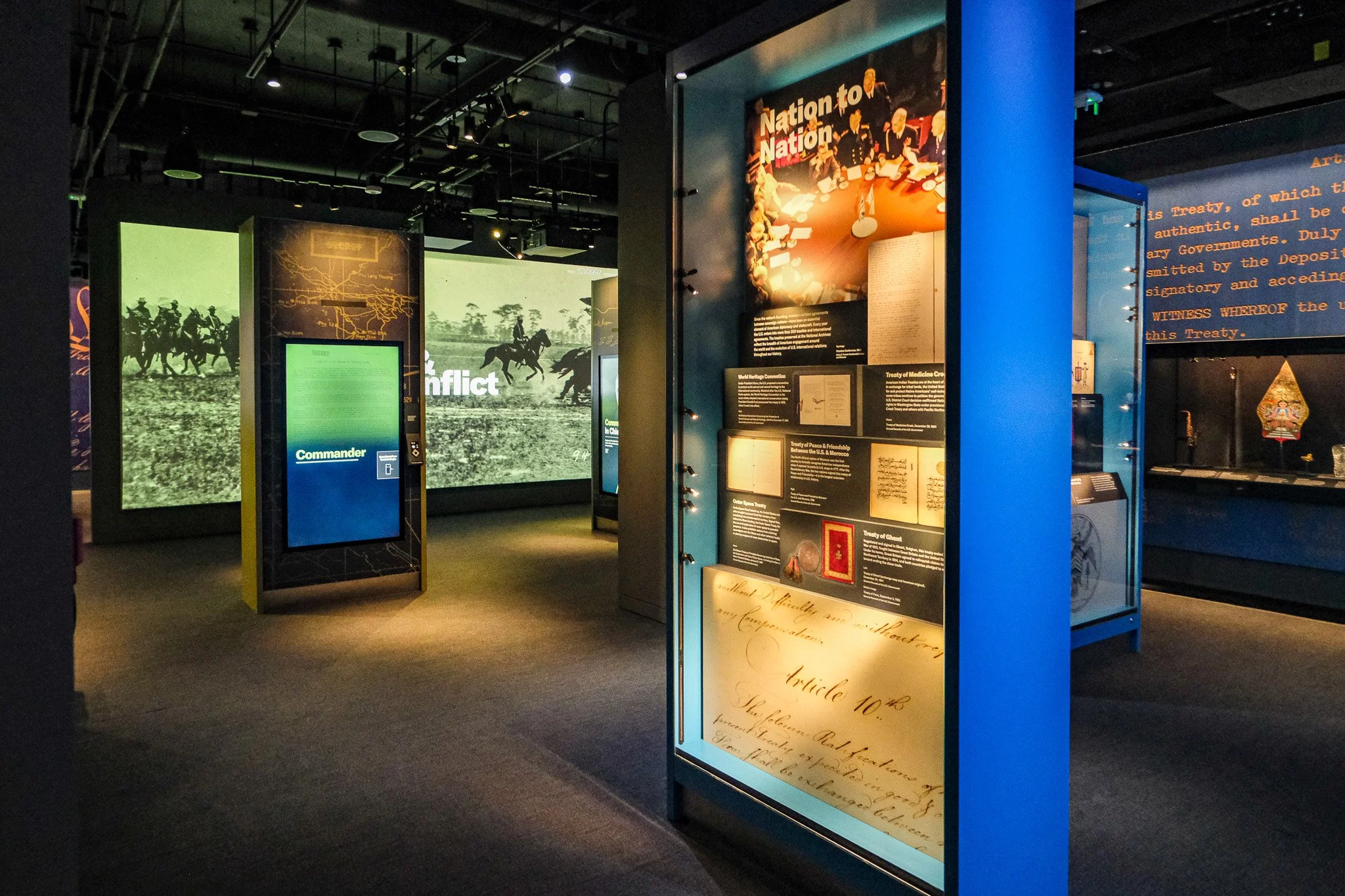
Officially, the National Archives and Records Administration (NARA) spans across the country in nearly 40 buildings including the main facility and museum in DC, a much larger archival storage and research facility nearby College Park Maryland, 10 regional archives, and 16 Presidential Libraries. In total, there are nearly 13 billion (13,000,000,000) documents under the purview of NARA. The building most associated with access to documents is the one you've probably visited -- the 1937 Archives building located on Constitution Avenue NW in DC. Aside from the Charters of Freedom, there are typically several other rotating exhibitions open in the museum portion of that building. 

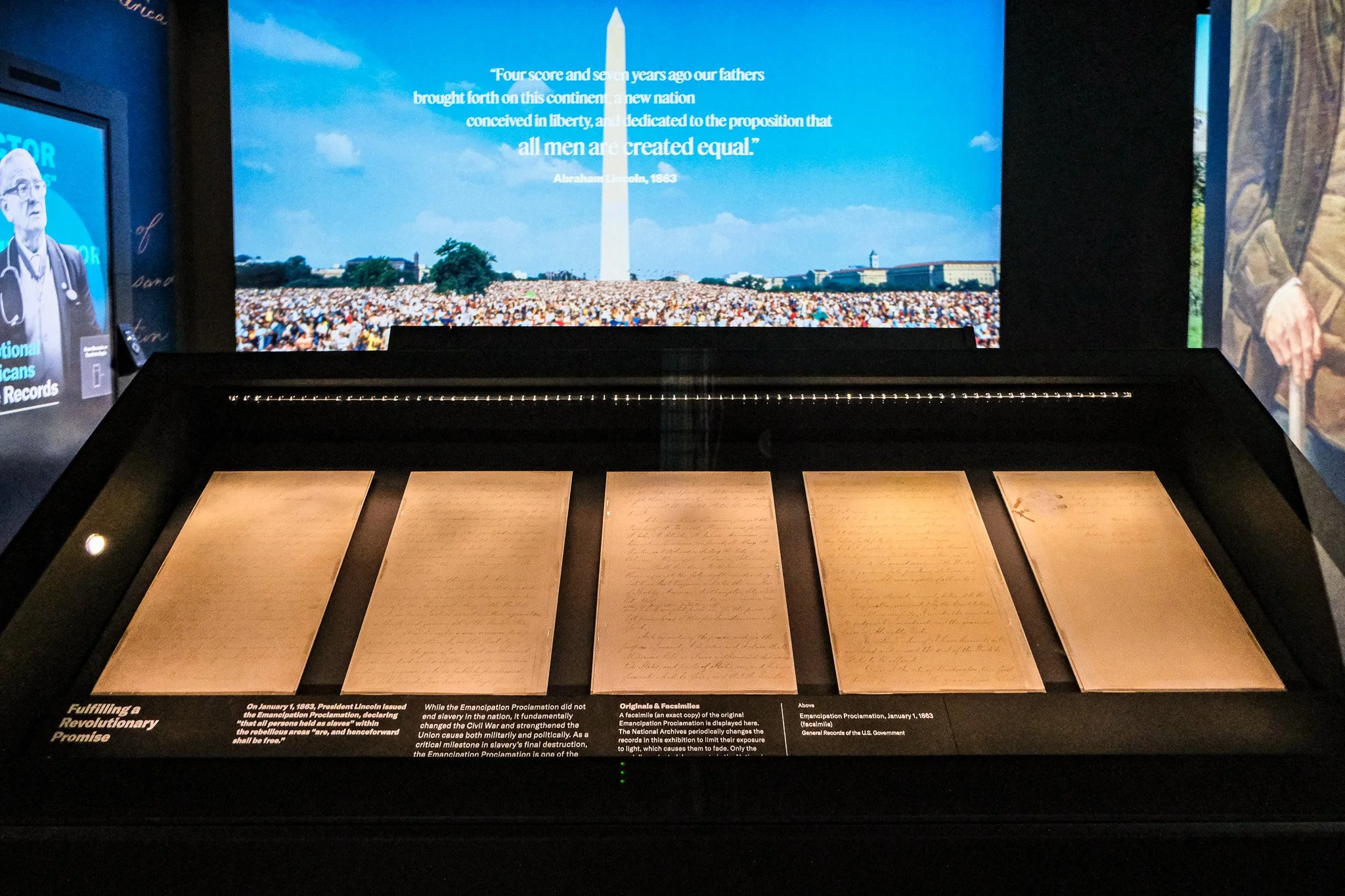
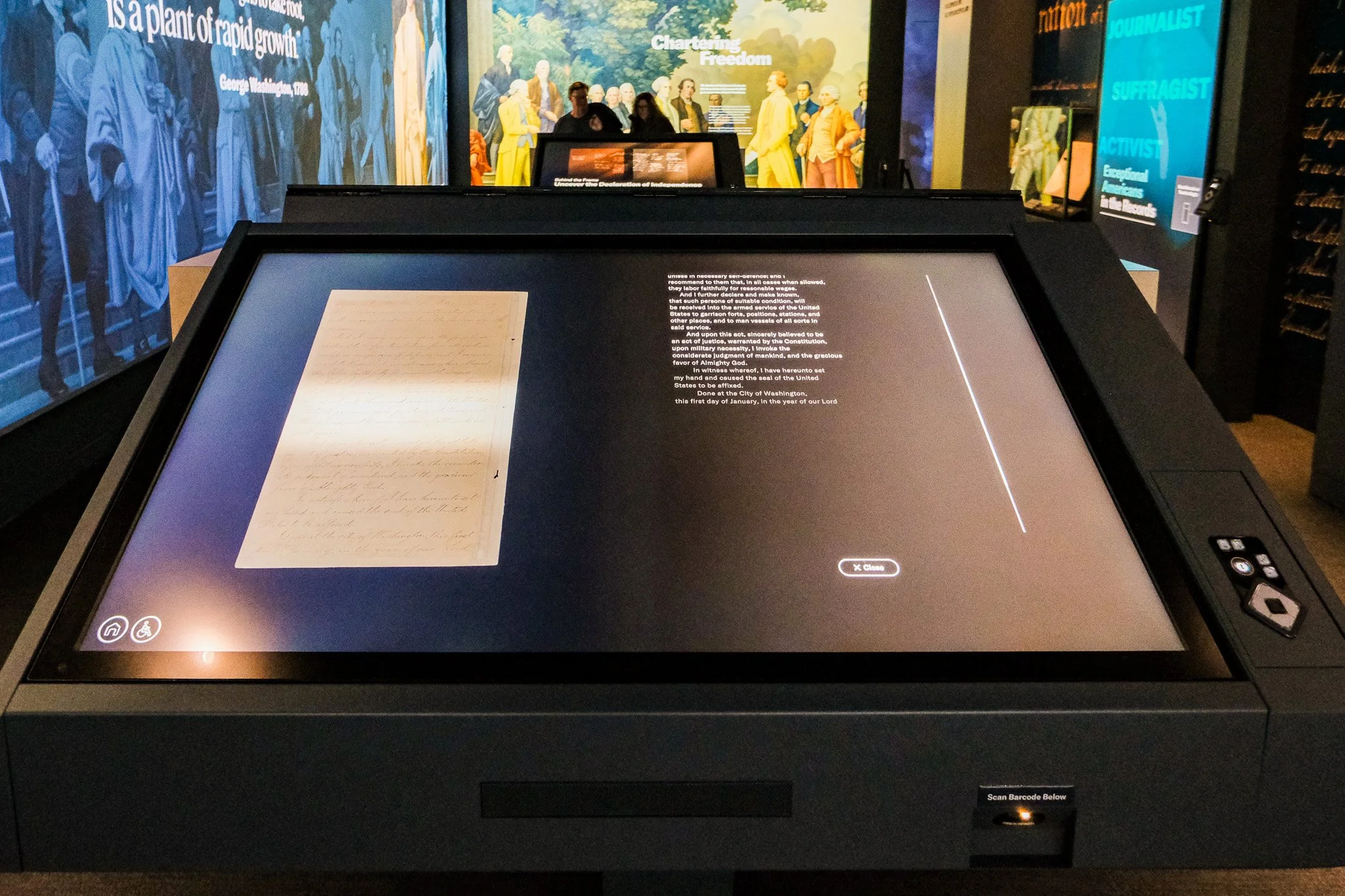
A surprising amount of documents on permanent display were facsimiles; like the Emancipation Proclamation.

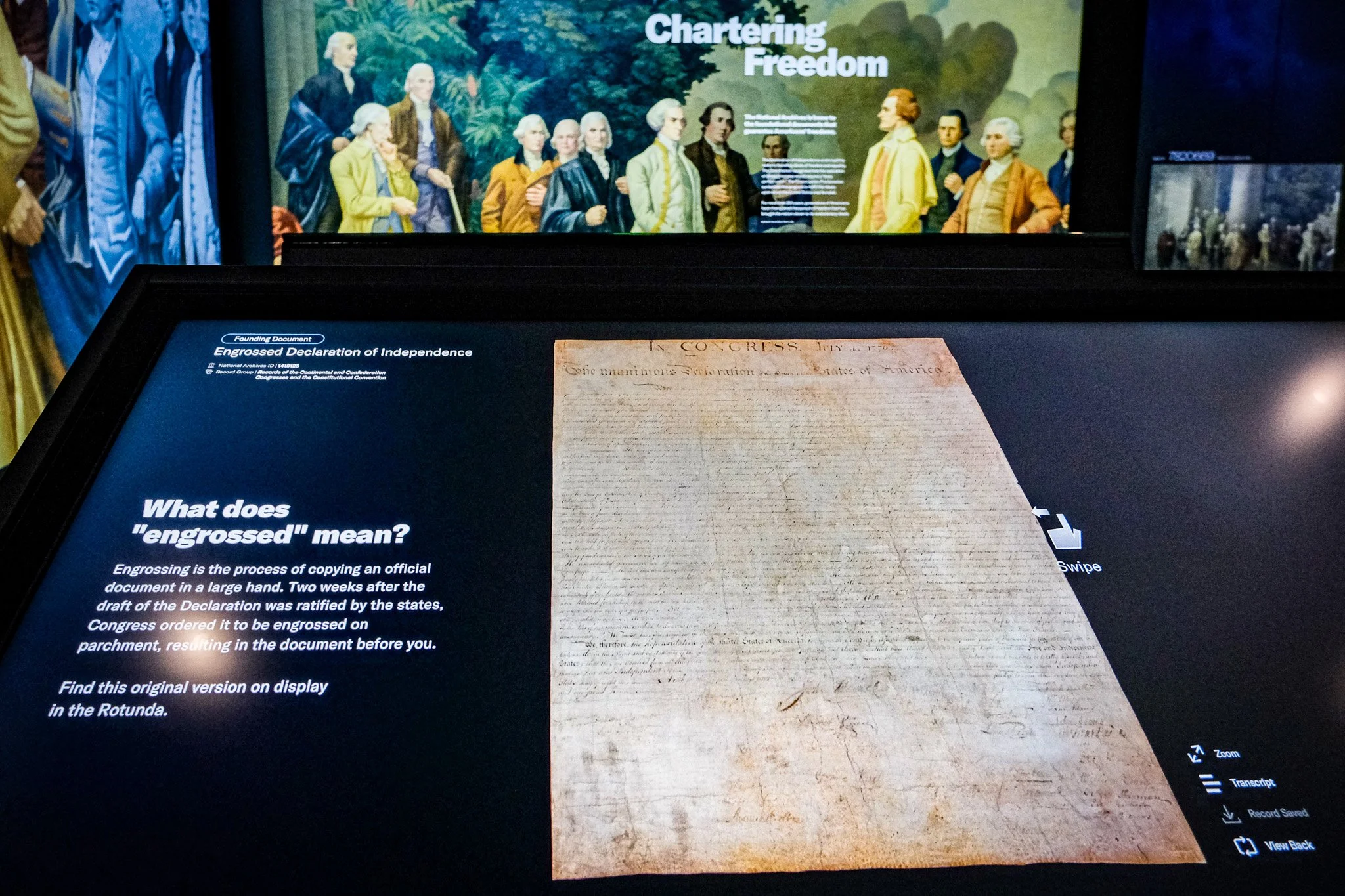
The amount of information about each document is astounding. From meaning behind the words to how the parchment was made.

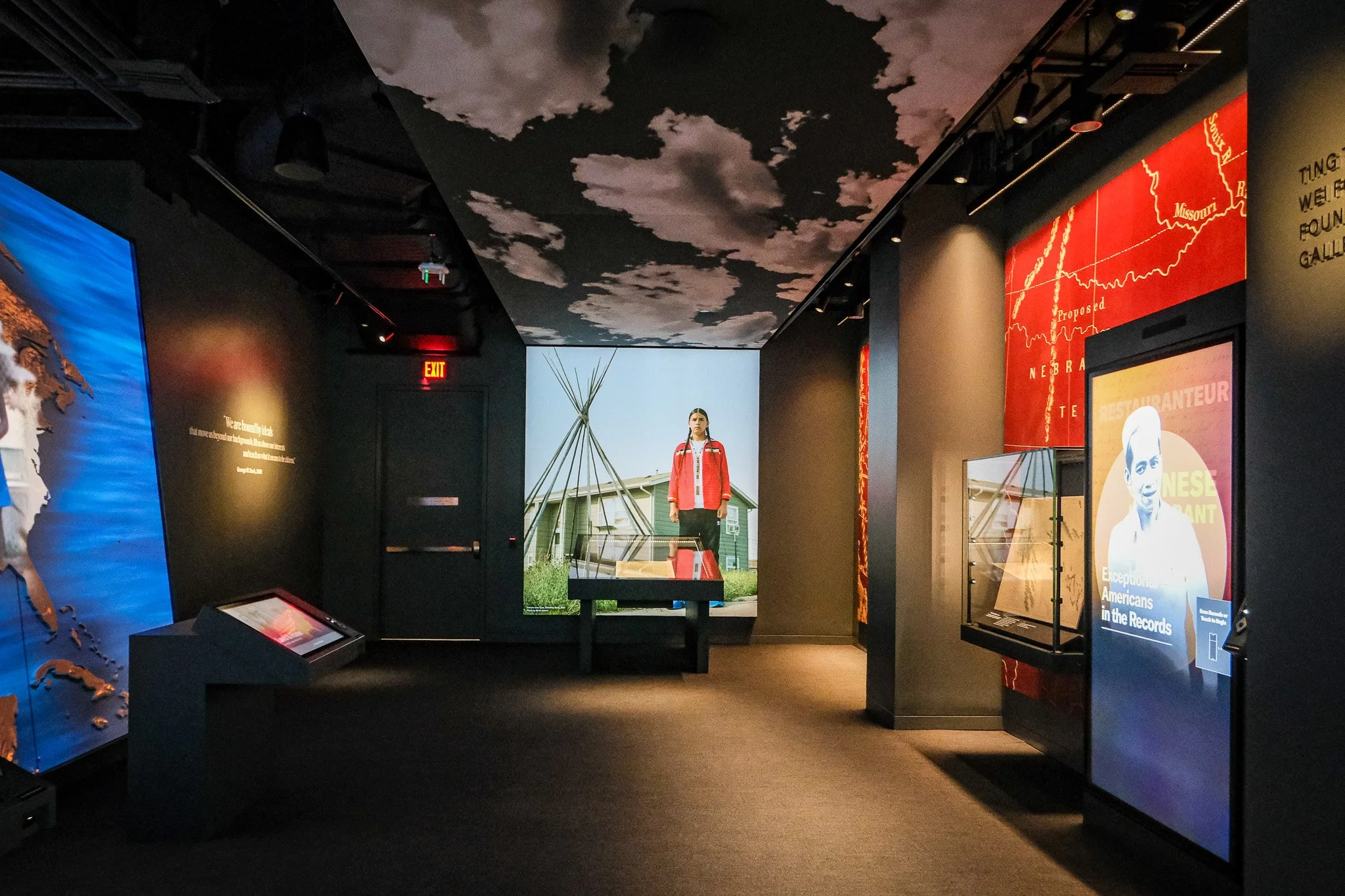
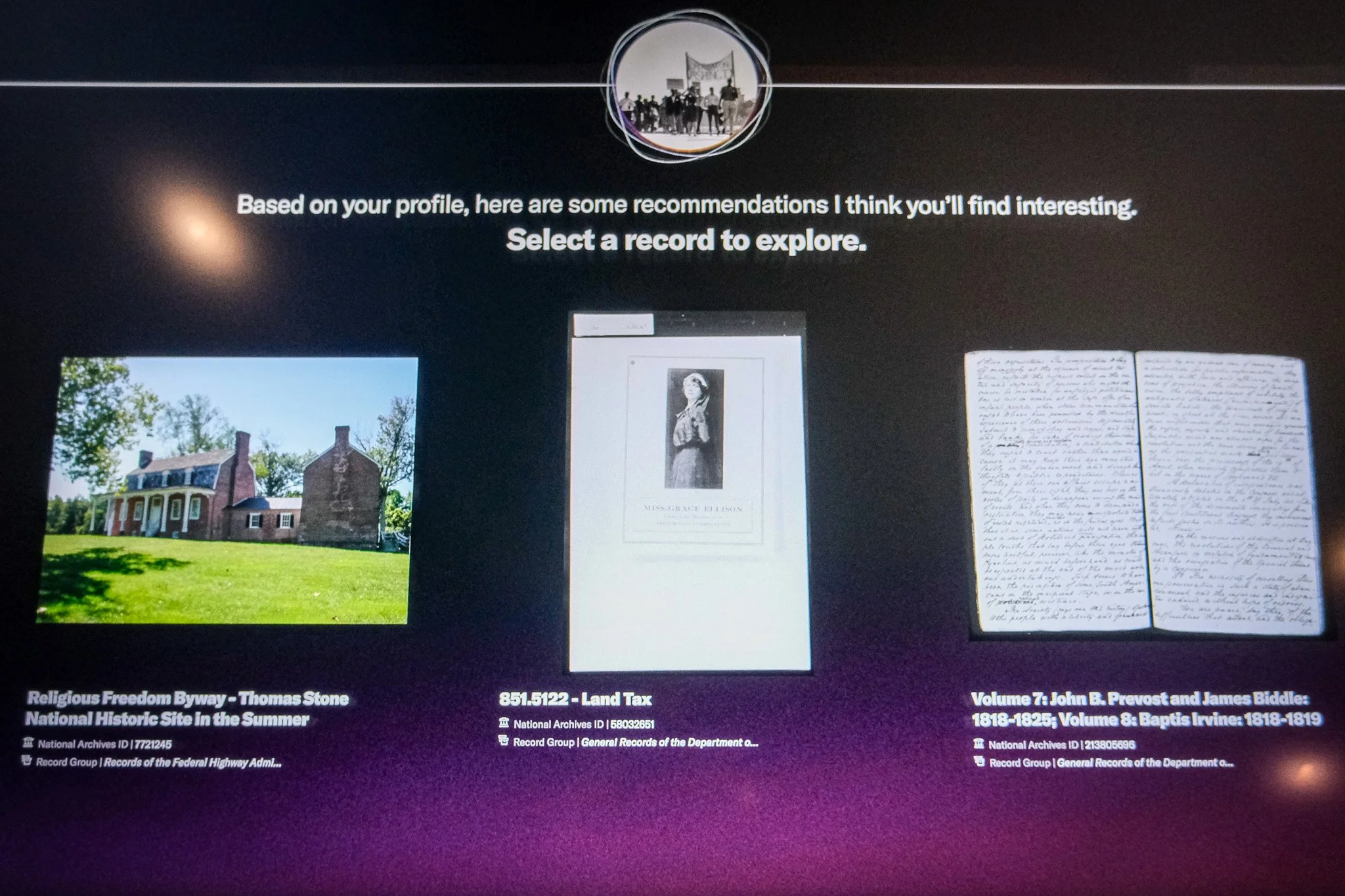
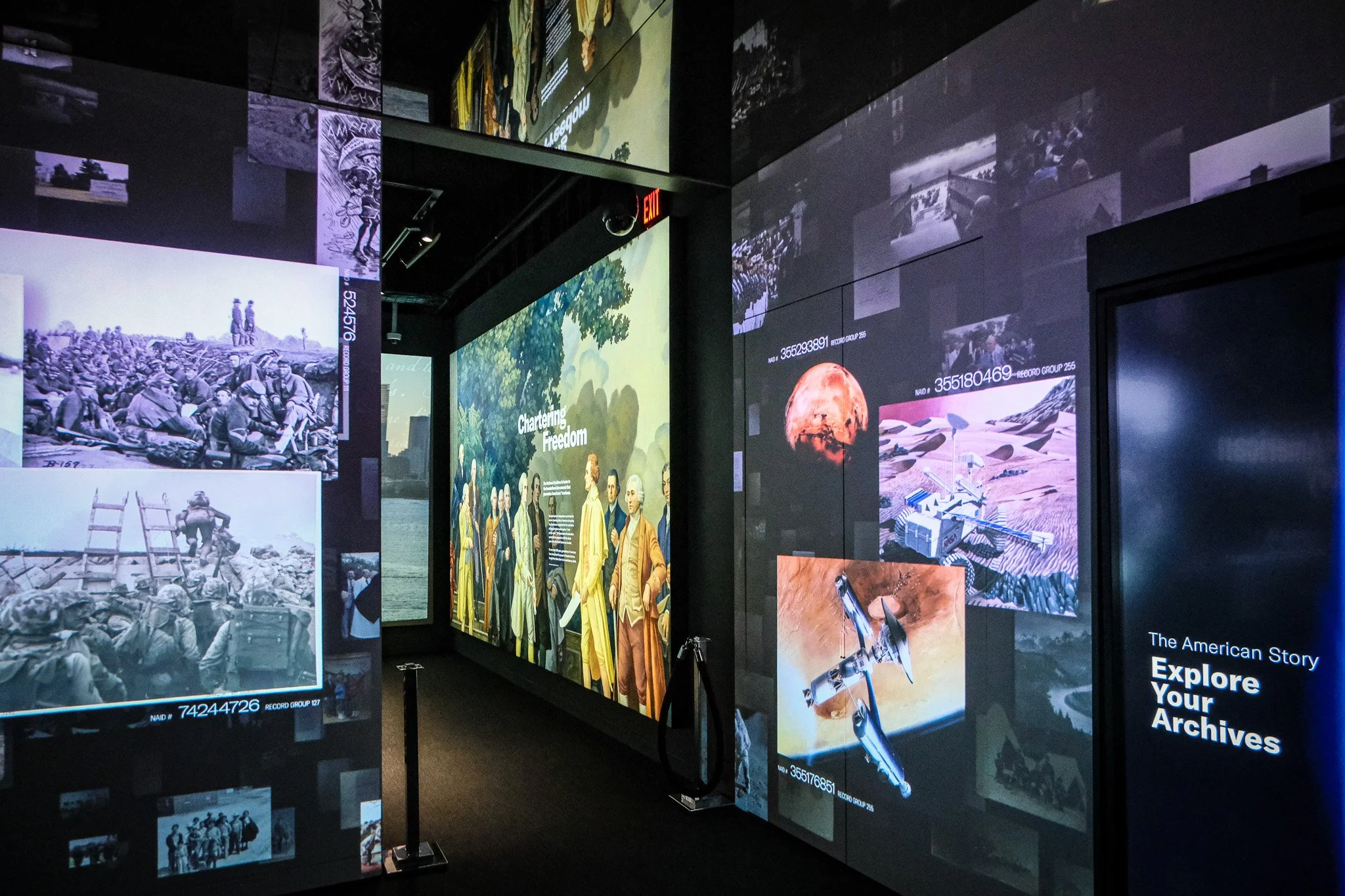
The newest exhibition, “The American Story” is the most forward attempt by the Archives to connect the visiting public to the vast amount of documents it oversees. Using what the Archives themselves have described as an Artificial Intelligence interactive, the main interface in this exhibition is a network screens that suggest documents for you to explore based on a combination of interests that you choose at the start of the exhibition and either the document you’re exploring at that particular station or the theme of the room you are in at the time.

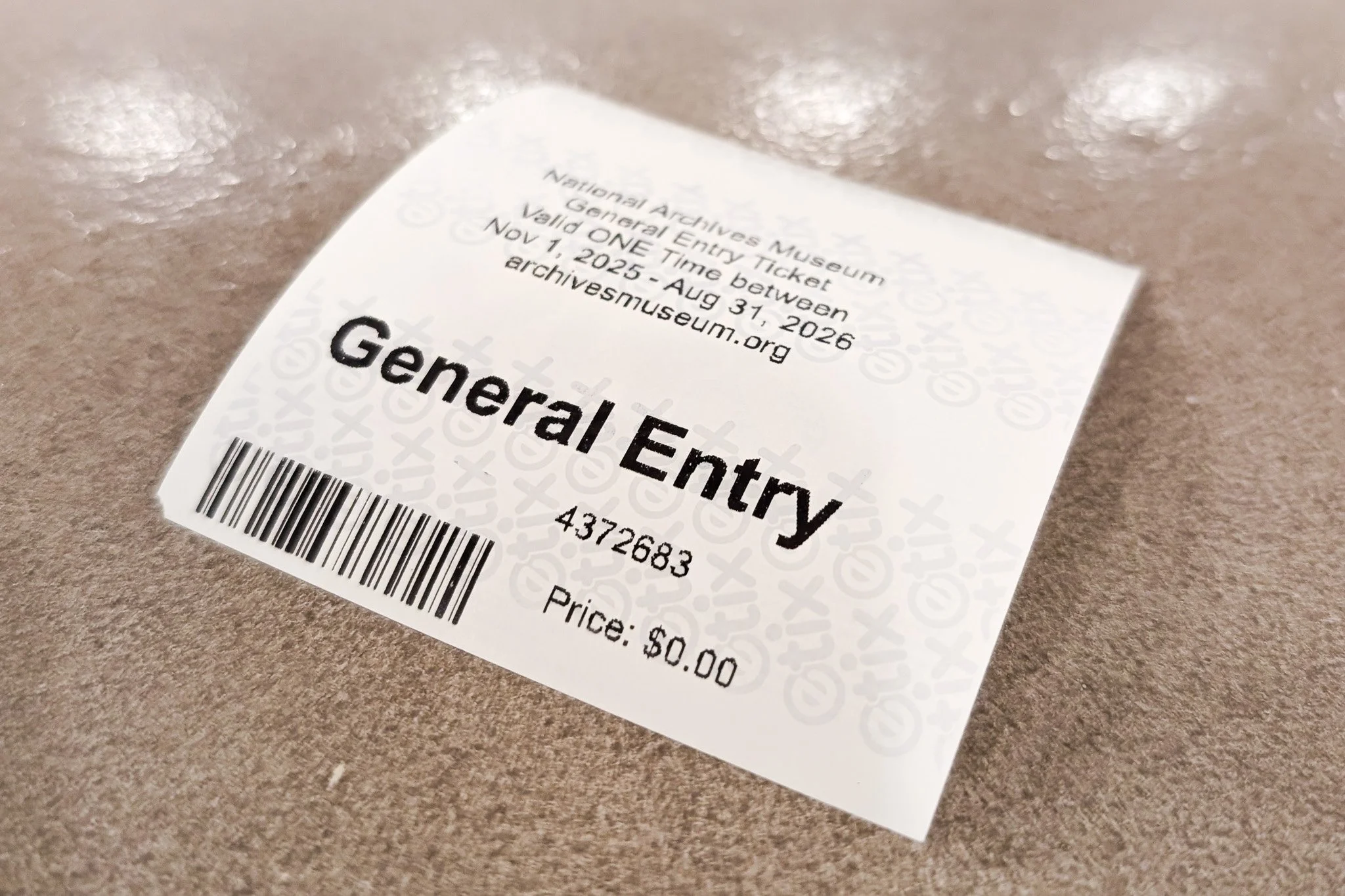
If you wish to keep track of the documents, you can grab a general entry ticket at the desk as you enter the Archives, after exciting security. You then scan that ticket at each touch screen kiosk in the exhibition as you interact along the way. At the exhibition exit, after your last scan, you have the option of navigation to a QR code linked to your personal ticket. There you can bookmark a unique web page on your phone in order to look in detail at all of your saved documents later. Hold on to the ticket! It’s good for the next year and you can return to add more documents to your unique web page. 

Here’s the web page for my last visit: https://archivesmuseum.org/14312293451. You can see which documents I saved in the exhibition in order to look more closely at them later at home.

For example, I saved this annotated draft copy of the Constitution that belonged to George Washington. You are able to see his hand-written notes in the margins! Now I can examine high quality digital files of this and other documents while I am at home. It’s not just an experience to be had inside the museum. 

How did I discover this George Washington related document? When I created my initial profile attached to my ticket, along with basic topical interests like founding documents, I indicated that I wanted to be offered associated items in the form of paper documents, photographs, and maps. These are all digitized of course. So at some point looking through the exhibition, the “AI Archives" program suggested that I save this document, which I did. Now I can bookmark this page in my browser for research purposes or just to relive the experience. Exploring further, I can also see where the actual paper document lives within the Archives system (actually in this same building!). Overall, on this visit I saved 34 documents which live across 6 different archive facilities and 2 presidential libraries. 

It is somewhat random, as many of the suggested documents were not at all linked to the content I was viewing or had very tenuous links to my purported interests. I’m not sure how this “AI” suggestion system is any different than an associated keyword search or metadata match.

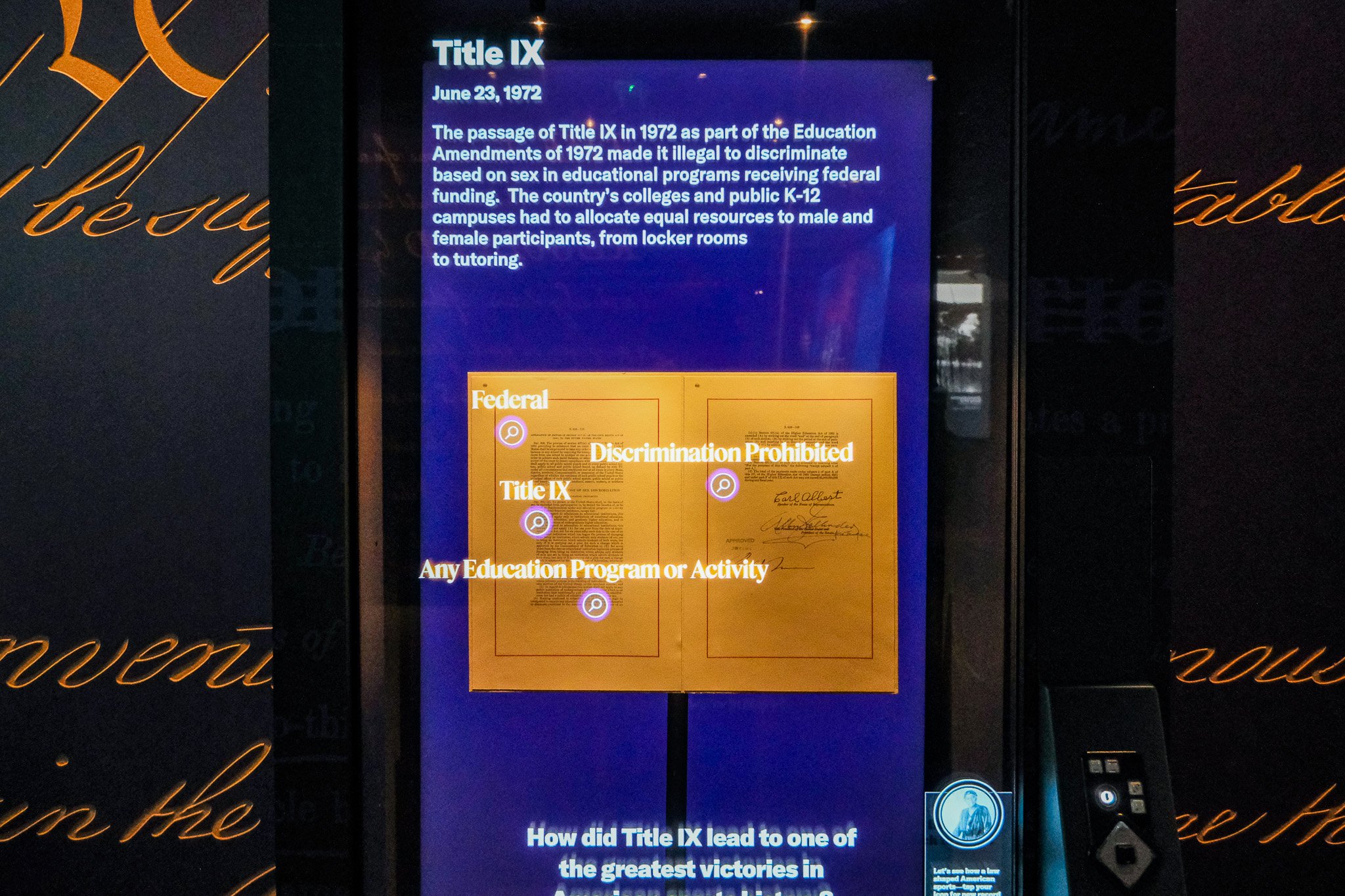
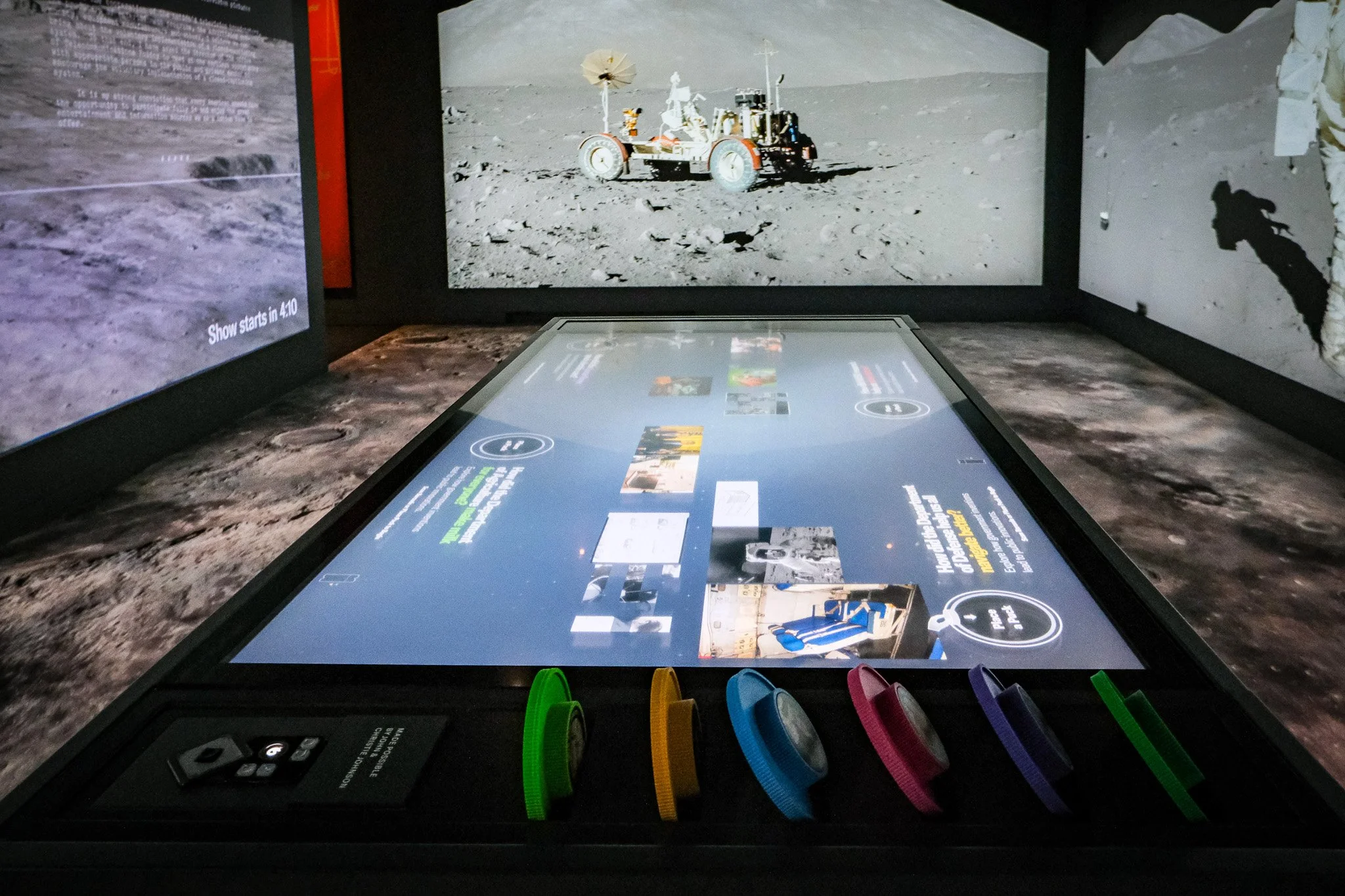
Immersive technology lets you read a document while using an overlying touch screen to learn more.

On a separate, more personal ticket, I saved some of my personal family information from a century-old Census record. You can begin basic genealogical research in this exhibition, too. There are privacy safeguards. Visitors are forced to link any saved ancestral/genealogical information accessed in the exhibition to a personal email address. This prevents that information from showing up to anyone who might find a lost ticket or randomly link to your Archives page online.

Along with a strong start featuring a deep dive into key documents like the Declaration, Emancipation Proclamation, and Louisiana Purchase (featuring mostly facsimile documents however), the exhibition branches out with a smattering of other topical deep dives including presidential gifts (received by), interesting patent history, genealogy, a thematic rotating photo gallery (currently featuring Ansel Adams), and a kids & family focused discovery center with "gamified" research and fun-fact stations.

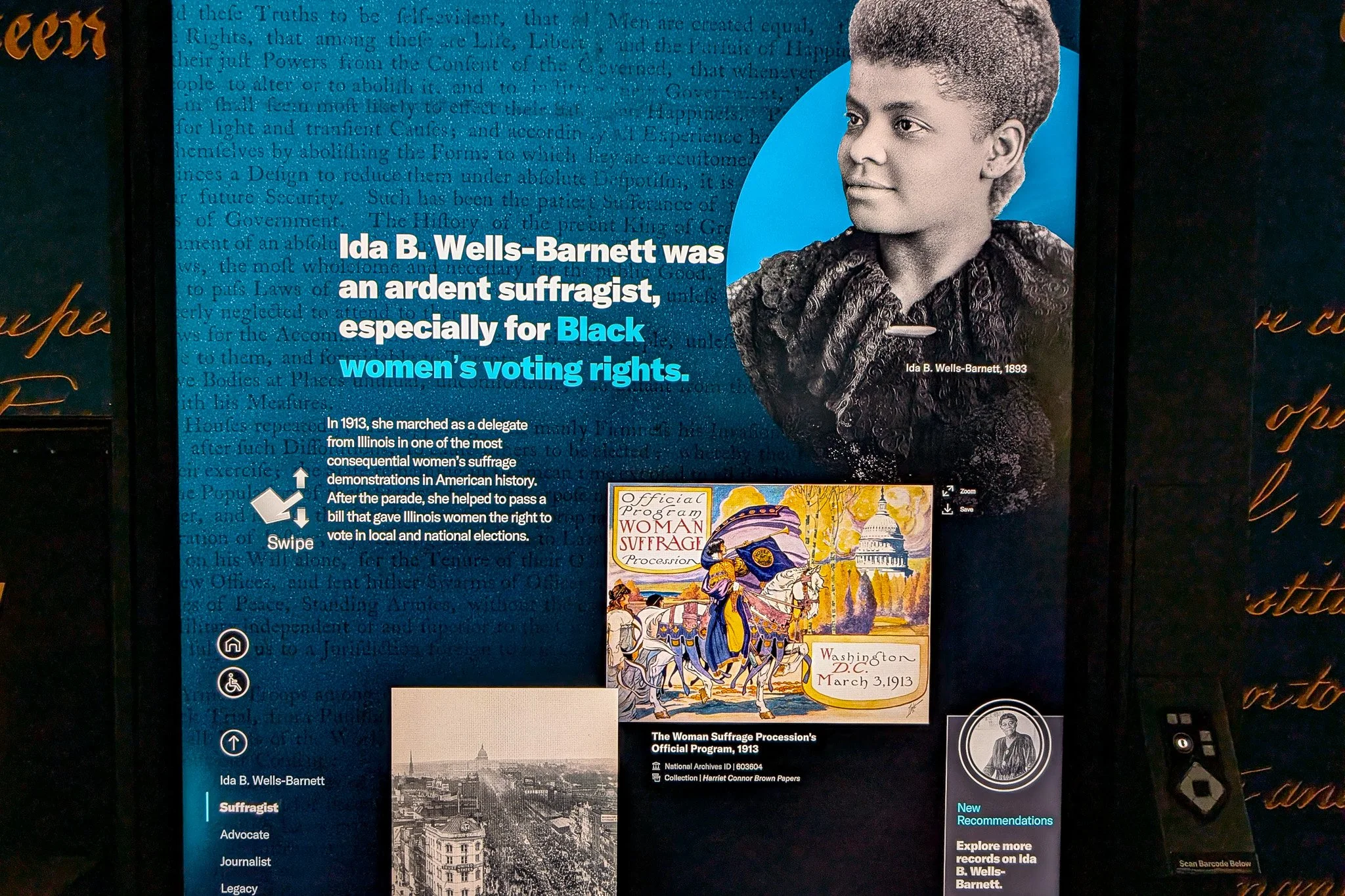
Profile of journalist and suffragist Ida B. Wells.

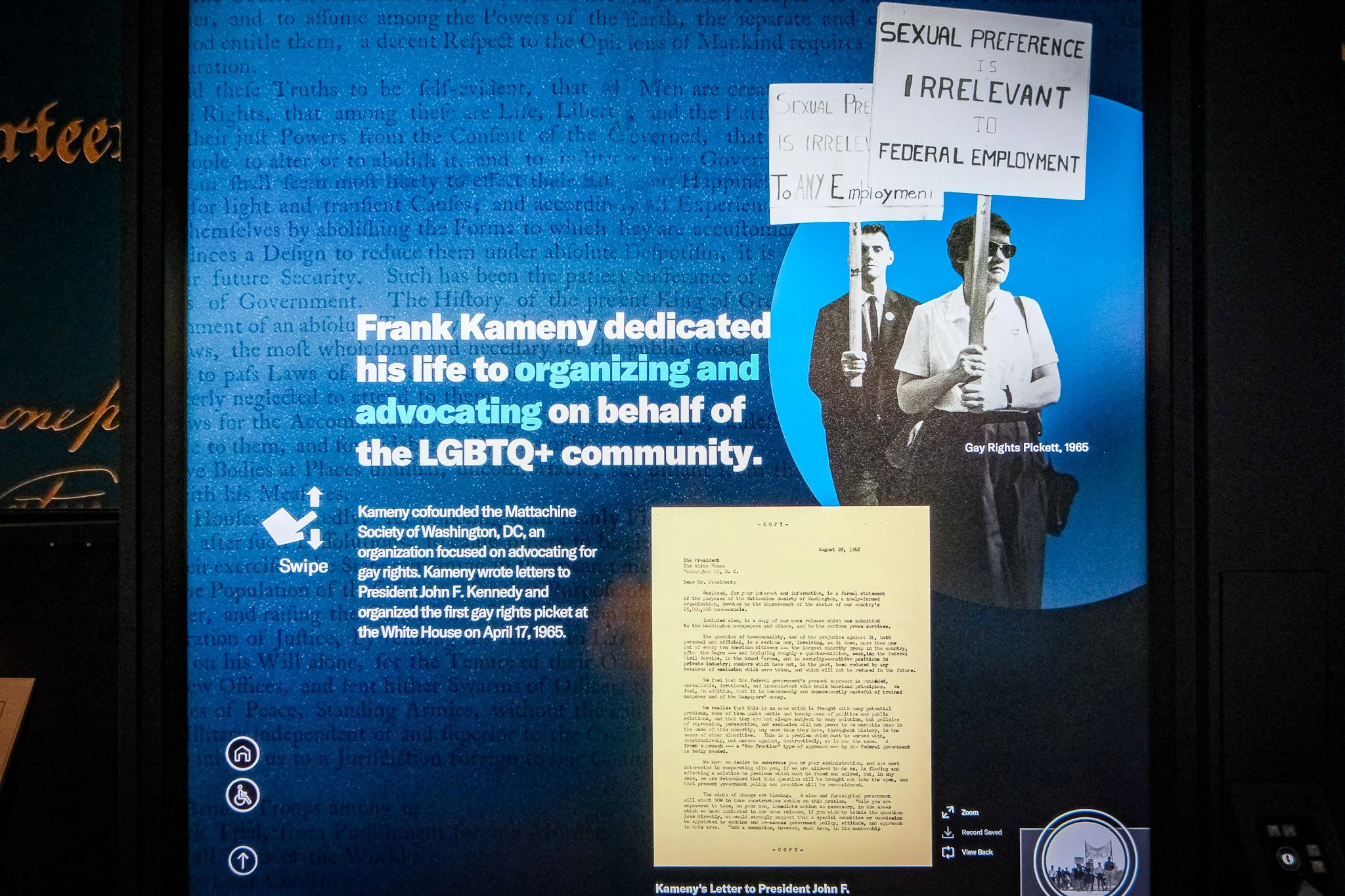
Profile of Frank Kameny and a letter he personally sent to President Kennedy.

One key attention grabbing aspect of select kiosks is the highlighting of personal profiles. The profiles are of influential or compelling change makers from American history that are related to the section of the exhibition you happen to be in or nearby documents to the kiosk. At the very first kiosk I was shown profiles of Ida B. Wells and Frank Kamany, two Americans I was immensely glad to see included in the exhibition. Linked to each profile are related government documents, of course – docs related to each person’s activism, struggle, or occasionally mundane government paperwork that became symbols of those struggles. I thought this was an extremely effective way to give a certain document meaning. We’re used to recognizing the importance of the written words on a few sheets of lined paper that make up the Emancipation Proclamation, for example. But, the links to other, lesser known documents or government paperwork along with the profile of the person who wrote or filled it out, AND the context as to why that mundane submission might have importance, kept me at the kiosk looking up various individuals and their related docs. Especially folks I have never read or learned about before. 

Overall, “The American Story" is a success, insofar as it provides a new, clever, and mostly accessible way to interact with the documents held in the Archives. And even though the “AI” is somewhat of a gimmicky idea to me in this case, the system does result in delivering suggestive documents in a way meaningful to one’s interests. I will also give points for the opportunity to discover transformative individual Americans at each station, relative to the documents on view in that section. On the other hand, the whole exhibition doesn’t come nearly as close to telling any one version of “THE” or even “AN” American story. The exhibition is just too scattered to weave a solid overall narrative. There are solid pocket narratives related to presidential decision making, westward expansion, innovation, and founding documents. And I can’t offer too many demerits outside of picking a slightly misleading name to the exhibition. If one is looking for a more cohesive and comprehensive national narrative, I  would visit any number of exhibitions in the nearby National Museum of American History or even NMAI or NMAAHC for that type of experience. 

The American Story is a permanent exhibition at the Archives and as such, has no closing date. It’s open 10am to 5:30pm daily with the rest of the Archives. The exhibition is located on the same floor as the Rotunda and Charters of Freedom.

Exhibition Spotlight: "I’ll Have What She’s Having”: The Jewish Deli

Learning through food histories is a fascinating & compelling way to explore the past and learn about peoples, regions, and cultures. For instance, a few years ago I wrote a 60 minute food histories of DC program for a client and through this strictly food-based research, I learned so much more about the District of Columbia itself. A new exhibition at the Capital Jewish Museum titled "I’ll Have What She’s Having”: The Jewish Deli encapsulates all of that same sentiment and more.

From exploring the effects of 20th century immigration, to defining the actual foods served in delis, to surprisingly relevant modern day pop culture movie references, this exhibition is more than just a food history. It showcases how American Jews, through delis, created new American food traditions, ensured continuity of important established traditions, and practiced a time-tested, cross cultural social exercise — sitting down together to have a meal.

Of course, since this is the Capital Jewish Museum —as in Washington, DC— there is a solid emphasis on the DC area history in deli culture from present day and years past. That includes the suburbs of Washington, too. Not to mention the existing interactive computer display of delis and other Jewish owned business, schools, places of worship, and significant sites in the ongoing exhibition (Connect. Reflect. Act.).

I loved the mix of laying groundwork through immigration histories while showing present day ephemera that makes every individual deli that particular deli — uniforms, menus, equipment, signage, and advertisements. We have all seen these places in everyday city life, but the context and meaning make seeing the exhibition more of a journey. And of course, if you explore it all from beginning to end, you'll get to watch the namesake, payoff “I’ll have what she’s havingfilm scene in the final gallery. Admittedly a somewhat hilarious sounding clip if you haven't seen the movie and you hear it while making your way through the adjacent room in the exhibition.

“I’ll Have What She’s Having”: The Jewish Deli” is on view through August 20, 2024. As a special exhibition, it does require an entrance ticket of $15. The rest of the museum is free with timed ticket. Walk-ins are excepted as space permits. 575 3rd St NW.
Exhibition Spotlight: Brilliant Exiles

Josephine Baker est aux Folies-Bergère. Lithograph, 1936. ByMichel Gyarmathy (1908-1996).
Happy belated birthday Josephine Baker! The singer, dancer, and actor who captivated Paris in the 1920s was born 118 years ago this week, on June 3, 1906.

Baker was but one of many innovative and creative American women who moved to Paris in the early 20th century seeking personal autonomy along with professional agency and success.

Some of these “brilliant exiles” are profiled in the new National Portrait Gallery exhibition by the same name, “Brilliant Exiles: American Women in Paris, 1900-1939.” The exhibition is open through February 23, 2025.

Loïs Mailou Jones 1905-1998. Charcoal and chalk on textured paper, c. 1940. By Céline Tabary (1908-1993) .

Gertrude Stein 1874-1946. Oil on canvas, 1905-6. By Pablo Picasso (1881-1973).

The show is made up of nearly 80 works of art, mostly in the form of portraits. The portraits are of, and sometimes also by these Americans who shifted and elevated the Paris culture through literature, visual, arts, dance, drama, and philosophy.

Portraiture has a way of annunciating identity in a more evocative way than even the written word can. This exhibition does that in a simple way, letting the paintings speak for themselves.

Baker, like the other American women featured in the exhibition, did not leave the U.S. and land in Paris by accident or coincidence. Crushing legal and social limitations in the U.S. left little room for freedom expression for independent and talented women. Restrictions were based not on just gender, but sexuality, race, economic stratifications, and politics. Paris was not a panacea for all U.S. societal ills, but the artistic climate offered more independence, agency, and freedom to an extent that, for these women, the U.S. could not compare.

Mercedes de Acosta 1893-1968. Oil on canvas, 1923. By Abram Poole (1882-1961).

Baker herself moved to Paris in 1925. She did return to the U.S. for short stints in theatrical productions, and more extensively to lend her aid to the cresting civil rights movements in the 1960s. But by then she was a Parisian through and through, having gained French citizenship way back in 1937. Baker died in Paris, passing away in her sleep on April 12, 1975, just days after performing in a show marking her 50th year of her Paris debut.

This exhibitions is about more than Baker herself. The portraits that make up the show give a luminescent view into the personality, and dare I say, aura, of the people captured. This is high recommend to visit before the show closes in February of 2025!

This and all Exhibition Spotlights are brought to you by our wonderful Patrons. Patrons get monthly insight into new and upcoming museum exhibitions, DC history posts, photographs not shown anywhere else, and more. If you like this post, there’s way more at Patreon.com/AttucksAdams! Memberships start at just $3/month.

In Exaltation of Flowers: Rose- Geranium; Petunia-Caladium-Budleya; and Golden-Banded Lily-Violets. Katharine Nash Rhoades 1885-1965. Marion H. Beckett 1886-1949. Mercedes de Cordoba Carles 1879-1963. Tempera and gold leaf on canvas, 1910-13. By Edward Steichen(1879-1973).

Exhibition Spotlight: Afrofuturism

Surprisingly, one of the more intriguing parts of my recent visit to the Afrofuturism exhibition was the exhibition booklet. Typically, the exhibitors booklet --if there even is one-- is a mostly ephemeral folded pamphlet with obligatory, but duplicate information. I will usually pick one up whenever I first enter a new exhibition, but if it looks like I won't get anything out to it, I put it back in the rack for the next person.

Not so with Afrofuturism: A History of Black Futures. Just as the NMAAHC has done with their exhibition websites, they have created a booklet that compliments and extends your experience beyond exhibition. It is deemed a "Cosmic Companion" and that rings true. 

The booklet helps you plan your walk through the exhibitors with "Discover Treks," offers prompts and questions to enhance your visit beyond the objects, and even offers tips on how to interact with the museum itself; from defining the word "object" wo helping you manage the time you have to see it all. I really loved the booklet and have been flipping through it the past few days admiring the work that went into it. 

As for the exhibition itself, it is a vast, but also focused on the evolving concept of Afrofuturism. Yes, it does concern the future, but also the past. It posits past and present struggles for freedom as afrofuturist in nature; reimagining a future of freedom and autonomy. 

The exhibition delves into multiple disciplines such as music, movies, television shows, literature, comics, commentary, and poetry. 

The objects and displays are broken up into three "Zones" -- 1) The History of Black Futures 2) New Black Futures 3) Infinite Possibilites. In between the Zones are "Portals," a tiny transitional story to the next section. There is even a looping replay of Gil Scott-Heron's "Whitey on the Moon" looping in one of the portals. Love it.

It's a vast exhibition that explores multiple aspects of what "future" has meant, and could mean as concept. This is a great follow up to the Smithsonian's FUTURES exhibition last summer at the Arts & Industries Building. 

Afrofuturism will be open for exactly one year: March 24, 2023 - March 24, 2024. It's located on Concourse Level C1, the first thing you see on the left after talking the escalator from the ground level down to the lower level exhibitions. 

Reserve tickets to the Museum here (link).