downtown dc

Freedom Plaza Part I: Origins

This is Part I of a III Part series. Please join and support us on Patreon to read the the rest!
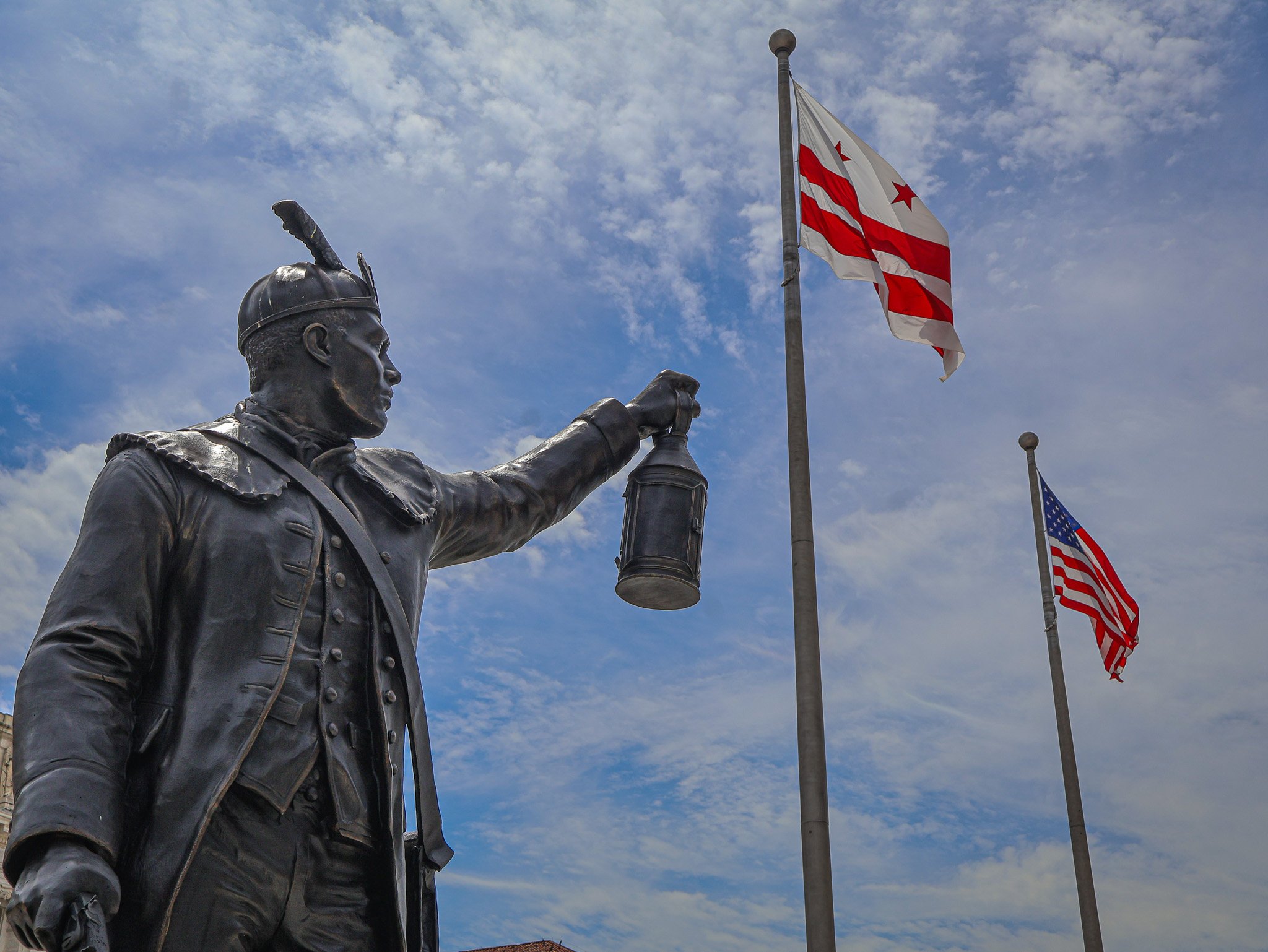
Statue of Jack Sisson. One of more than a dozen new statues added to Freedom Plaza over the past year.

Over the past calendar year downtown DC’s Freedom Plaza has been transformed and updated, with some changes permanent and others temporary. Reopening this summer after a long closure dating back to the early winter months, the plaza has seen the addition of a cadre of statues, updated quotations, and a renovated water fountain. In this series, I will explore the origins of Freedom Plaza, some of the key infrastructure changes, cover each of the new statues including who (or what) they commemorate, and how the meaning of Freedom Plaza has changed over the last 40 years.

Part I: Origins of Freedom Plaza

Freedom Plaza is the name of a rectangular, city block-sized park located just southeast of the White House and north of the National Mall area. The park is bounded by 13th Street, 14th Street, and a split Pennsylvania Ave on the north and south sides, although some maps still label the north side of Penn Ave as E Street. Across the southern edge of Freedom Plaza is the John A. Wilson Building, the home of DC's local municipal government. The Wilson Building has its own adjacent statues, Alexander Shepherd and Marion Barry.

Freedom Plaza dates back to 1980 and was originally named Western Plaza. In 1974 a new Congressionally established agency, the Pennsylvania Avenue Development Corporation (PADC), created a report to guide the next few decades of growth along the Avenue corridor. The PADC’s main goal was to revitalize the portion of the Avenue between the White House and the Capitol. In order to accomplish this goal, they set ambitious objectives including making Pennsylvania Avenue more attractive and practical for pedestrians, preserving existing historic structures on the Avenue and its side streets, and establishing new spaces for commercial, residential, and cultural venues. The PADC’s work spanned from basic projects like repaving the roadway and sidewalk landscaping all the way to establishing complex public-private partnerships with developers to create new buildings that aligned with PADC plans. 
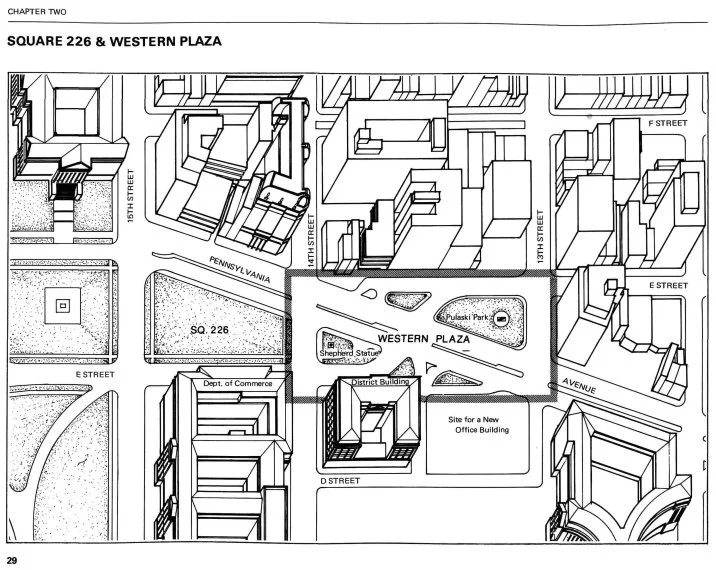
Illustration of the area around Western Plaza before it was consolidated into an actual park.
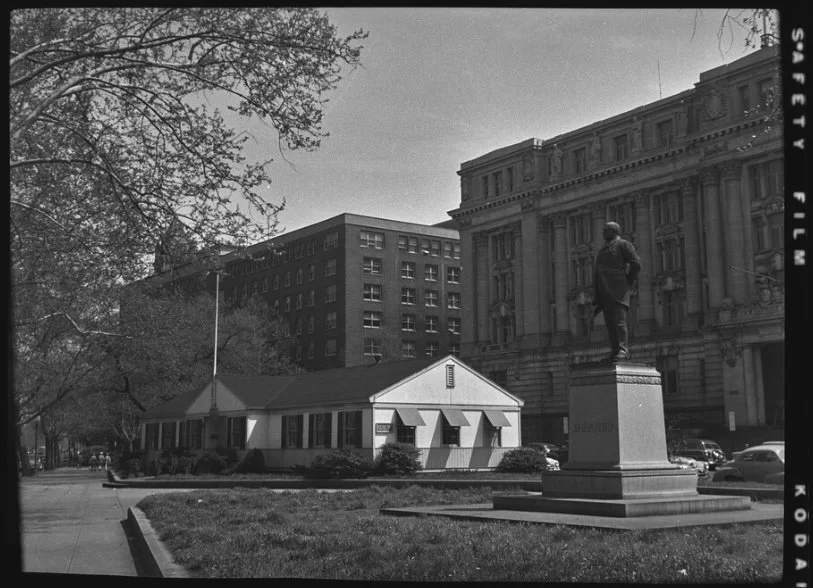
1952 pre-Western Plaza photo of the Veterans Information Center and Shepherd statue, in front of the District Building.

The proposal that resulted in the creation of Western Plaza leaned on the original L’Enfant plan of Washington, which included a plaza on this site. In the late 1970s, this area was bisected by car travel lanes of Pennsylvania Avenue (see illustration above). On each side of the thoroughfare were two smaller existing pocket parks, one of which already held a statue of General Casimir Pulaski (now in Freedom Plaza), and the other a statue of Alexander Shepherd (now at the Wilson Building).

One of the goals of Western Plaza was to better frame and present the District Building (now known as the John A. Wilson Building) from Pennsylvania Ave, as well as any future buildings on the land next to the District Building. Those lots ended up becoming the massive Ronald Reagan Building and International Trade Center. The design of Western Plaza is credited to the firm Venturi, Rauch & Scott Brown with additional contributions from George E. Patton.
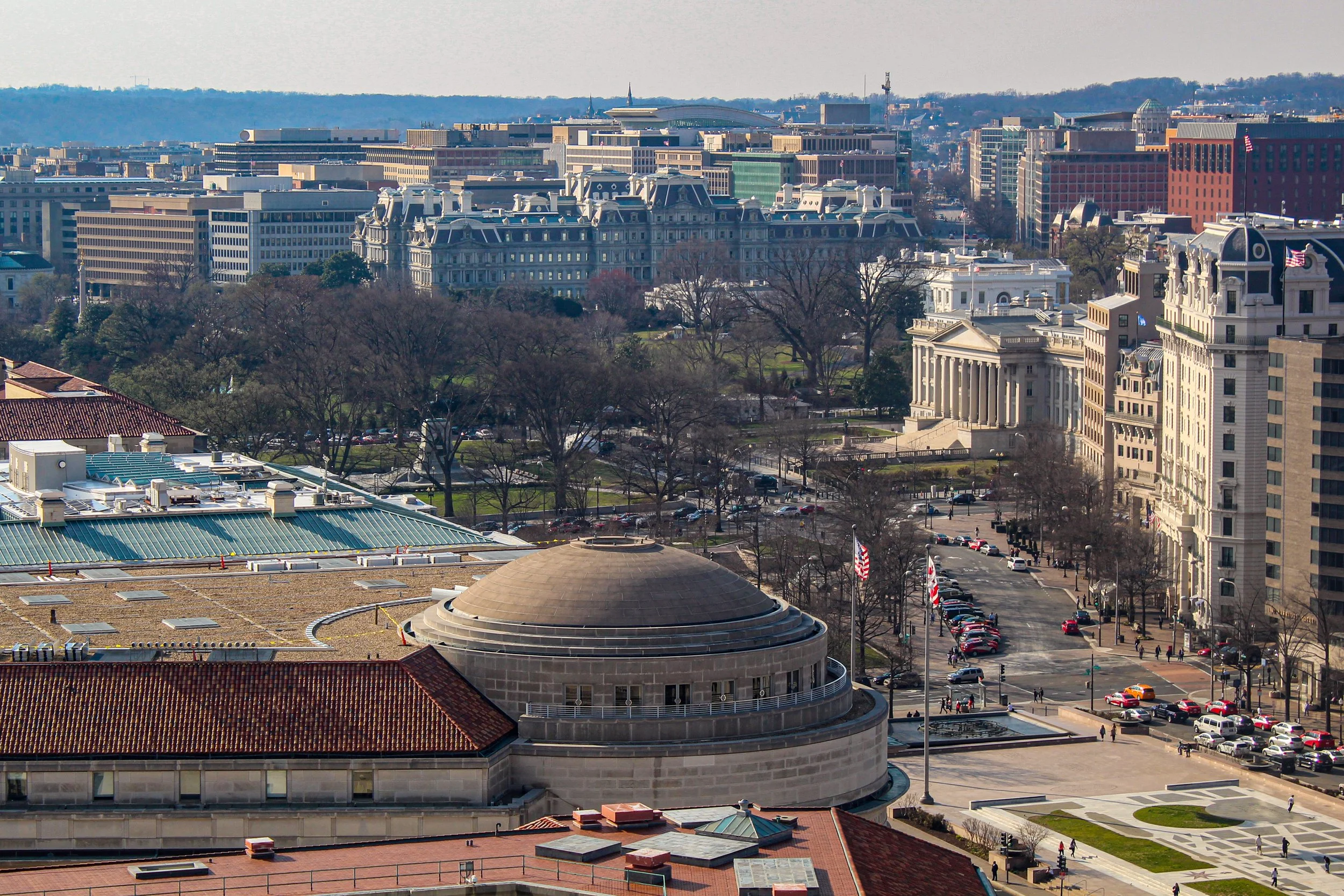
Freedom Plaza (lower right) is one block from the U.S. Treasury and the White House. The domed Trade Center building is seen at center.

The plaza was planned to be a place for workers or visitors to escape the busy city sidewalks, despite much of the plaza being an open stone plinth with little tree cover or seating. The main artistic element is an oversized blueprint style, 1887-era map of the L’Enfant plan, specifically the part of the city linking the White House to the U.S. Capitol. Early plans included three dimensional models of the White House and Capitol Building to be placed on the plaza, but those were ultimately scrapped. What did make it into the plaza were multiple historic quotations that are incised across the Plaza’s floor. Quotes range from selections from the Constitution, to literary giants, presidents, civil rights leaders, and others from the first 200 years of American history. Once completed in 1980, the plaza remained essentially static over the past 40 years, except for one big change.

In 1988 the name of Western Plaza was changed to Freedom Plaza to honor Dr. Martin Luther King, Jr. 1988 marked 20 years since the assassination of Dr. King and 5 years since his birthday became a federal holiday. King also stayed at the adjacent Willard Hotel before the March on Washington in 1963. To mark the plaza’s name change, a time capsule was placed under the plaza, set to be opened in 100 years time (2088), when we are set to reflect on Dr. King's legacy more than a century after the Civil Rights Movement. The capsule contains one of King’s bibles, a clerical robe, cassette tapes of a number of his speeches, and a special U.S. flag with 51 stars, a nod to potential statehood status for Washington, DC. Dr. King supported local control for the residents of DC, and a version of home rule was passed into law after his death, in 1973. More than a decade later, Congress authorized the King time capsule by Joint Resolution in 1987.
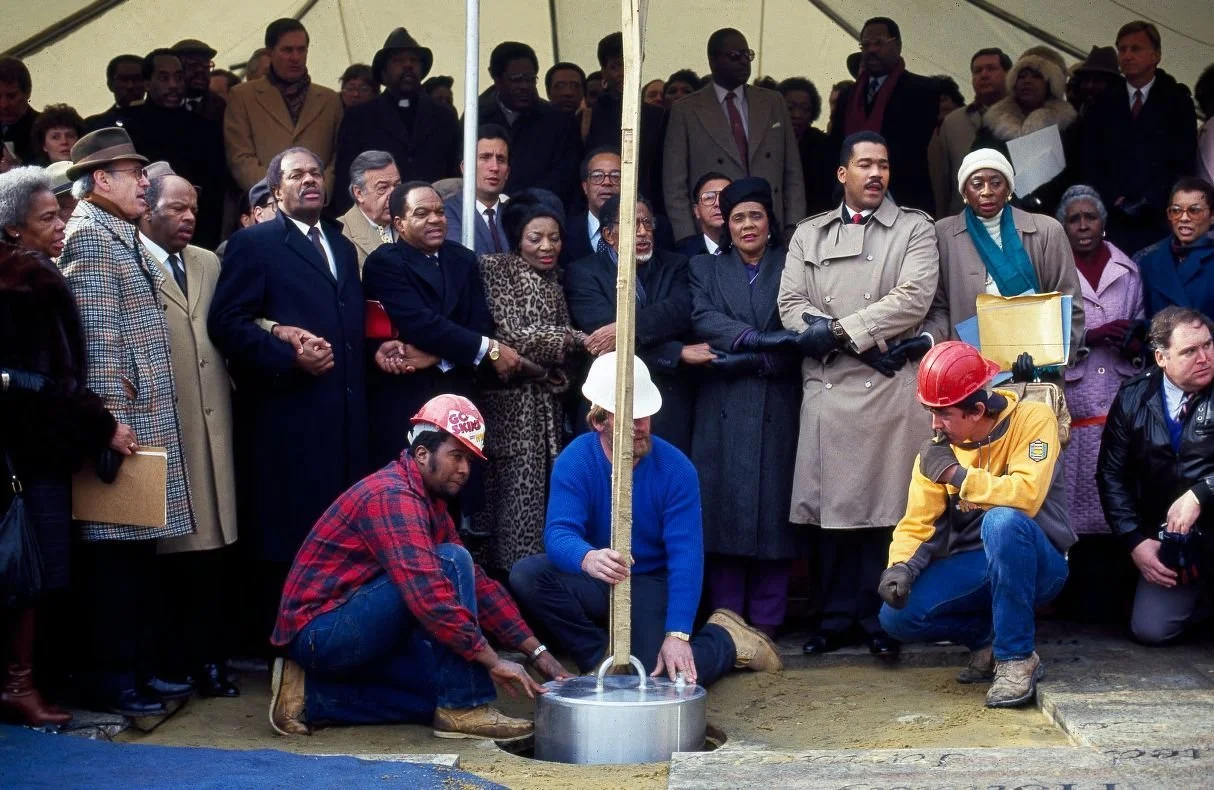
Coretta Scott King and others gather to dedicate Dr. King's time capsule in 1988.
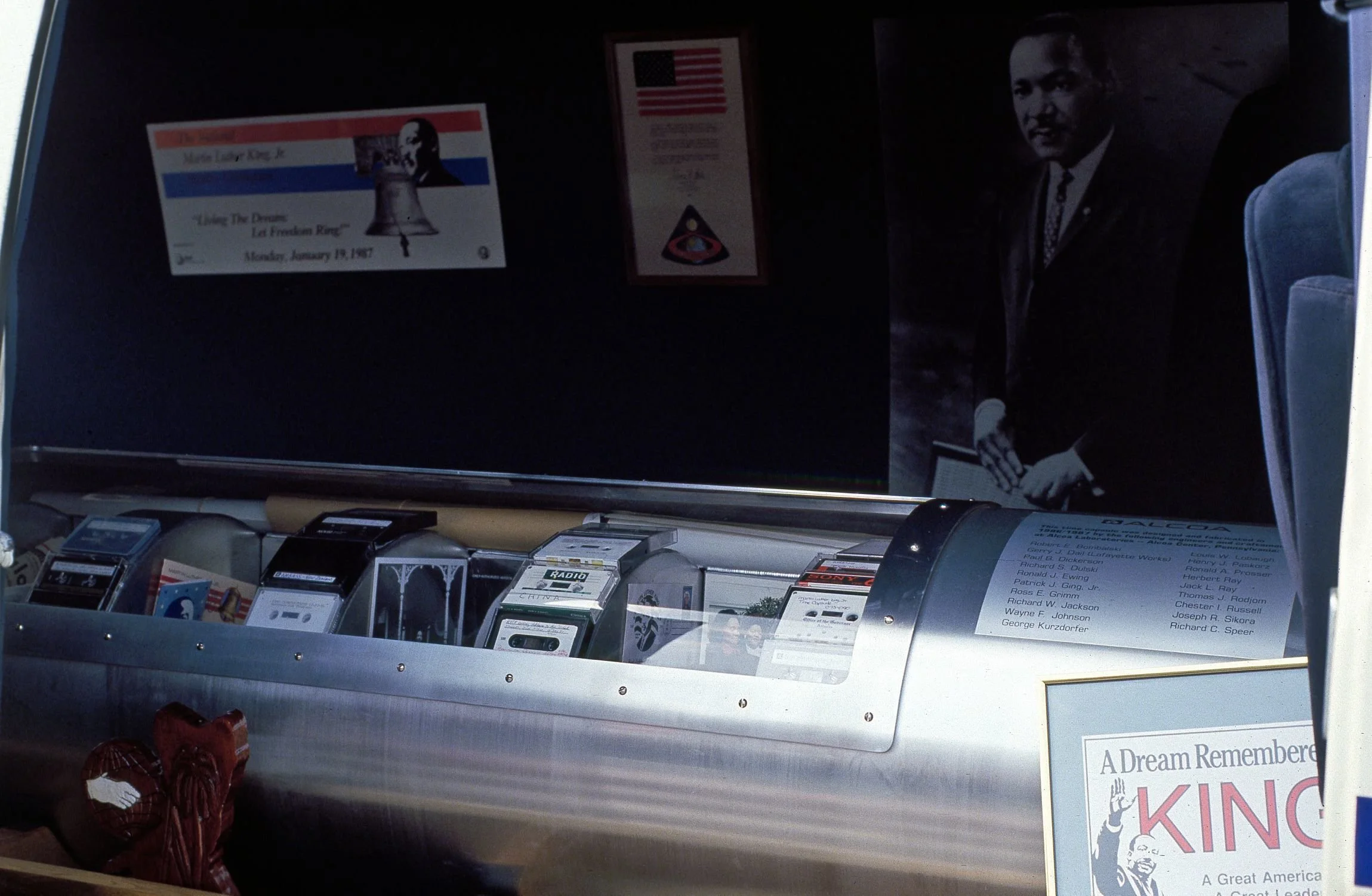
The time capsule before being lowered into the ground.

Since 1980 Freedom Plaza has indeed been a public commons of sorts, acting as a flex space for all types of gatherings. It’s been the home base of protest marches and demonstrations, a stage for musical performances, home to the annual celebration of Emancipation Day in DC, the start & end point to many road races and marathons, witness to every Presidential Inaugural parade since 1980, the location of temporary outdoor exhibitions, and as a transitional space between the National Mall and the commercial area of downtown DC.
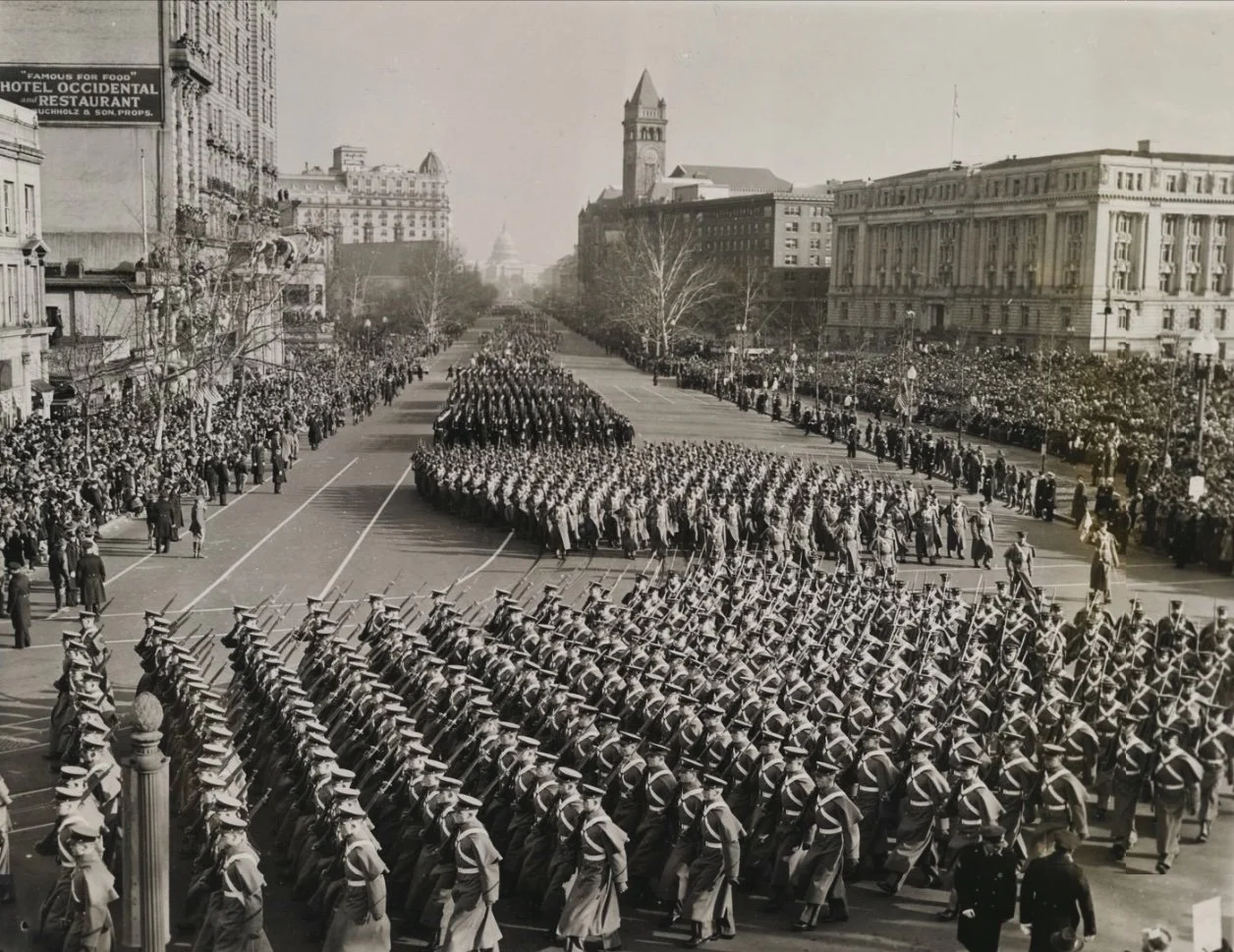
Parade for Franklin Roosevelt's third Presidential Inauguration in 1941. This area became Western Plaza 40 years later.

By 2020, the vision for Freedom Plaza and Pennsylvania Avenue established by the PADC had run its course. The National Capital Planning Commission is currently operating under a new plan with a similar name, the Pennsylvania Avenue Initiative

Aside from the greater Pennsylvania Avenue Initiative, over the course of this year, the Plaza has been transformed in accordance with the larger acknowledgments of the 250th anniversary of the Declaration of Independence. A number of statues have been added to the park, ostensibly by the Department of the Interior and the National Park Service. Including a statue of the allegorical Spirit of Liberty, more than a dozen new statues have been added to Freedom Plaza in 2026, all representing men from the era of the American Revolution. The first added and most prominent of the new statues of the group is of Delaware's Caesar Rodney. 

In Part II of this adventure guide we’ll take a close look at the Rodney statue as well as all the new additions, who the new statues represent, what the purpose of the new additions are, how they still qualify as ephemeral even though they are in the form of semi-permanent statuary. And in Part III we’ll tie it all together, diving into the identities of the other new statues on the plinth and what what says about the new narrative of Freedom Plaza.

Continue the journey with Part II: Commemorations on Commemoration and Part III: A New Narrative and a New Reflection.

Want to experience this in person? We see all this and more on our Eyes on Emancipation Pennsylvania Avenue tour. See the tour schedule here or contact us for a private tour.
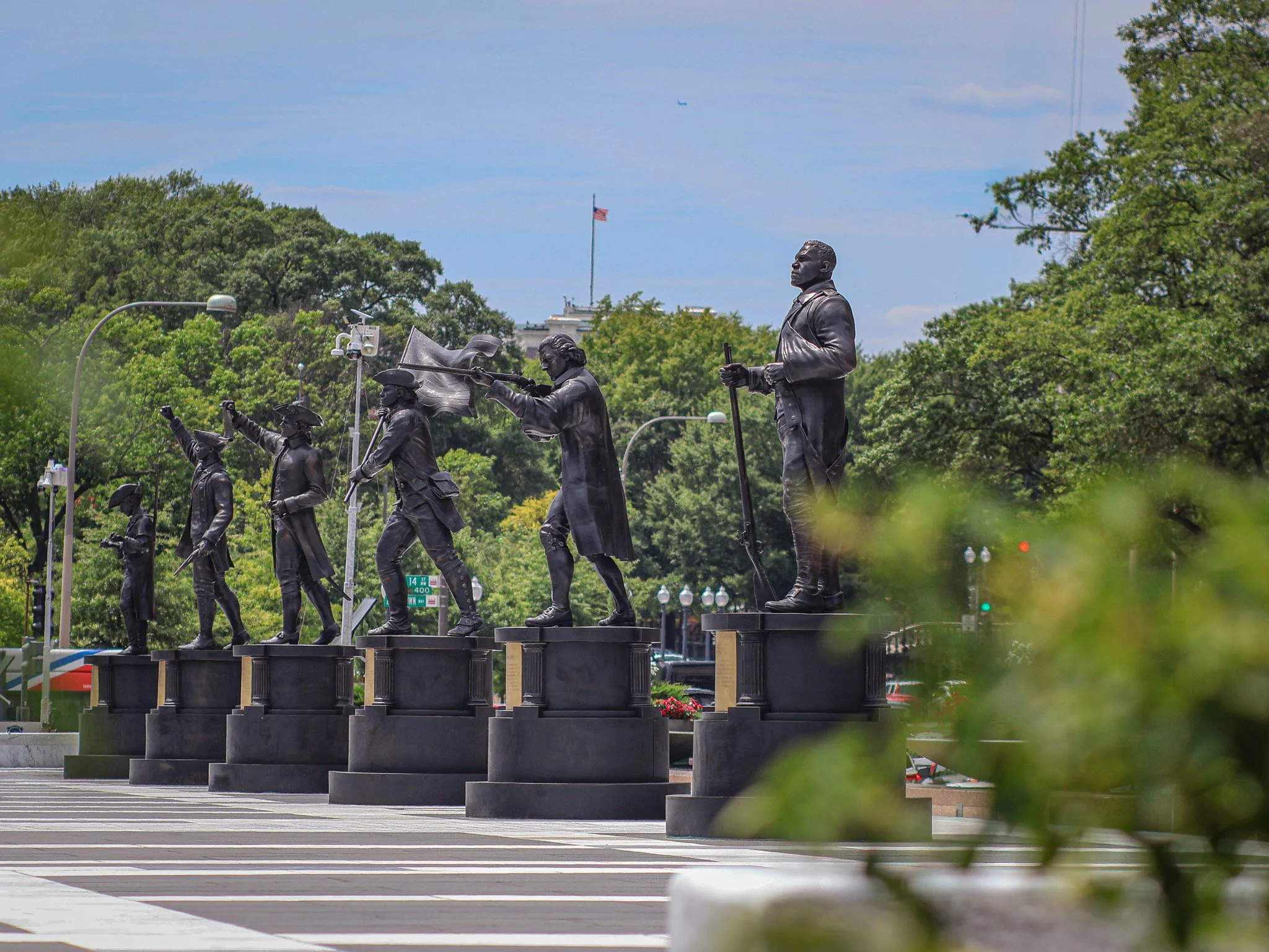
Six of many temporary (?) additions to Freedom Plaza.
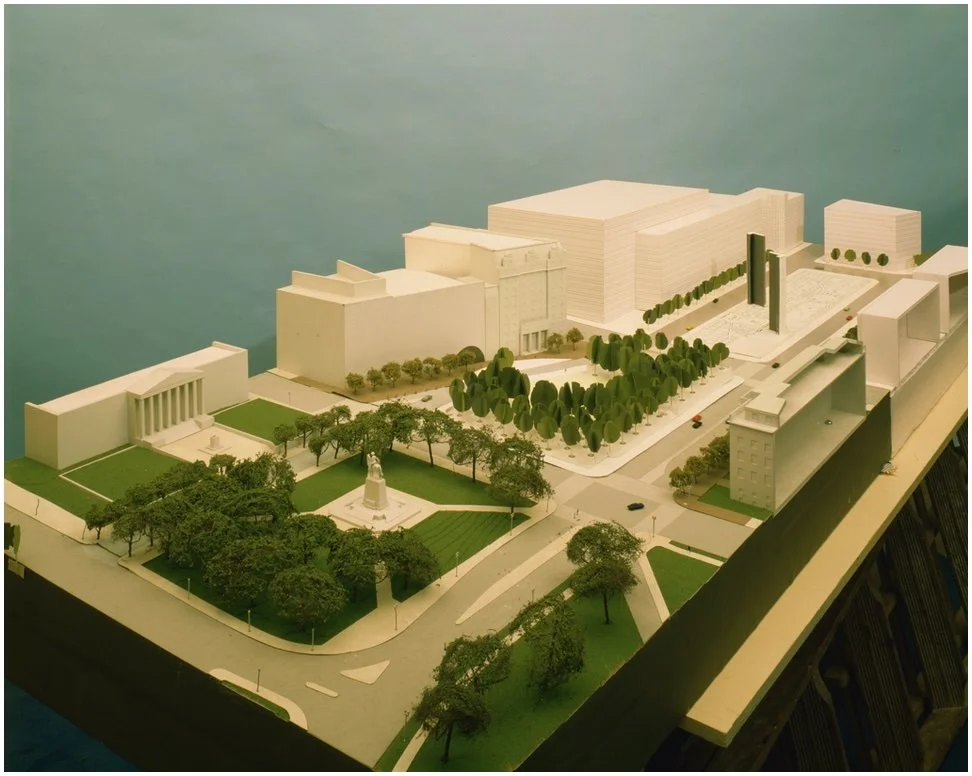
Early plans called for tall monolith-type towers and 3D models of buildings in Western (Freedom) plaza. These never made it into the final design.
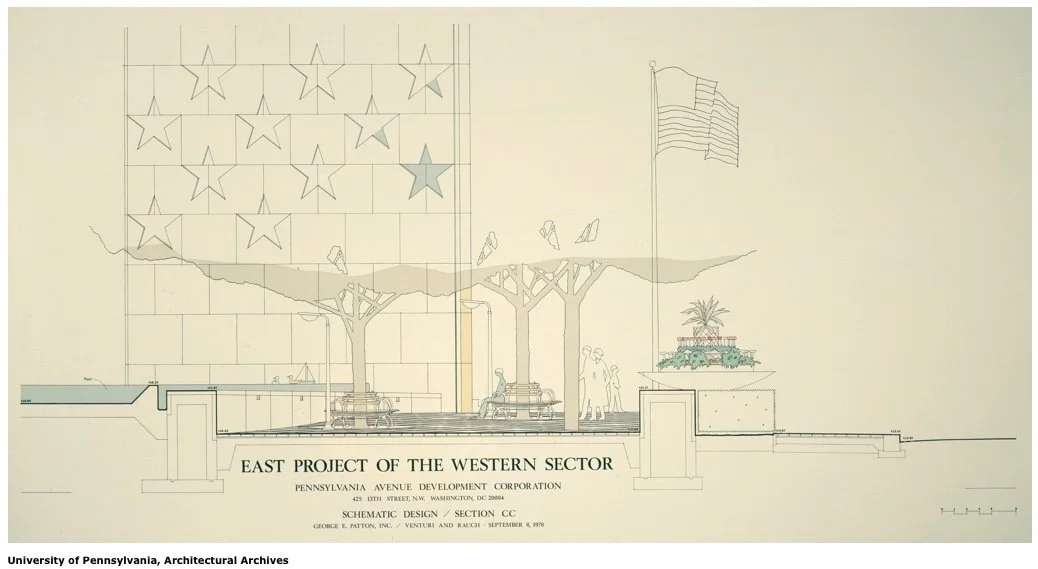
Tall monolith towers and seating concepts that are not part of the present day Freedom Plaza landscape.
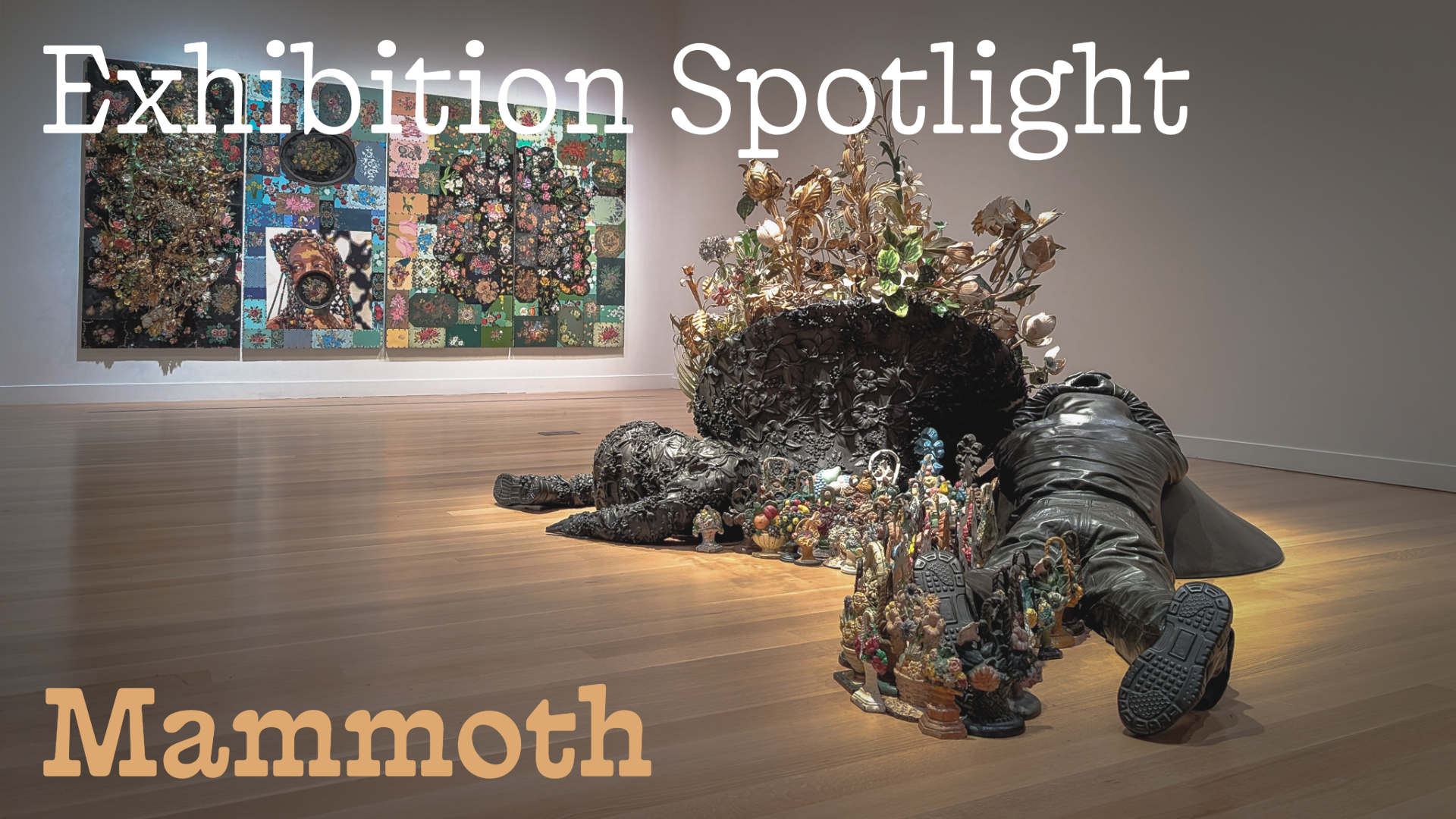
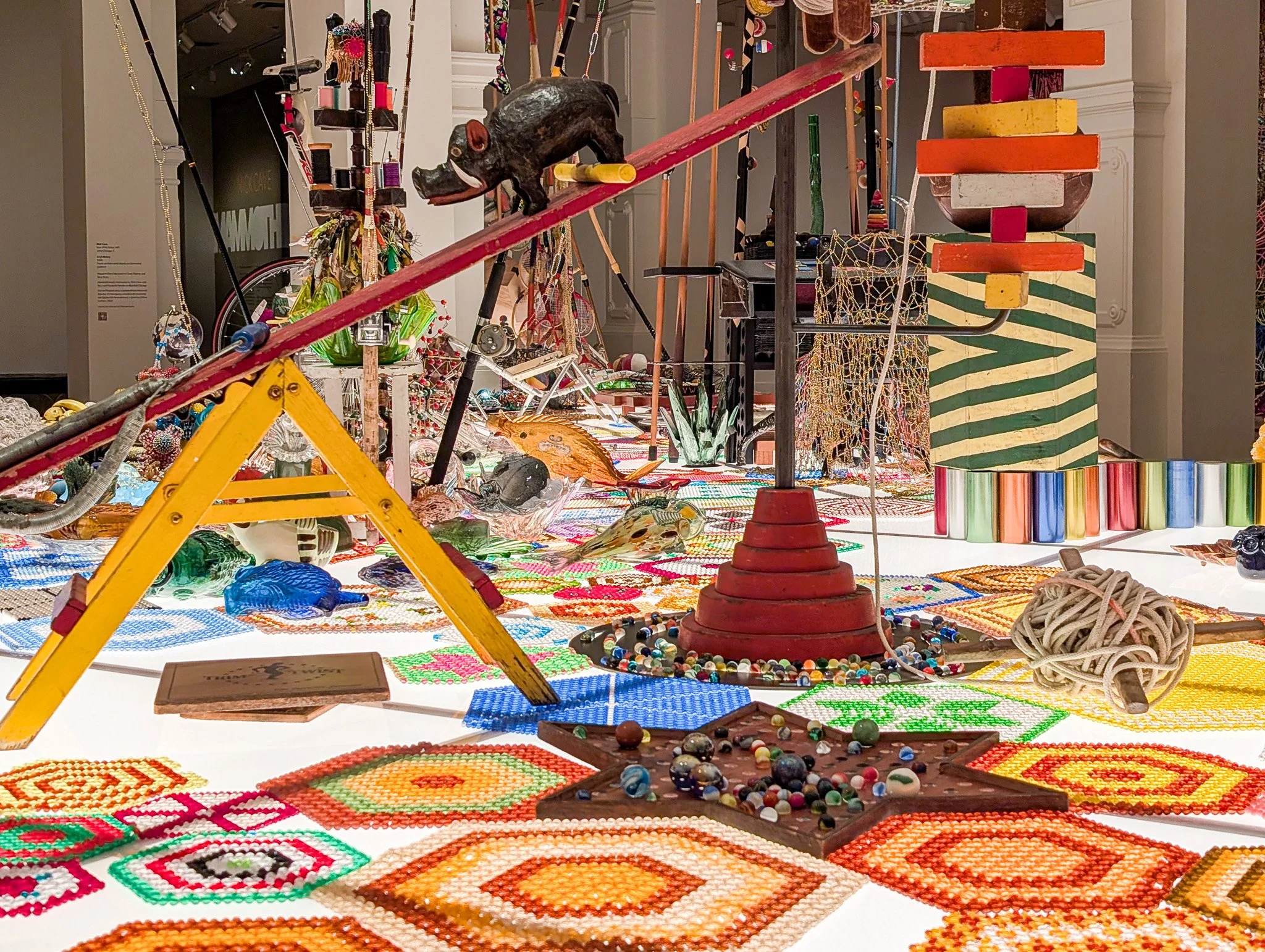
Mammoth: Exhibition Spotlight

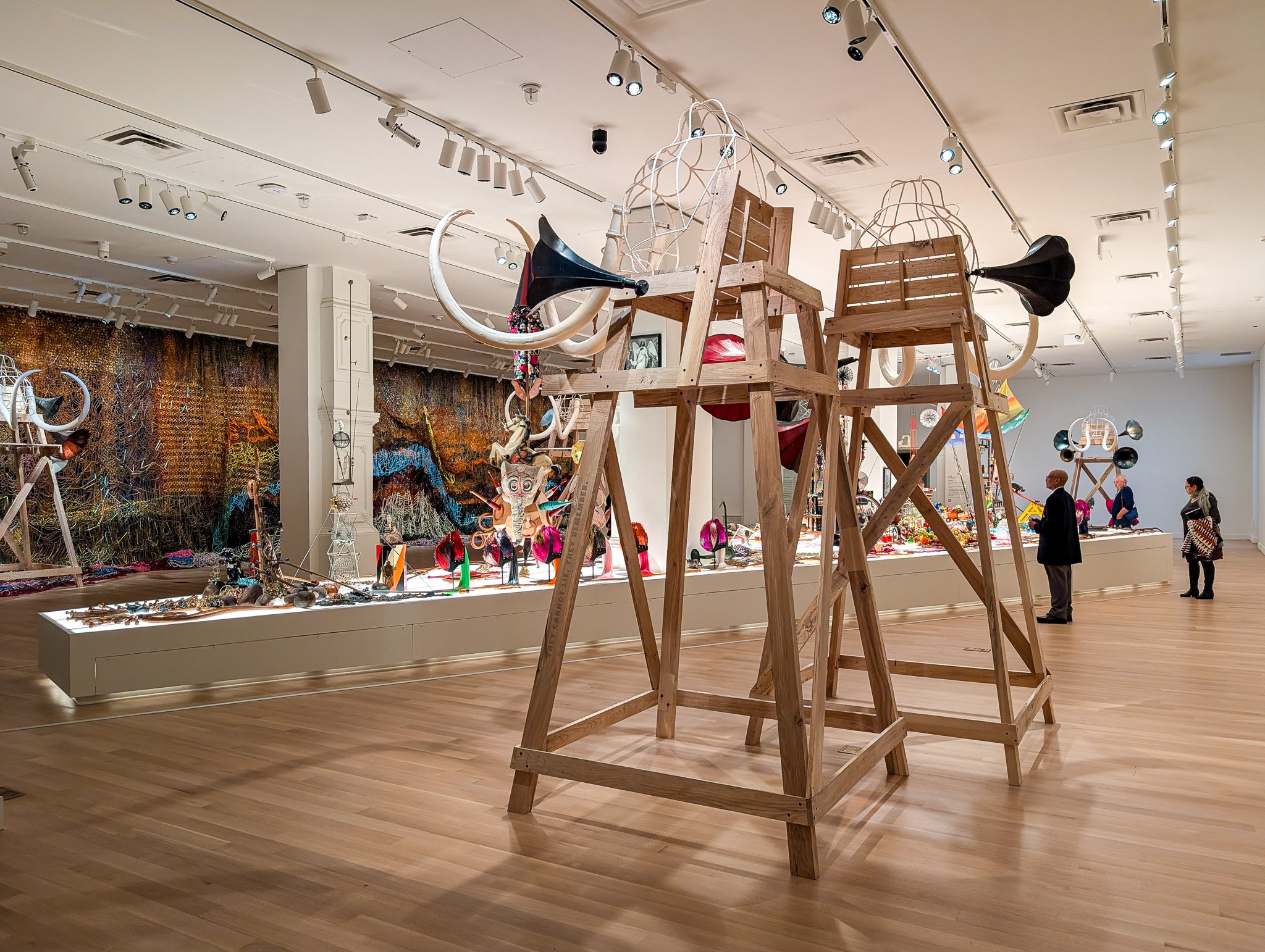
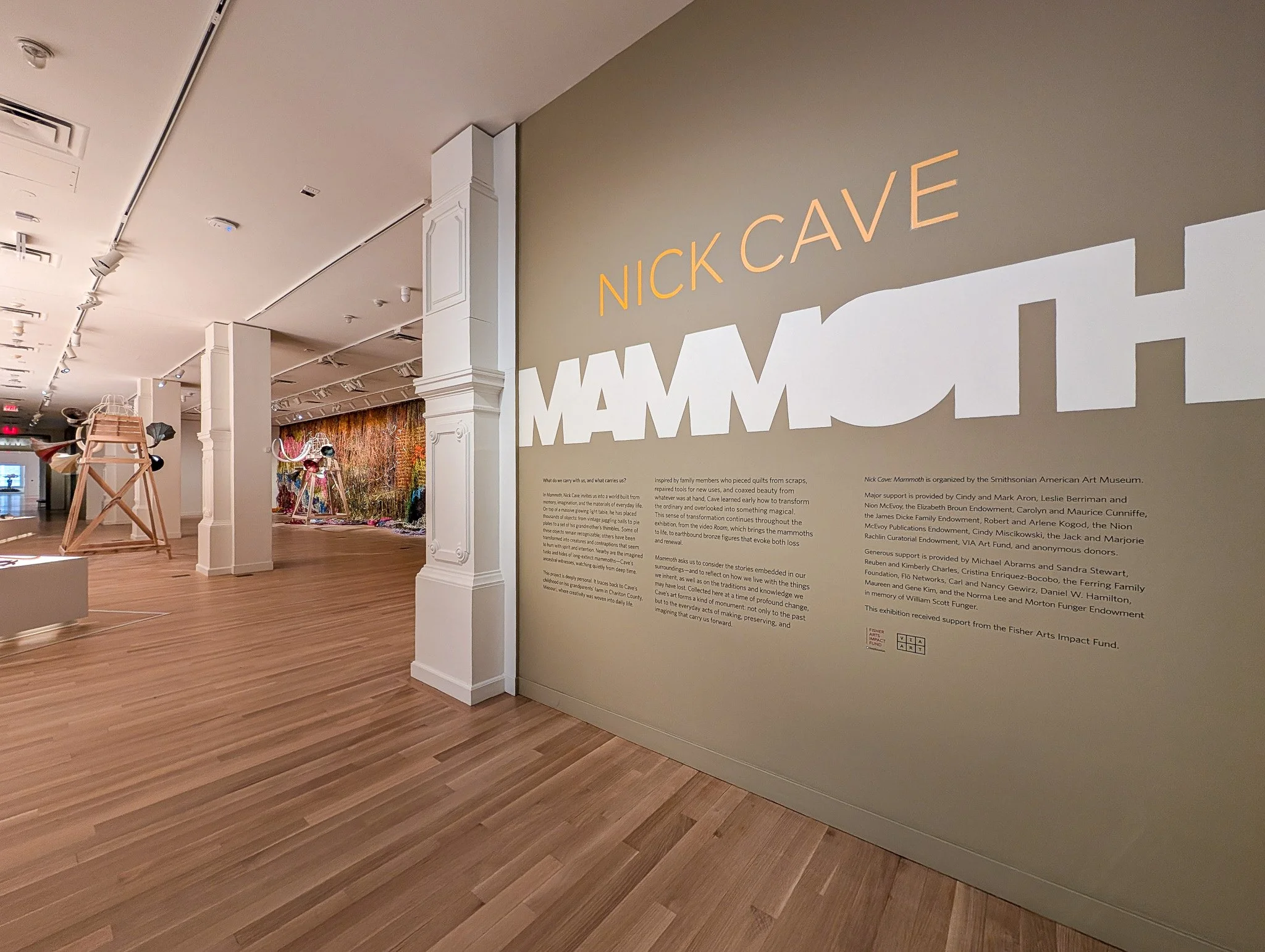
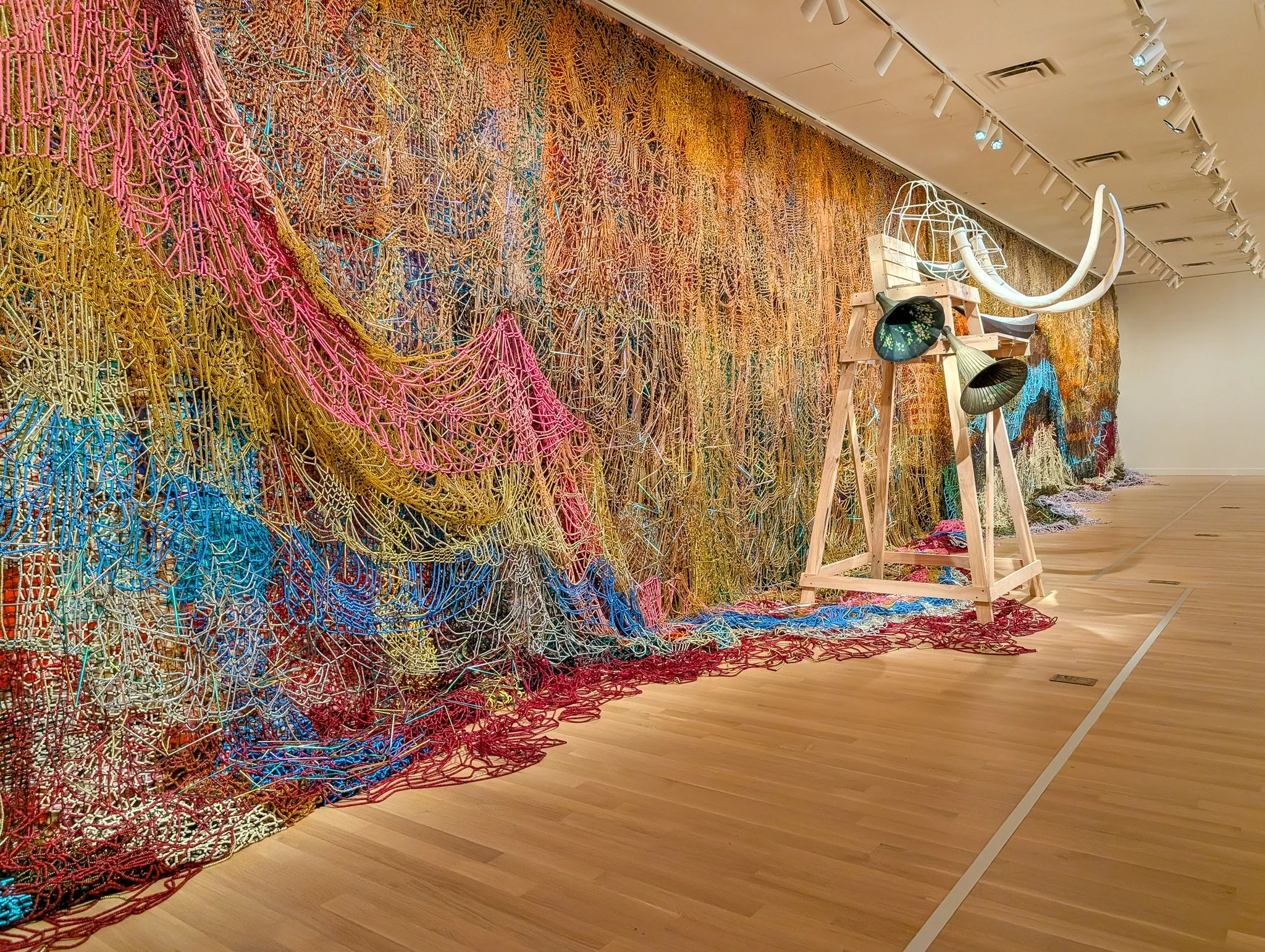
Nick Cave achieved the double of at once overwhelming me and at the same time, stoking my desire to engage further. In a way, this exhibition lived up to the title. Mammoth likely hits you differently depending on how much you know about Nick Cave's art and life. I went in not knowing more than this exhibition had been recommended to me multiple times by multiple people from different parts of my life, and having read reviews from a few national publications. I might now know him a little more having seen and absorbed this work.

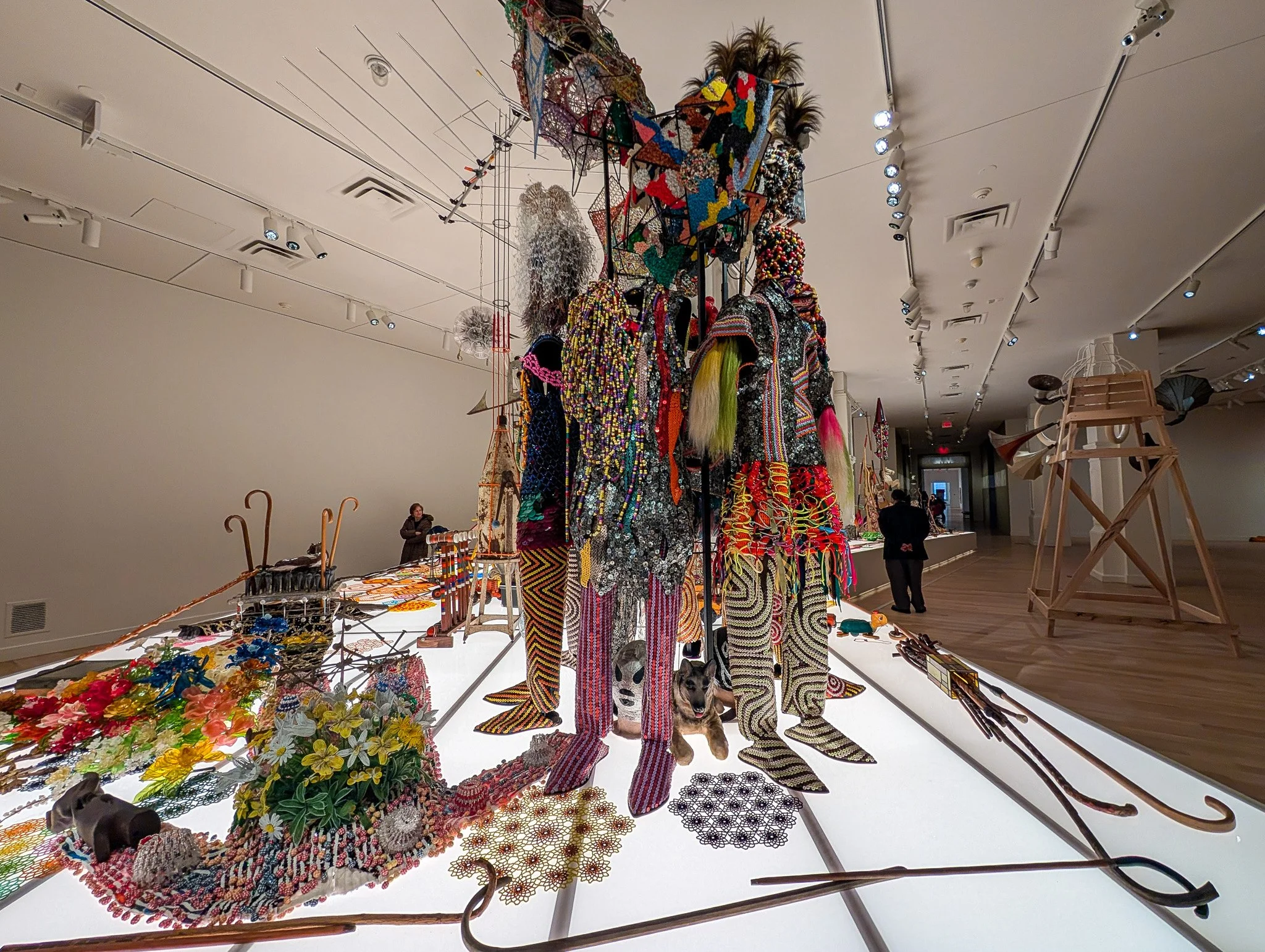
Having this exhibition's main draw (the light table) hosted in a huge open gallery space featuring ethereal lighting, with narrow exits at each end, led me to do what I believe many visitors will; spend a lot of time looking down at the plethora of objects presented on the life-sized light box, perhaps at the expense of the other parts of the exhibition.

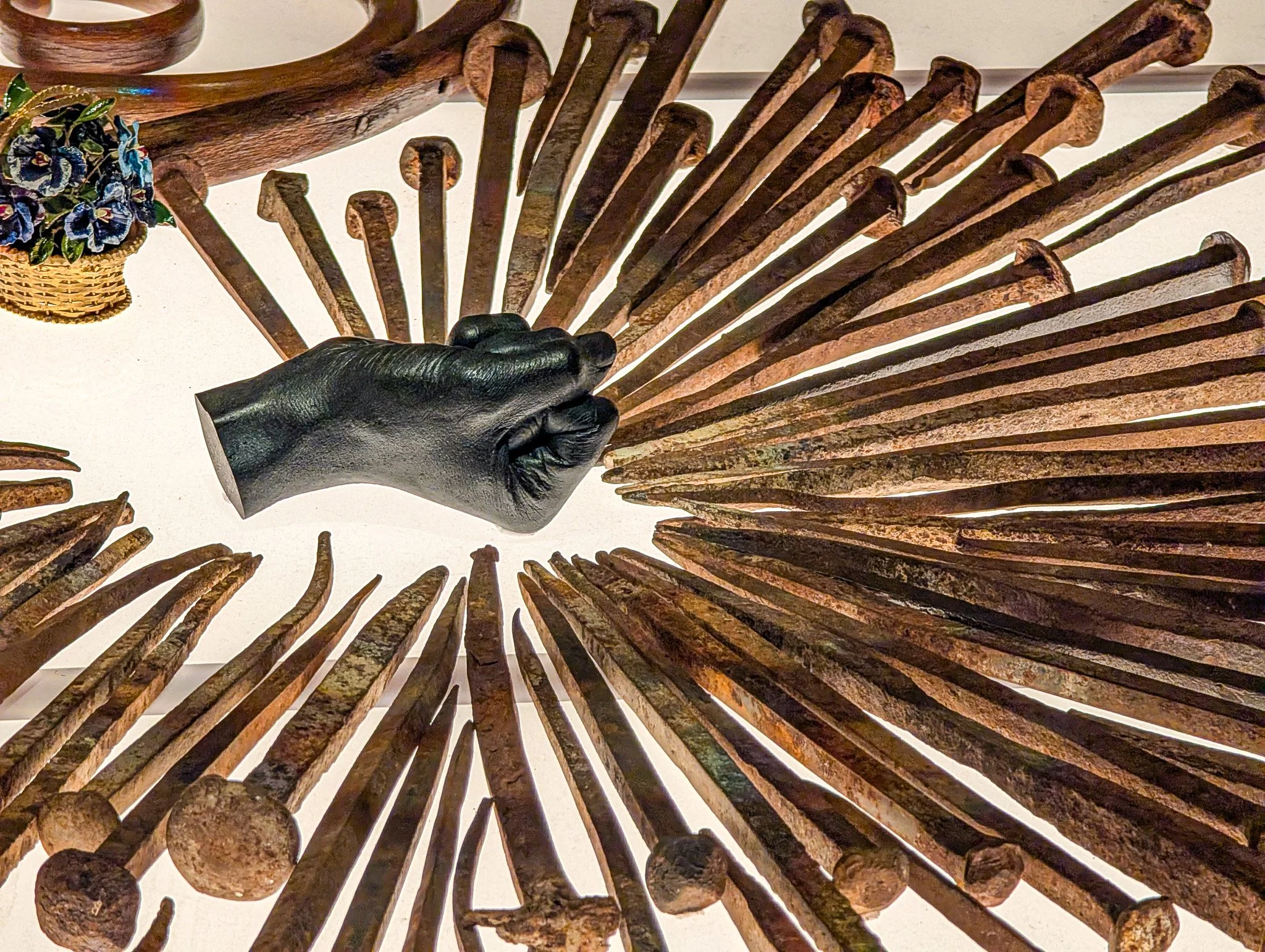
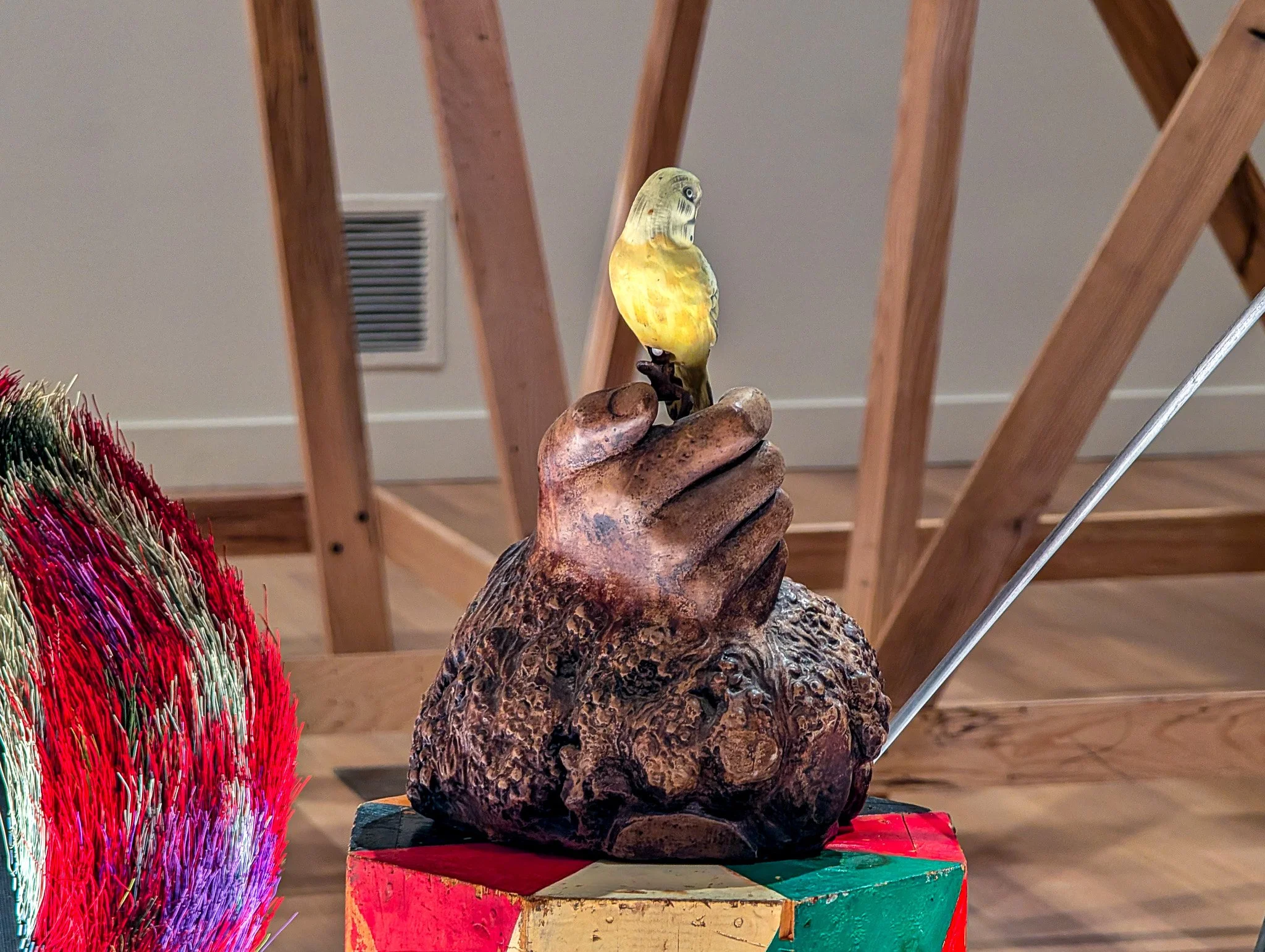
To think of the objects on the light box as detritus would mask the value in looking at everyday objects in this way. The exhibition is as much an examination of life at a moment in time as it is a collection of what makes us, us, over the course of an entire lifetime. Or in this case what made Nick Cave, Nick Cave. Toys, tools, textiles, and more -- the light table has it all. The overwhelming part is that there is just too much to observe in a single passing. The desire to engage more is partially fed by the slight chaos. Curiosity gives way to engagement. And questions. Who owned this one? Was that passed down through the family? What is it, exactly?

All the while, the massive mammoth bone structures watch from atop lifeguard-like platforms. Are they judging us for leering? Are they benevolent overseers of the cosmos? Are they watching for mistakes or learning? With consternation or pride?

While the light box is engrossing, the two pieces near the entrance of the exhibition are as powerful. First, a moving image short film of the titular mammoths (people adorned as mammoths) walking/wandering though what appears to be the Chicago landscape.

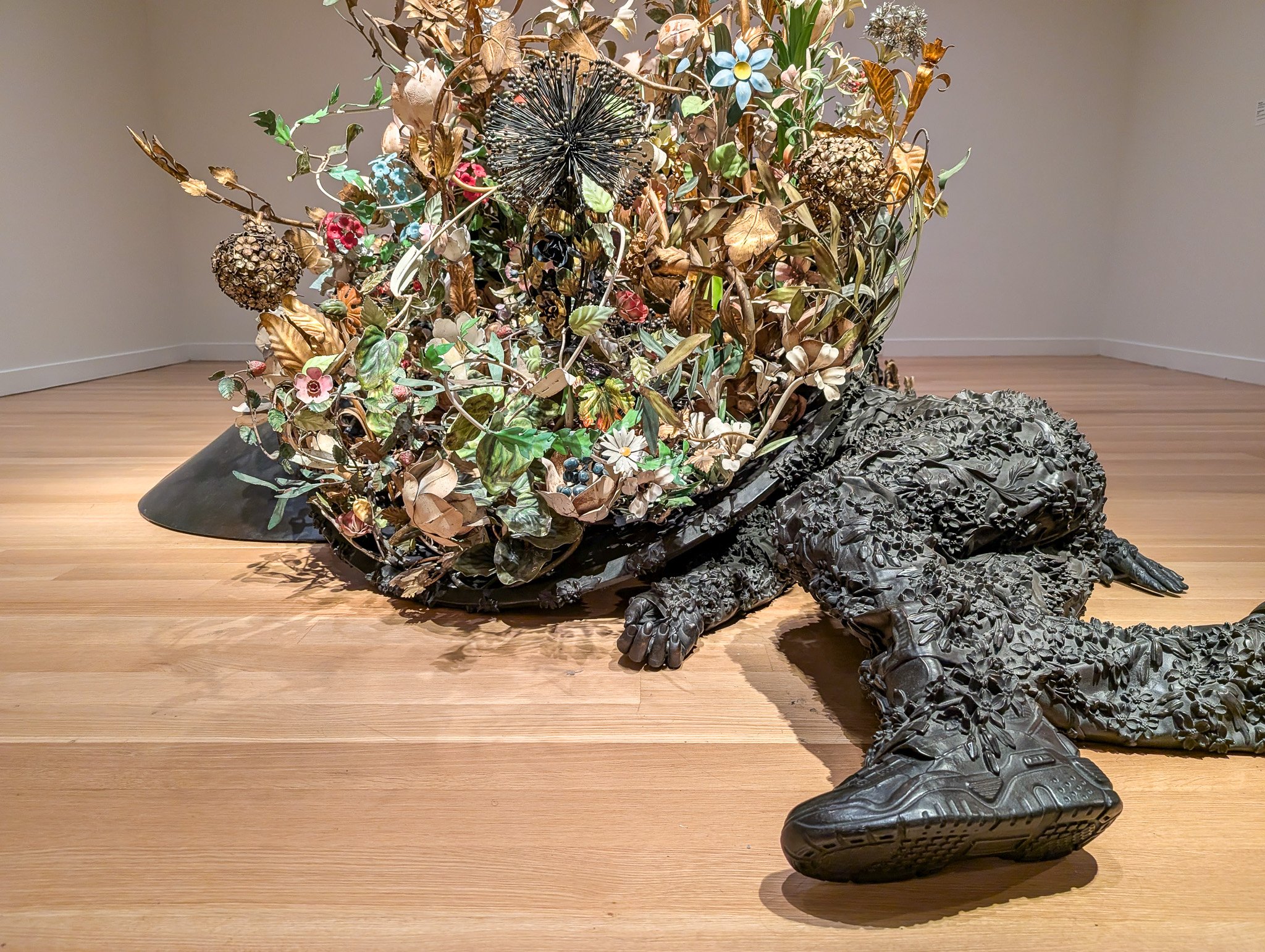
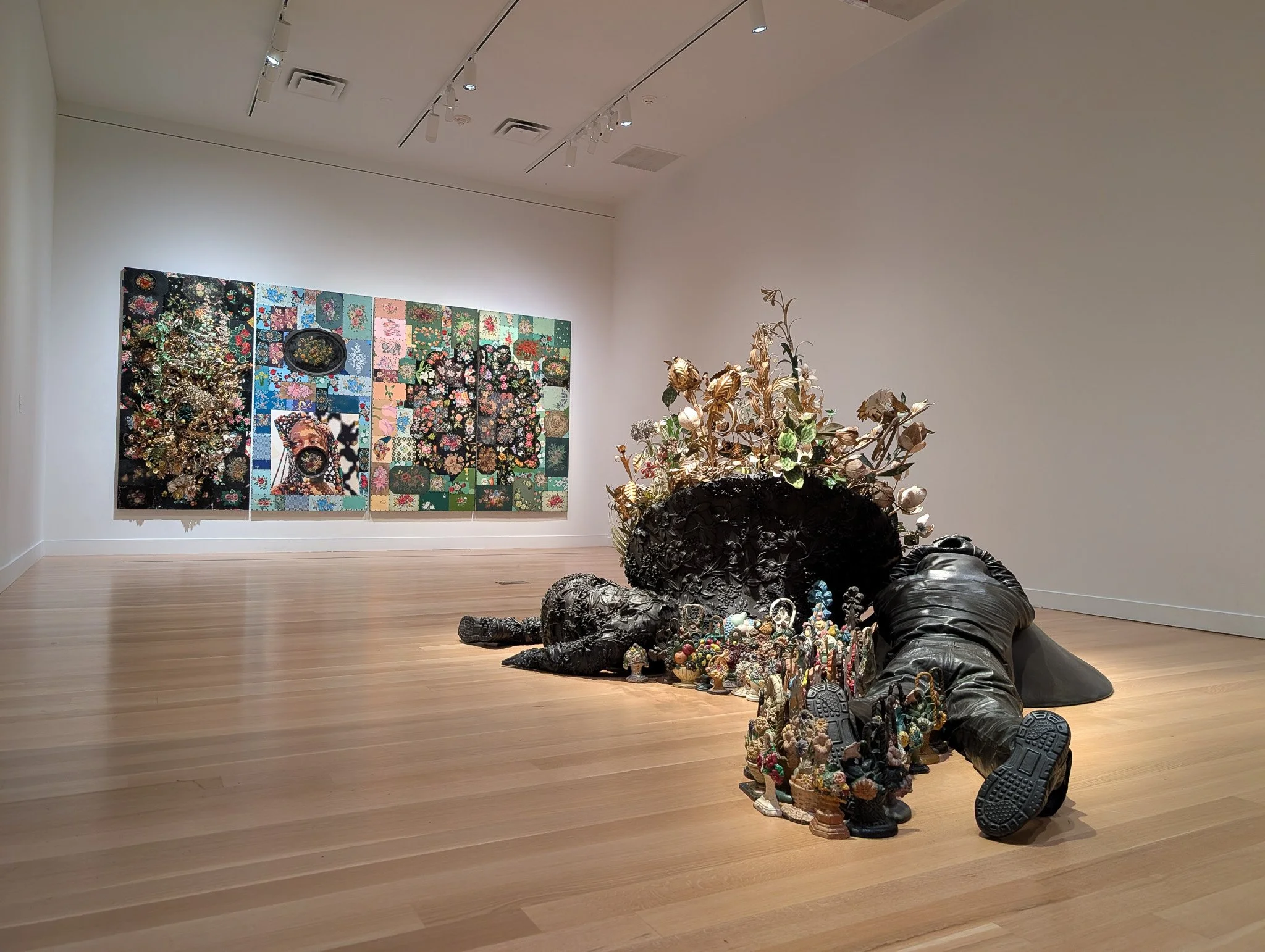
And in what was the most intriguing and slightly disconcerting piece, Amalgam (Plot). Two prone bodies meet on the floor, faces obscured. How did they get there? How long have they been there? Almost presented as another part of the body, flowers rise up along the edges of the prone figures and from the meeting of the two figures. This reminded me of one of the scenes from a dystopian movie where the survivors walk aimlessly among the ruins of a great catastrophe, occasionally coming across a body in the wild. A dark interpretation -- but the door is seemingly left open for rosier thoughts.

Overall, I was really taken with Mammoth. I was prepared to walk in with an open mind., and even then was surprised by the depth and presentation. Sometimes I have trouble connecting to "found art" style exhibitions. I did not write up the Material Witness exhibition showing at Rubell Museum, but perhaps I will. It was chaotic in a different way than Mammoth, but they both share few thematic links. Until then, Mammoth is worth a view! It has plenty of time to breathe, showing at the Smithsonian American Art Museum January 3, 2027.

DC's Alternative Art Spaces, Past & Present

DIY -- Do It Yourself. As applied to music and the arts, DIY usually signifies the show, project, or venue is produced by the artists themselves. Even though not always not-for-profit on paper, usually DIY spaces are run without being part of, or subject to direct oversight of a typical corporation, government agency, or overarching bureaucratic framework. Nor would shareholder be profit the main motive.

The idea of having multiple DIY arts spaces in downtown DC is somewhat of an anomaly today. Many of those arts spaces are located outside the downtown core in group houses, places of worship, or underutilized retail spaces.

A new exhibition (D.I.Y. in the District) located on the first floor of the MLK Library highlights alternative DIY arts spaces in DC from the 1970s to the present. From Rhizome (located in a residential setting way uptown), to d.c. space (formerly located in the heart of downtown DC), the exhibition uses venue ephemera, archival photos, and audiovisuals to show how these venues helped shape the usually unrecognized arts culture embodied in DC's local population. That is to say, the arts outside of national or international museums and organizations.

Perhaps a partial "victim of their own success," dc. space closed in 1991 as downtown DC was about to see a 30 year boom of redevelopment and new construction that continues today. That redevelopment boom transformed downtown culture to favor retail and entertainment, but much of the DIY arts scene was left out. There are art galleries, theatres, and entertainment venues downtown, but the cultural scene is dominated by larger entities such as the Smithsonian (SAAM and NPG) and the 20,000 Capital One Arena which is primarily a sports venue. But, smaller artist-run galleries such as Touchstone (1976) do still exist.

MLK Library has grown over the past decade to be a place for so many diverse resources and I'm glad these great hall exhibitions have been a part of that growth.

D.I.Y. in the District is open through December 7, 2025. 901 G St NW, Washington, DC 20001.

Support us on Patreon to receive all posts, and early!

The Future of Telling Stories Part I: Museums

Lillian Evanti by Loïs Mailou Jones

In what can only be described as blitz, the White House and President Trump, as of today --April 3, 2025-- has issued 109 executive orders.

We're just 74 days into the term and the administration has issued more executive orders than any other in their first 100 days, already surpassing Franklin Roosevelt, who issued 99. The first Trump administration (2017-2021) itself issued just 33 executive orders in its first 100 days. Biden issued 43, Obama 19, W. Bush 11, and Clinton 13.

First of all, what is an executive order? I found this explanation by the ACLU helpful. (linked)

An executive order is a written directive, signed by the president, that orders the government to take specific actions to ensure “the laws be faithfully executed.” It might mean telling the Department of Education to implement a certain rule, or declaring a new policy priority. Executive orders, however, cannot override federal laws and statutes.

...

With an executive order, the president can’t write a new statute, but an order can tell federal agencies how to implement a statute.

...

With an executive order, President Trump can order the federal government to take any steps that are within the scope of the constitutional authority of the executive branch, and do not violate any federal law.

For perspective, I am not lawyer. I am an historian that relays histories through walking tours and storytelling. I have also been a civics educator, museum educator, and a professional development expert for teachers. Across several disciplines, I have two decades of experience in the education field. But, you don't have to be a lawyer or an educator to understand the practical, on-the-ground consequences of an executive order.

One of the recently issued orders was "Restoring Truth and Sanity to American History," issued on March 27th. The order chastises two museums in particular, the National Museum of African American History and Culture and the American Women's History Museum.

In the order, the Smithsonian is cautioned (by way of conditioning federal expenditures) against creating programs that:

  • "...degrade shared American values, divide Americans based on race, or promote programs or ideologies inconsistent with Federal law and policy; and

  • ... recognize men as women in any respect in the Museum."

In essence, this order seeks to control narratives of American history & culture developed by Smithsonian museums through exhibitors and other programming. Federal policy has revealed itself in the past few months as essentially opposing mentions or acknowledgment of any struggle against racism, sexism, transphobia, xenophobia, and other institutional challenges faced by marginalized people.

Which leaves me wondering what exactly Smithsonian museums will be allowed to showcase within their walls. Of course, not all museums feature historical exhibitions. Visual arts, music, design, textiles, crafts, math, science, aviation, geography, history, culture, and even the humble postage stamp are covered in some part by Smithsonian museum exhibitions. And yes, the National Zoo is included.

Would these past exhibitions be allowed under what are sure to be newly introduced guidelines?

Righting a Wrong, NMAH. Closed in 2019. A very small (maybe 1,000 square foot) exhibition exploring the effects of Executive Order 9066 on Japanese Americans during World War II. About 120,000 people of Japanese descent were imprisoned against their will and without due process by President Roosevelt's Executive Order. Is presenting this information divisive? What about nomenclature and terminology -- Would the camps be referred to "assembly centers," internment camps, concentration camps, works camps, or prisons? Would this exhibition be allowed at all? This exhibition, like many successful exhibitions, features stories told by real people themselves or through objects from their lives.

We Belong Here, NMAH. This is a current exhibition (unveiled in 2022) in the common area on the first floor. It features stories of athletes that exemplify the changes made possible by Title IX, a landmark law that bolstered equality in sports. Some of the original text of the exhibition read "...athletes continue to face sexism, racism, transphobia, and other forms of bigotry." Would that statement be allowed under the new executive order? Currently, the exhibition features Leo Baker, a trans, non-binary skateboarder. Would their story be scrubbed? Will exhibitions be allowed to acknowledge both the progress made AND lingering disparities, as this exhibition does? This exhibition, like many successful exhibitions, features stories told by real people themselves or through objects from their lives.

Americans, NMAI. This is also a current, but long running exhibition. Americans may be my favorite permanent exhibition of the National Mall museums. Filled with artifacts, this exhibition explores the full extent that American Indian imagery has been embedded in American life -- from the seemingly benign to the extremely problematic and hurtful. And it's deep. Many "traditional" narratives about Americana are challenged, including deeply embedded historical narratives about the Thanksgiving holiday and misinterpreted historical narratives about Pocahontas & other real life figures. Will these illuminations be removed? Will visitors be allowed to receive this information and be prompted to think about reasoning and implications? This exhibition, like many successful exhibitions, features stories told by real people themselves or through objects from their lives.

To be clear, none of these specific exhibitions have been slated for removal, adaptation, or any other changes as of today. But my fear is that either 1) vague, prohibitive, and punitive guardrails are placed on museum leadership and staff, or 2) line-item, word-for-word changes are made in specific exhibitions by non-museum government overseers, or 3) both. Either would lead to a diminished and tarnished role for these museums as centers of learning. This would be a disservice to U.S. Americans and non-American visitors alike.

Where would that leave the museum landscape? Storytelling comes in many forms. When helping the average visitor to Washington, DC start to understand the deep and complex woven fabric of U.S. history and culture, the Smithsonian is the first place most people start. The artifacts within the museums are not static pieces of history. The text, photos, websites, and programming that accompany the objects bring the objects to life.

It's not perfect, and any one museum wouldn’t be able to paint every picture from every possible perspective. However, across 19 museums (and hopefully more) this institution, along with other non-Smithsonian museums, are the most accessible way to see the vast narratives that make us, us. Disrupting this pathway to leaning for narrow political and punitive reasons would harm the work museums have been doing to be more representative and could destroy public trust that those efforts will continue.

In Part II, I'll dive into what this executive order could mean for me as a researcher, guide, and educator. I use narratives to pass along information to visitors who are with me for just a short amount of time, but want to learn a lot of DC and American history. Will that change? And how will our relationships with museums change if many are forced into editing history for unjust reasons?

Links:
Official White House page "Restoring Truth..." EO
Akin (law firm) summary of "Restoring Truth..." EO
Federal Register (Archives) list or 2025 EOs
UCSB American Presidency Project EO Tracker

Exhibition Spotlight: "I’ll Have What She’s Having”: The Jewish Deli

Learning through food histories is a fascinating & compelling way to explore the past and learn about peoples, regions, and cultures. For instance, a few years ago I wrote a 60 minute food histories of DC program for a client and through this strictly food-based research, I learned so much more about the District of Columbia itself. A new exhibition at the Capital Jewish Museum titled "I’ll Have What She’s Having”: The Jewish Deli encapsulates all of that same sentiment and more.

From exploring the effects of 20th century immigration, to defining the actual foods served in delis, to surprisingly relevant modern day pop culture movie references, this exhibition is more than just a food history. It showcases how American Jews, through delis, created new American food traditions, ensured continuity of important established traditions, and practiced a time-tested, cross cultural social exercise — sitting down together to have a meal.

Of course, since this is the Capital Jewish Museum —as in Washington, DC— there is a solid emphasis on the DC area history in deli culture from present day and years past. That includes the suburbs of Washington, too. Not to mention the existing interactive computer display of delis and other Jewish owned business, schools, places of worship, and significant sites in the ongoing exhibition (Connect. Reflect. Act.).

I loved the mix of laying groundwork through immigration histories while showing present day ephemera that makes every individual deli that particular deli — uniforms, menus, equipment, signage, and advertisements. We have all seen these places in everyday city life, but the context and meaning make seeing the exhibition more of a journey. And of course, if you explore it all from beginning to end, you'll get to watch the namesake, payoff “I’ll have what she’s havingfilm scene in the final gallery. Admittedly a somewhat hilarious sounding clip if you haven't seen the movie and you hear it while making your way through the adjacent room in the exhibition.

“I’ll Have What She’s Having”: The Jewish Deli” is on view through August 20, 2024. As a special exhibition, it does require an entrance ticket of $15. The rest of the museum is free with timed ticket. Walk-ins are excepted as space permits. 575 3rd St NW.