memorial

Youth Movement: Barbara Johns in the U.S. Capitol

Indeed, children are citizens! Beyond nationality and arbitrary political borders, children are world citizens and have the capacity to both inspire and make change. While they initially experience the environs adults have brought them into, they too can also shape the world. A new statue inside the U.S. Capitol commemorates one of those moments. 

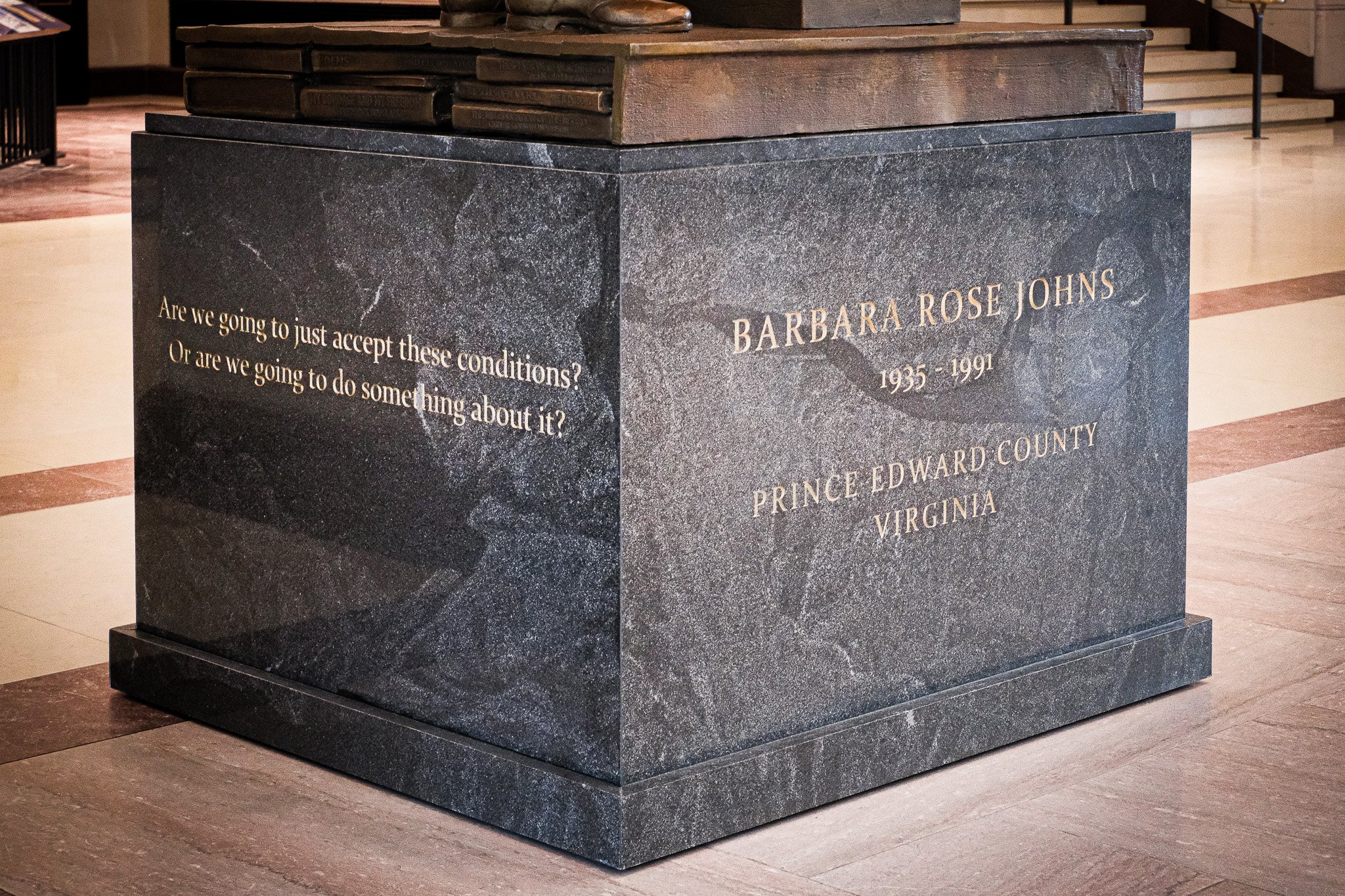
Barbara Johns was just sixteen years old in 1951 when she organized a strike amongst students in Prince Edward County, Virginia. Born in the South, but having lived in New York for some time, Johns was keenly aware of the discrepancies and unequal treatment she and her Black classmates & teachers were living with attending the racially segregated Robert Russa Moton High School. Severely diminished classrooms, a school building with inadequate heating, old & outdated textbooks, no proper labs for the sciences, no gymnasium, no cafeteria; the blatant subpar school experience was clear. Originally the strike was meant to spur action in the school system – build an equally operational school for Black students. But it grew into a much loftier effort that changed education and schooling nationwide. 

Having seen adults previously being rebuffed by the school superintendent, Johns organized a walkout and student strike – as a sixteen year old. 450 students protested for two weeks. When further student-parent conversations with the superintendent resulted in no effort towards change, the NAACP Richmond chapter joined, including lawyer Oliver Hill.

Hill and other NAACP lawyers agreed to challenge the school system if and only if the students agreed to fight on constitutional grounds -- against the separate but equal edict; as opposed to demanding a newer, nicer, but still segregated school for Black students. The students and parents agreed, and the student strike ended, while the legal fight began.  “Separate but equal” segregation was established U.S. doctrine since 1896. Barabra Johns’ protest for true quality started the upending of precedent set in that 1896 case, Plessy v. Ferguson.

Author’s note: As an aside, I grew up in Richmond, Virginia and witnessed Hill receive a number of commemorations in the city. Upon his death, he laid inside the Executive Mansion for public viewing under then governor Tim Kaine.
After the strike, the case that ended up going through the system was Dorothy E. Davis, et. al. v. County Schoolboard of Prince Edward County. While Johns was one of over 100 students to sign an official petition against the school board, Dorothy Davis was the first to sign, therefore her name came to define the case. Davis v. Board was later consolidated with a few other cases before eventually being heard in front of the Supreme Court: Briggs v. Elliott (South Carolina), , Gebhart v. Belton (Delaware), and Bolling v. Sharpe (District of Columbia), and Brown v. Board of Education of Topeka (Kansas). Joined by the others, Brown v. Board became the seminal Supreme Court case that partially overturned the 60 year old Plessy v. Ferguson decision and made segregationist separate but equal provisions unconstitutional.

One moment of protest led to a generation change in how we operate as a society in the United States. 

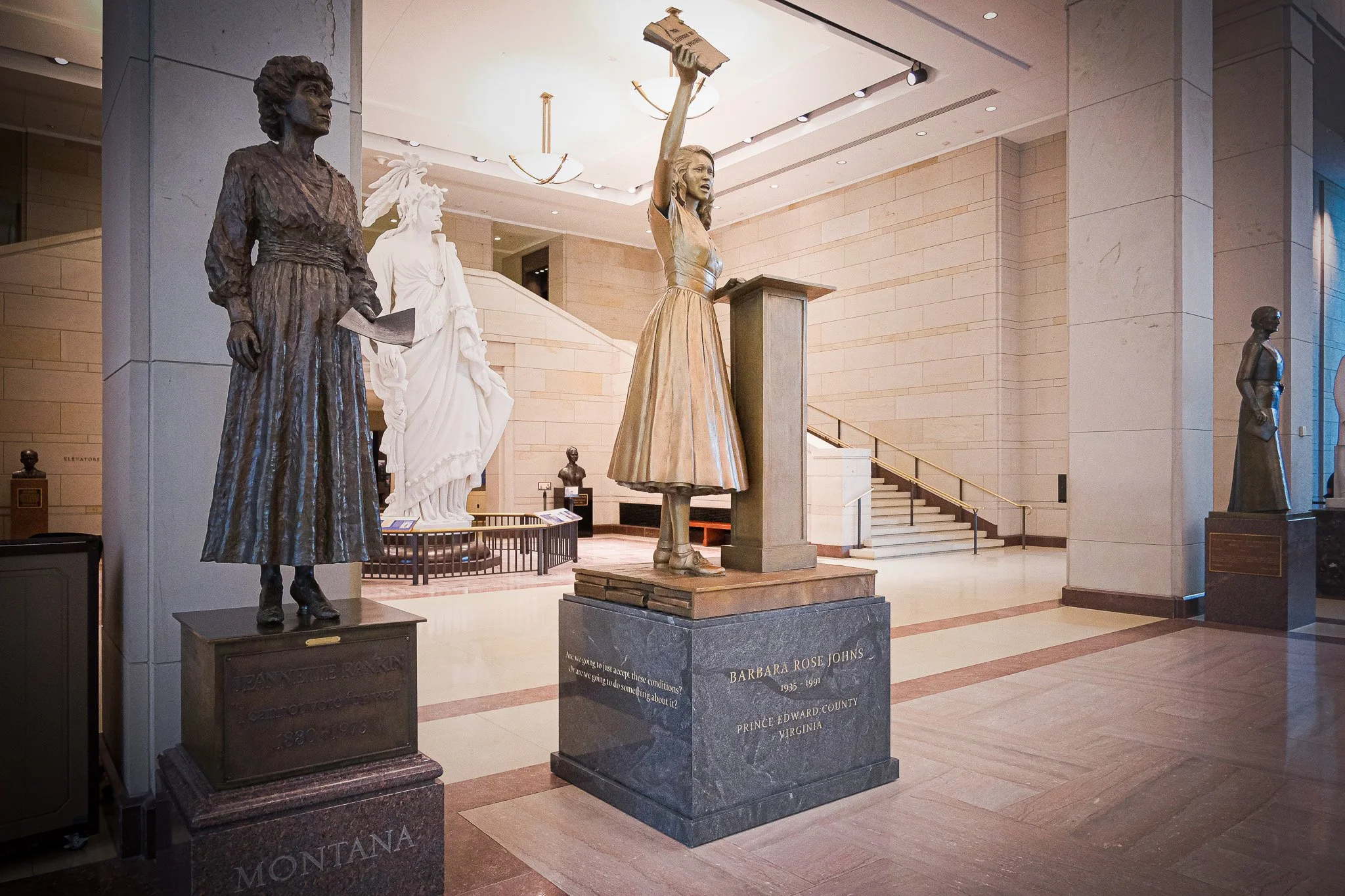
The Barbara Johns statue was offered to Congress to be placed in the Capitol by the Commonwealth of Virginia. Each  of the 50 United States are able to produce and gift two statues to the Capitol National Statuary Collection. Typically these are people important to state's history or U.S. history. Unsurprisingly, one of Virginia’s statues is George Washington. Virginia’s second statue was of Robert E. Lee. Lee’s statue was removed in 2020 and Barbara Johns has come to replace it as of this month. 

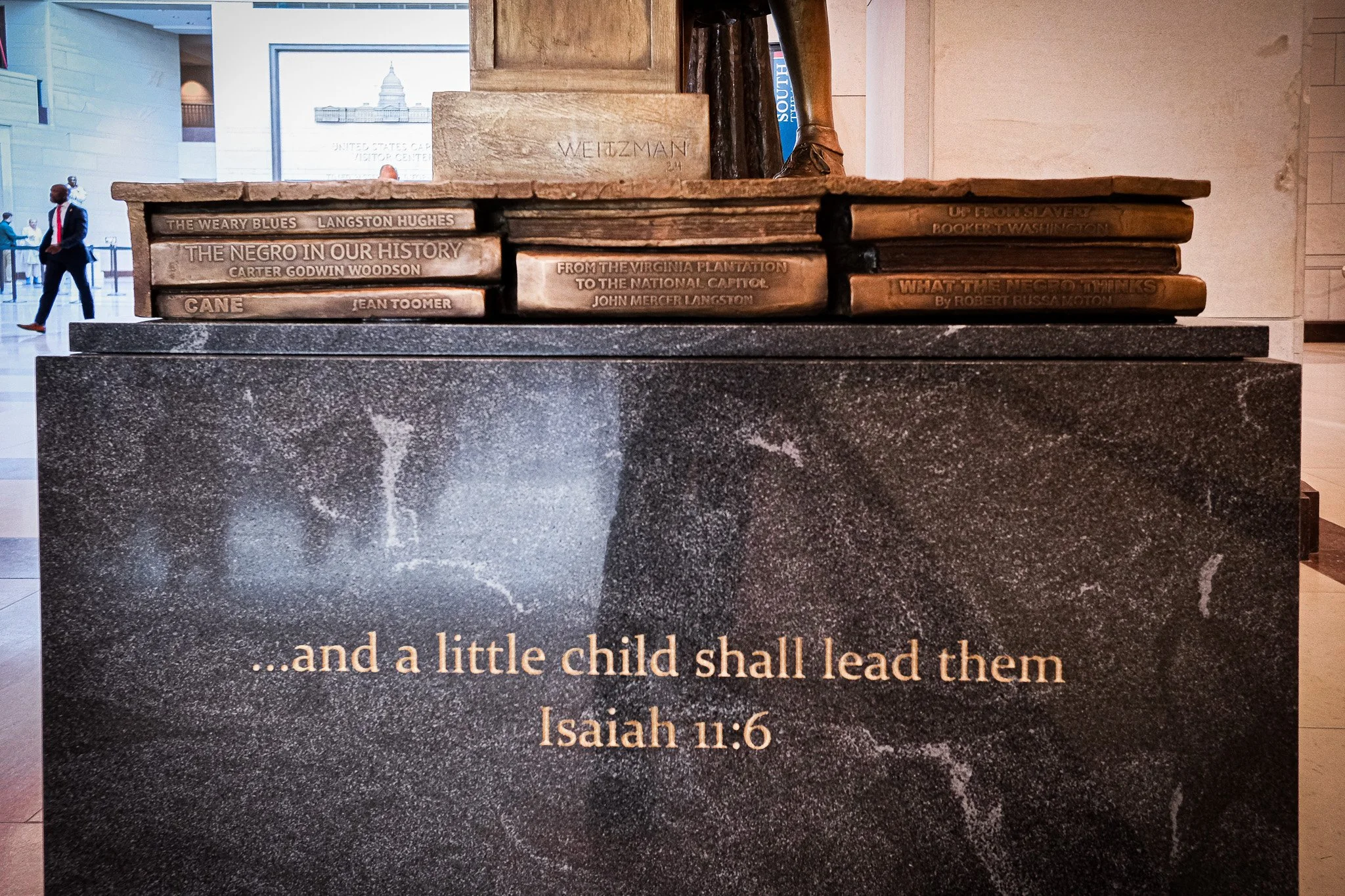
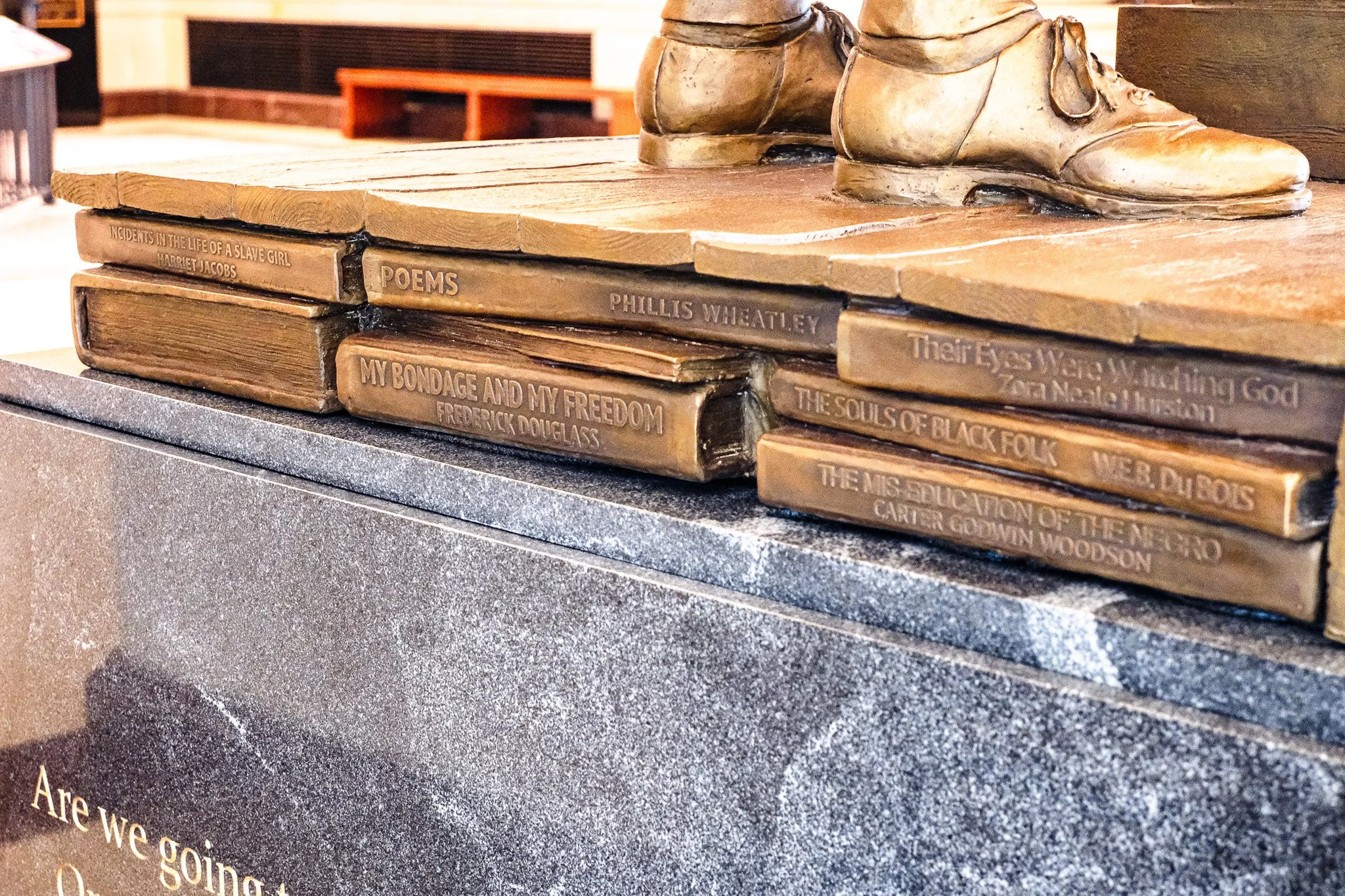
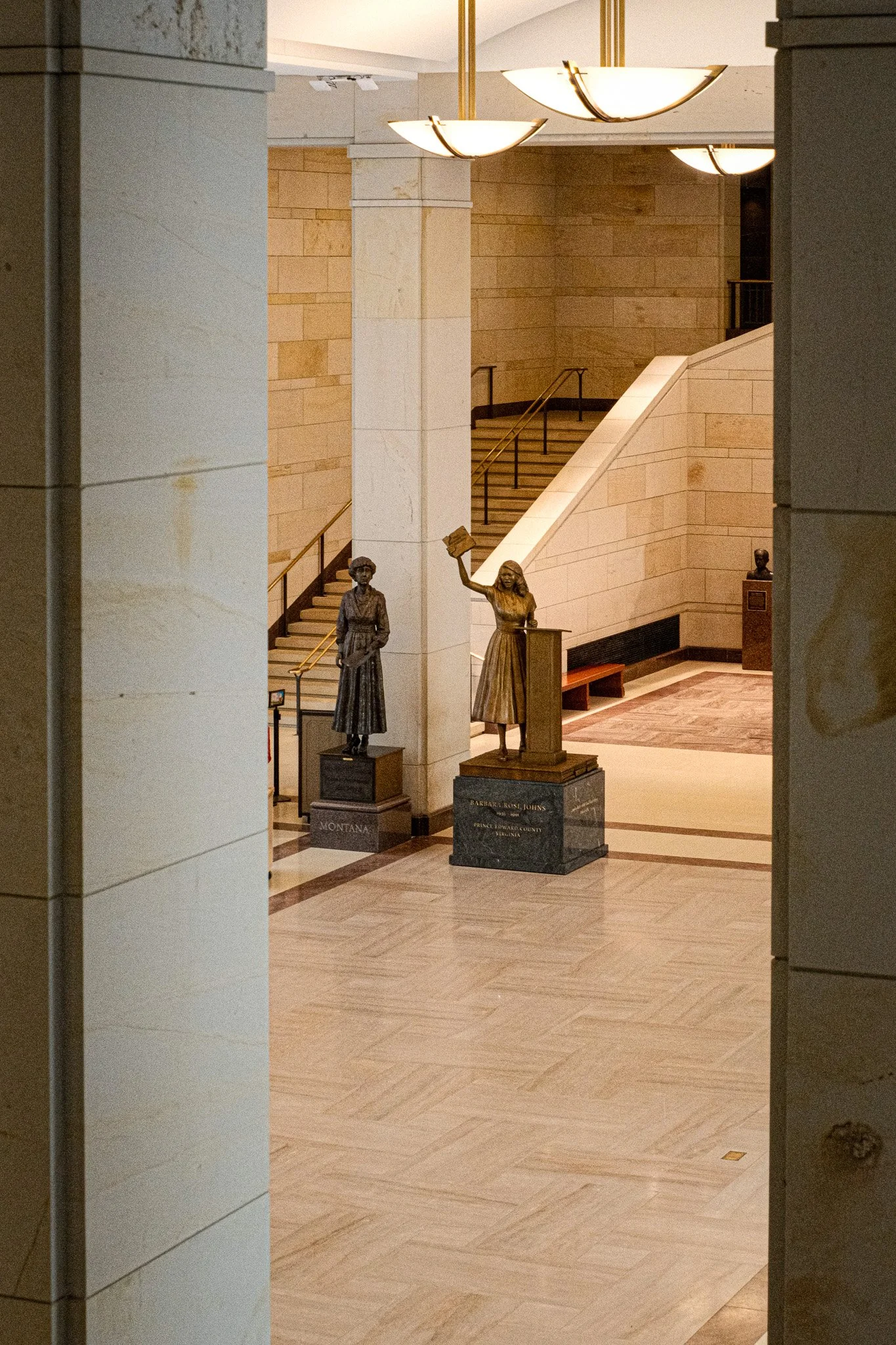
Johns’ statue is of her from the time of the student strike, aged 16 years old. She is depicted rallying other students while holding a textbook, “The History of Virginia.” The book is old and tattered; a used hand-me-down. It’s indicative of what she may have encountered at a school forced to utilize sub-par, second hand materials. Her clothes are typical of what a teen would have worn at the time, including saddle shoes, cuffed socks, and a puffed skirt. Under those shoes: floorboards with books underneath. The sculptor chose to represent Black artists and seminal works that the students at Johns' school may not have had access to, but nevertheless contributed to the through-line of striving for equality and justice. The books underfoot are: 

Incidents in the Life of a Slave Girl by Harriet Jacobs

Poems of Phillis Wheatley

My Bondage and My Freedom by Frederick Douglass

Their Eyes Were Watching God by Zora Neale Hurston

The Souls of Black Folk, The Talented Tenth, and Black Reconstruction in America by W.E.B. Du Bois

The Mis-Education of the Negro and The Negro in Our History by Carter Godwin Woodson

The Weary Blues by Langston Hughes

Cane by Jean Toomer

From the Virginia Plantation to the National Capitol by John Mercer Langston

Up from Slavery by Booker T. Washington

What the Negro Thinks by Robert Russa Moton

Native Son by Richard Wright
Below the books one side of the statue, an apt quote of Barbara Johns: “Are we going to just accept these conditions? Or are we going to do something about it?”

I’m so pleased that we honor Johns as an agent for change and honor her in the moment of change, as a teenaged person. While the statue was briefly in the U.S. Capitol Visitor’s Center, it has been moved to its permanent home, the Capitol Crypt, a vaulted space in the center of the Capitol under the Rotunda. This is typically the first area explored on the official U.S. Capitol tour, which is the best and easiest way to see the statue.

Consider joining the Attucks Adams Patreon where we have continued this conversation, looking at a number of other DC area commemorations featuring young people.
Views From the Monument

This post is powered by Patreon. Get weekly DC history posts, my DC Top 5 lists, and all my photo sets here.

Ever since I first visited the Washington, DC in elementary school, the Washington Monument came to indicate the end of long trip. Riding in a school bus from Richmond, the monument was the first sign of DC as we passed through Pentagon City, Crystal City, and the Virginia suburbs. It’s the first part of DC we could actually see from afar. Then came the Jefferson Memorial, Capitol Building, Lincoln Memorial, and the rest of downtown.

Looking up to the monument is something one can do from almost anywhere in the DC area.

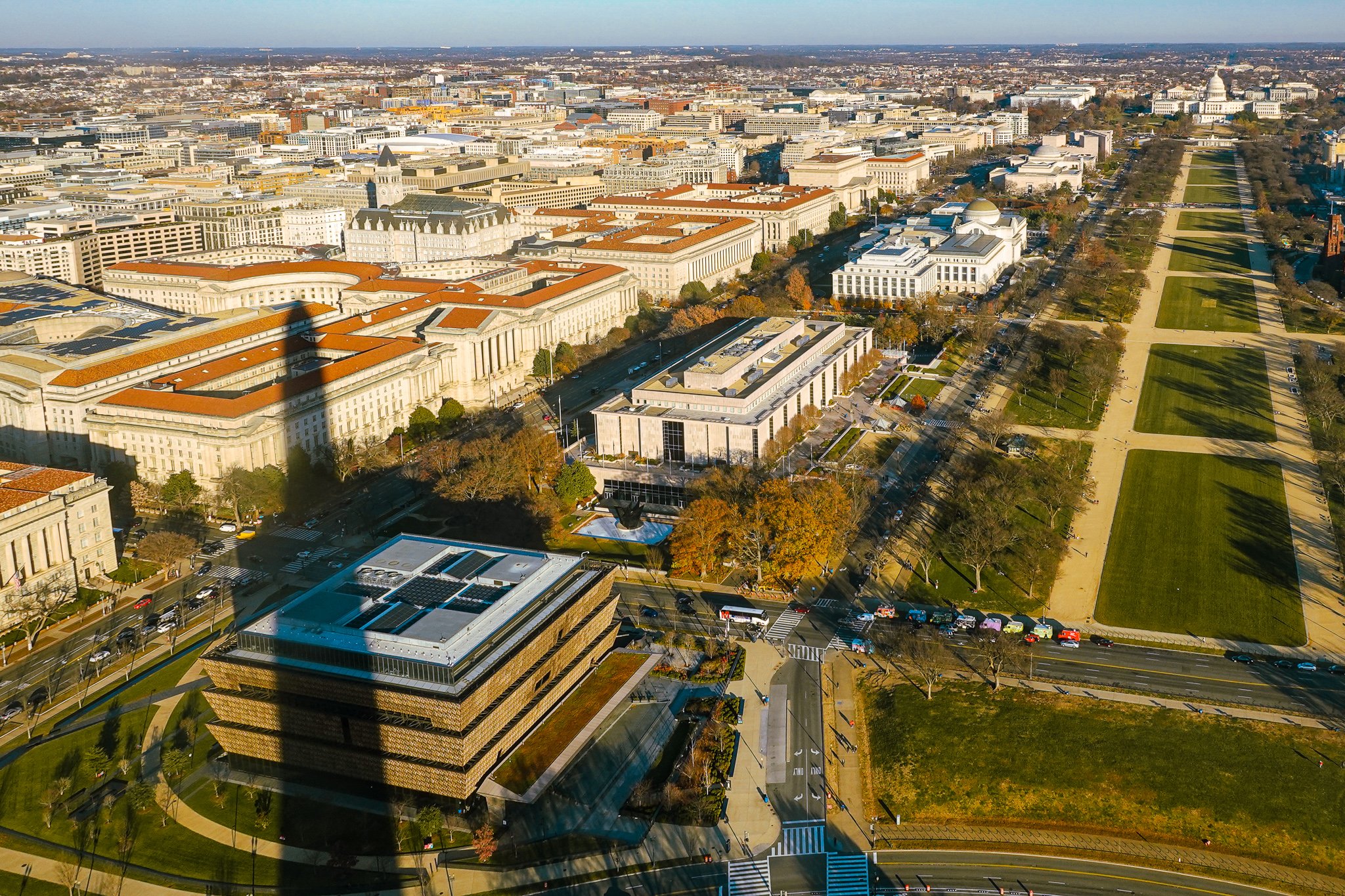
Looking down from it is another story. I recently visited the top of the monument and wanted to share a few photos! But, the fact that I was actually able to ride the elevator up to the top was somewhat a feat in and of itself.

When an 5.8 magnitude earthquake centered 85 miles from DC hit in 2011, the Washington Monument was one of the buildings damaged to the extent that it needed to close to visitors immediately. The repairs, mostly to stones near the top of the memorial, took nearly two and a half years. After reopening in 2014, the lone elevator that takes visitors up and down the 555 tall obelisk failed more than two dozen times over the course of the next two years. Starting in 2016 the monument has been closed intermittently for various reasons, including the pandemic. Here’s a very brief timeline:

August 28, 2011: Closed due to damage from the earthquake
May 12, 2014: Opened to great fanfare after all earthquake repairs are complete.
September 26, 2016: Closed after the elevator failed multiple times since 2014.
September 19, 2019: Opened, with a new elevator, electrical, and mechanical systems. The National Parks Service also debuted a small security screening building at the base of the monument.
March 14, 2020: Closed due to public health implications related to the pandemic.
October 1, 2020: Opened with new pandemic mitigation protocols.
December 18-21, 2020: Closed and reopened due to a covid-19 outbreak related to a private tour inside the monument.
January 11, 2021: Closed indefinitely for the upcoming inauguration and the ongoing pandemic.
July 14, 2021: Opened.
August 16, 2021: Closed after a lightening strike caused the electrical systems to malfunction.
August 28, 2021: Opened and remains so to this day.

Did you get all of that?

Since August 28, 2021 the Washington Monument has been open to visitors with timed entry passes. You can secure a ticket on the Recreation.gov website the day before your visit. At this point, there are no same-day tickets available.

Fun fact: When complete, the Monument became the tallest building in the world passing Cologne Cathedral in Germany by 40 feet. That distinction lasted just five years when it was surpassed (at almost twice the height) by the the Eiffel Tower.

For even more photos from the top (40+) and more fun facts about the Monument, check out the Attucks Adams Patreon. And a hearty thanks to all the Patrons who have supported my work over the past year. You are appreciated!

National World War I Memorial: First Look

IMG_3353.jpg

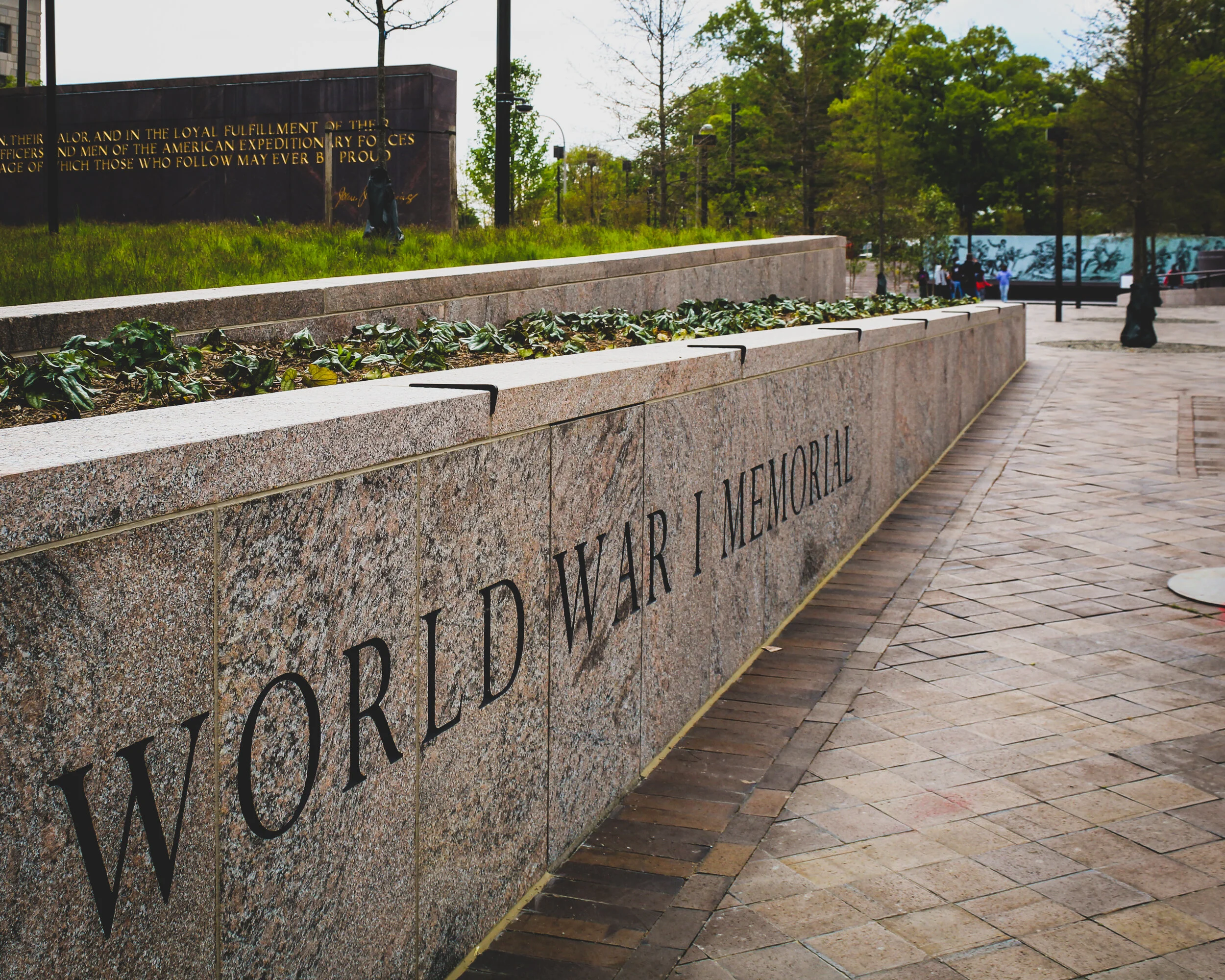
One hundred four years after the United States Congress declared war on Germany and entered World War I, the first national World War I Memorial was dedicated in Washington, DC. Known as The Great War or The War to End All Wars, what began as a Europe-centric conflict quickly spread to include sovereign and colonized nations worldwide in Asia, Africa, the Middle East, and the Americas.

IMG_4637.jpg
IMG_4640.jpg

After resisting entering the war during his first term as President, Woodrow Wilson eventually asked Congress to declare war against Germany in April 1917, which they did. The war, which began July 1914, ended 19 months later, on November 11, 1918.

4,734,991 U.S. Americans served during World War I. With 116,516 total deaths, it remains one of the deadliest conflicts in United Stated history, leaving only World War II and the Civil War with more total deaths during a single conflict. The new memorial has been years in the making and is unique among war memorials in DC.

See the full 24 photo set on our Attucks Adams Patreon page. That’s also where you will find additional posts featuring interpretation, historical context, and my final observations about this newest addition to the memorial landscape of Washington, DC. A huge thanks to all Patrons for making this work possible!

IMG_3365.jpg
IMG_4618.jpg
IMG_3362.jpg
IMG_3369.jpg

Patreon Preview: National Native American Veterans Memorial

200CF1E6-6F16-45C8-BAD3-A500C27E1CC5.jpg

One characteristic of the National Mall I really appreciate is that there are dozens of smaller spots among the museums and large memorials that end up being excellent stages for more intimate spaces. Whether that space is used as a farmers market like the one hosted next to the USDA or a public garden like Haupt Garden at the Smithsonian Castle, there are pockets of land available for new additions to the living, civic work of art that is the National Mall.

The newly opened National Native American Veterans Memorial is in one of those spaces… (con’t)

Read more on our Patreon page including more than a dozen images: patreon.com/attucksadams.

377C81CD-1F8A-4CCE-AD5E-0A324DB52CE9.jpg
5AFBE4BF-EA55-4932-ACCA-13CF99BEE173.jpg

Video: Two Minutes at "In America"

Capturing the quiet sounds and remarkable images of Suzanne Firstenberg's "In America.”

The installation honors the, to date, 225,000 Americans who have died from covid-19, the disease caused by coronavirus. Each of the individual flags represents an individual person who has passed away from covid-19. Some flags have been planted by relatives of those who passed. Others were placed by Suzanne herself, by a cast of volunteers, or visitors to the memorial.

This installation is planned to run from October 23 - November 6, 2020. It’s located near the DC Armory and RFK Stadium. The closest address is 1900 East Capitol Street NE, for the adjacent parking lot.

For more information on the artist and installation, visit suzannefirstenberg.com.