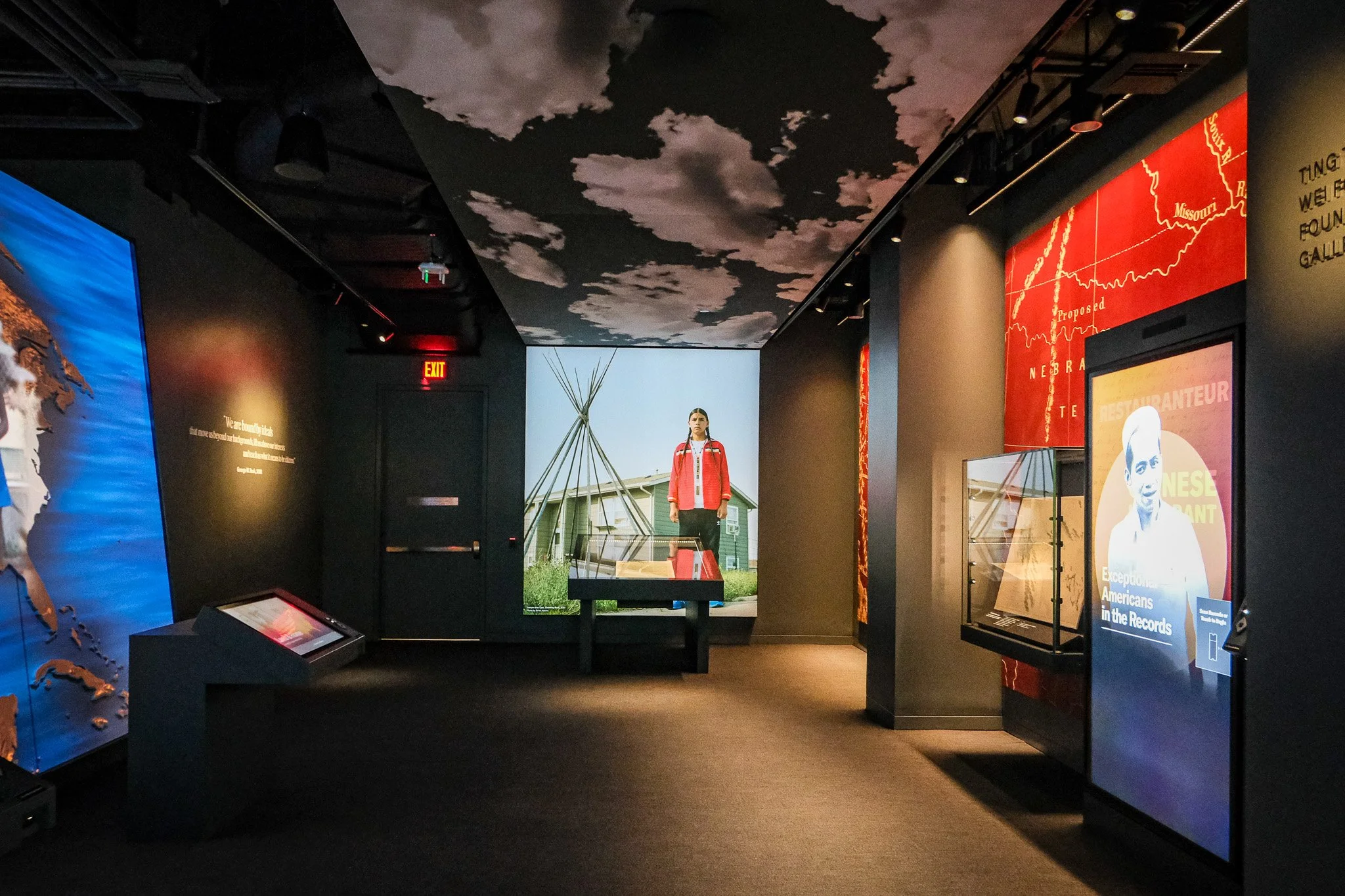
The American Story: Exhibition Spotlight

The National Archives serves an outsized role in our country at this moment. As we grapple as a nation with how and what values drive policy, sentiment, laws, mores, behaviors, and citizen expectations, the documents that are foundational to life in the U.S. are still on display for public scrutiny. 

The Archives calls the collective documents including the Declaration of Independence, Constitution, and Bill of Rights the “Charters of Freedom.” Those three documents are the literal centerpiece of the main Archives building here in Washington, DC. The entire Rotunda and balance of remaining programming & exhibitions in the building –all the way down to ticketing, entrance, and egress–  have been built around access to the Charters of Freedom. But there is so much more to the Archives, especially to the average, non-researching visitor.

Officially, the National Archives and Records Administration (NARA) spans across the country in nearly 40 buildings including the main facility and museum in DC, a much larger archival storage and research facility nearby College Park Maryland, 10 regional archives, and 16 Presidential Libraries. In total, there are nearly 13 billion (13,000,000,000) documents under the purview of NARA. The building most associated with access to documents is the one you've probably visited -- the 1937 Archives building located on Constitution Avenue NW in DC. Aside from the Charters of Freedom, there are typically several other rotating exhibitions open in the museum portion of that building. 
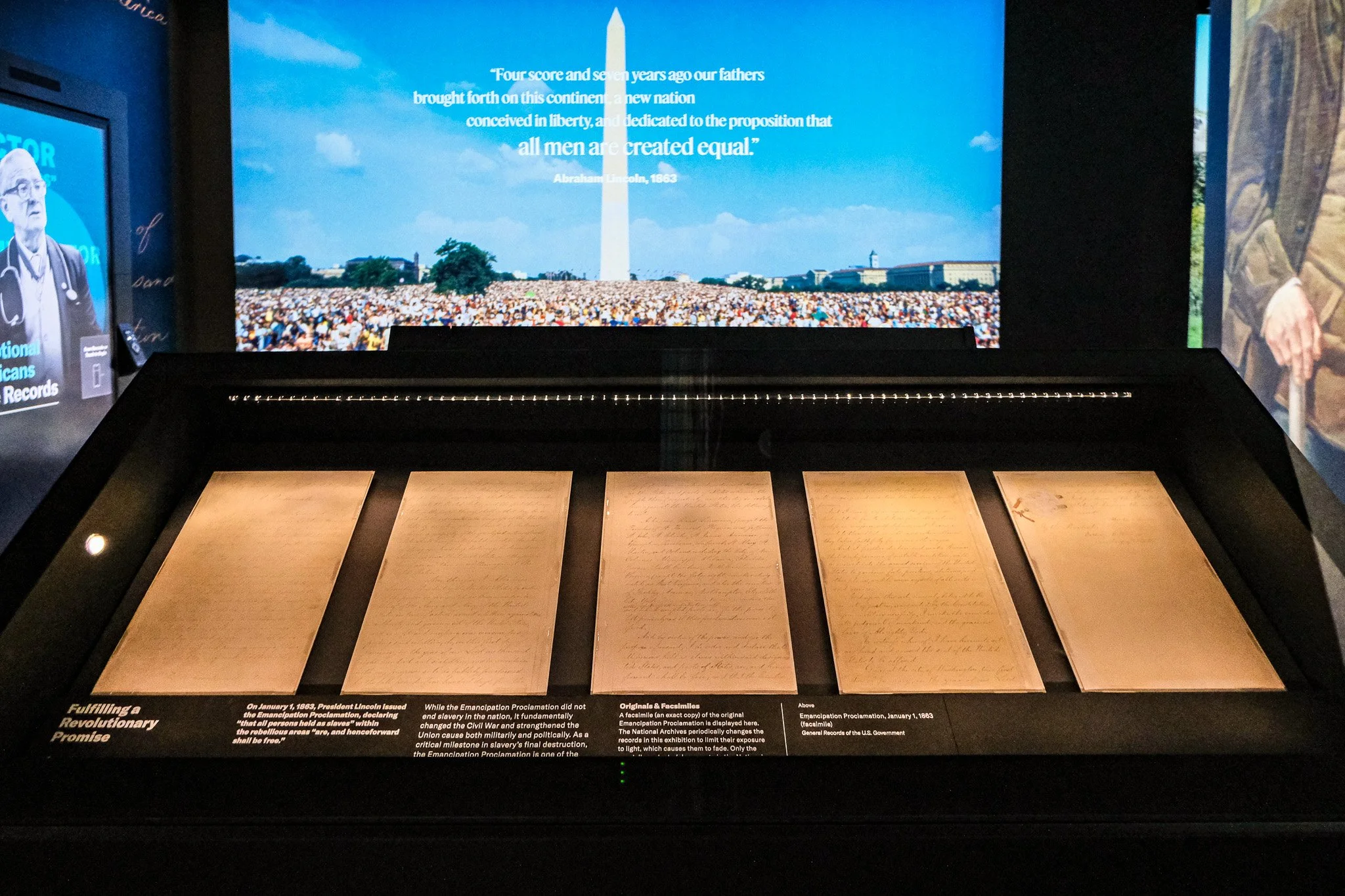
A surprising amount of documents on permanent display were facsimiles; like the Emancipation Proclamation.
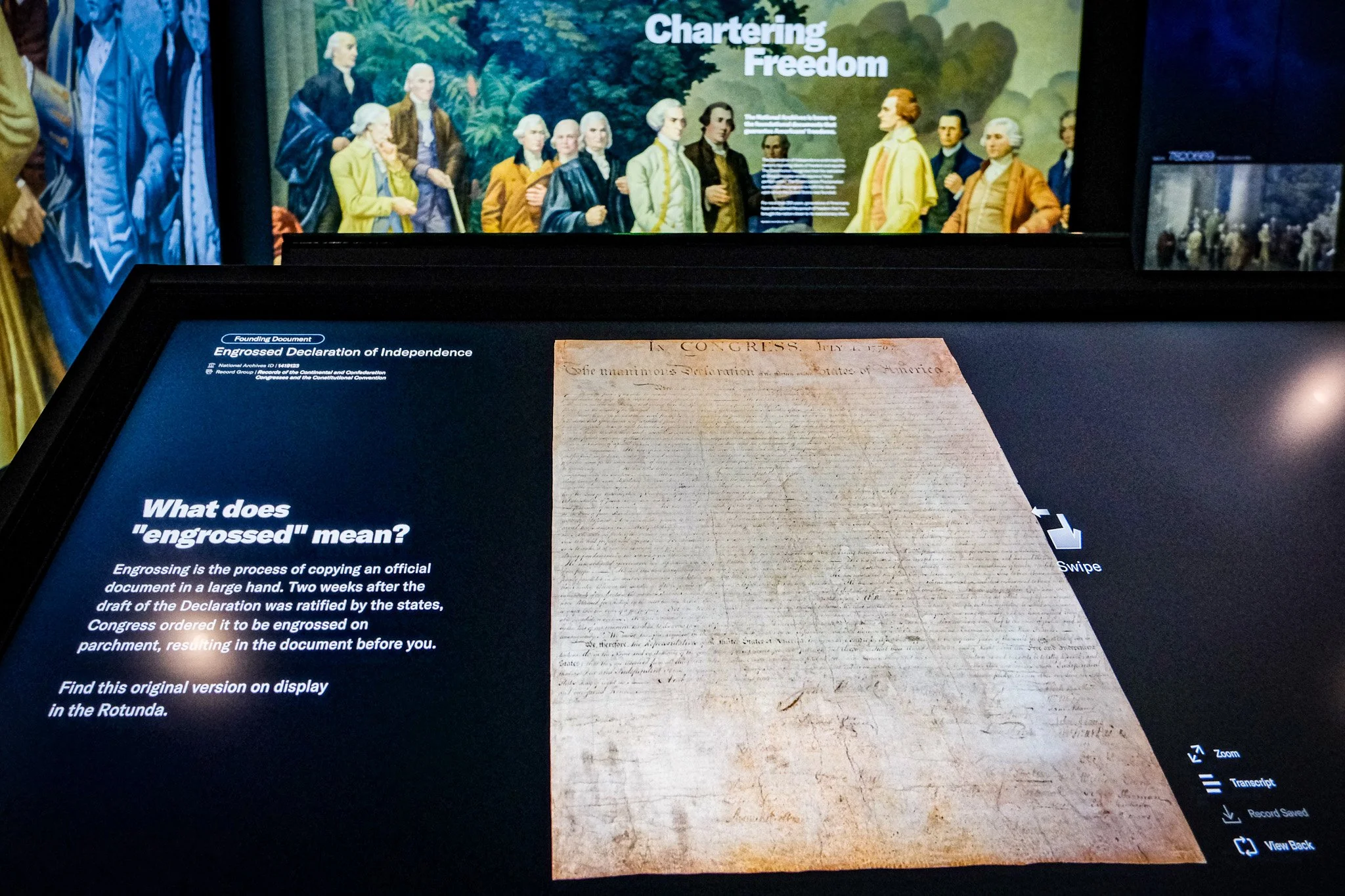
The amount of information about each document is astounding. From meaning behind the words to how the parchment was made.

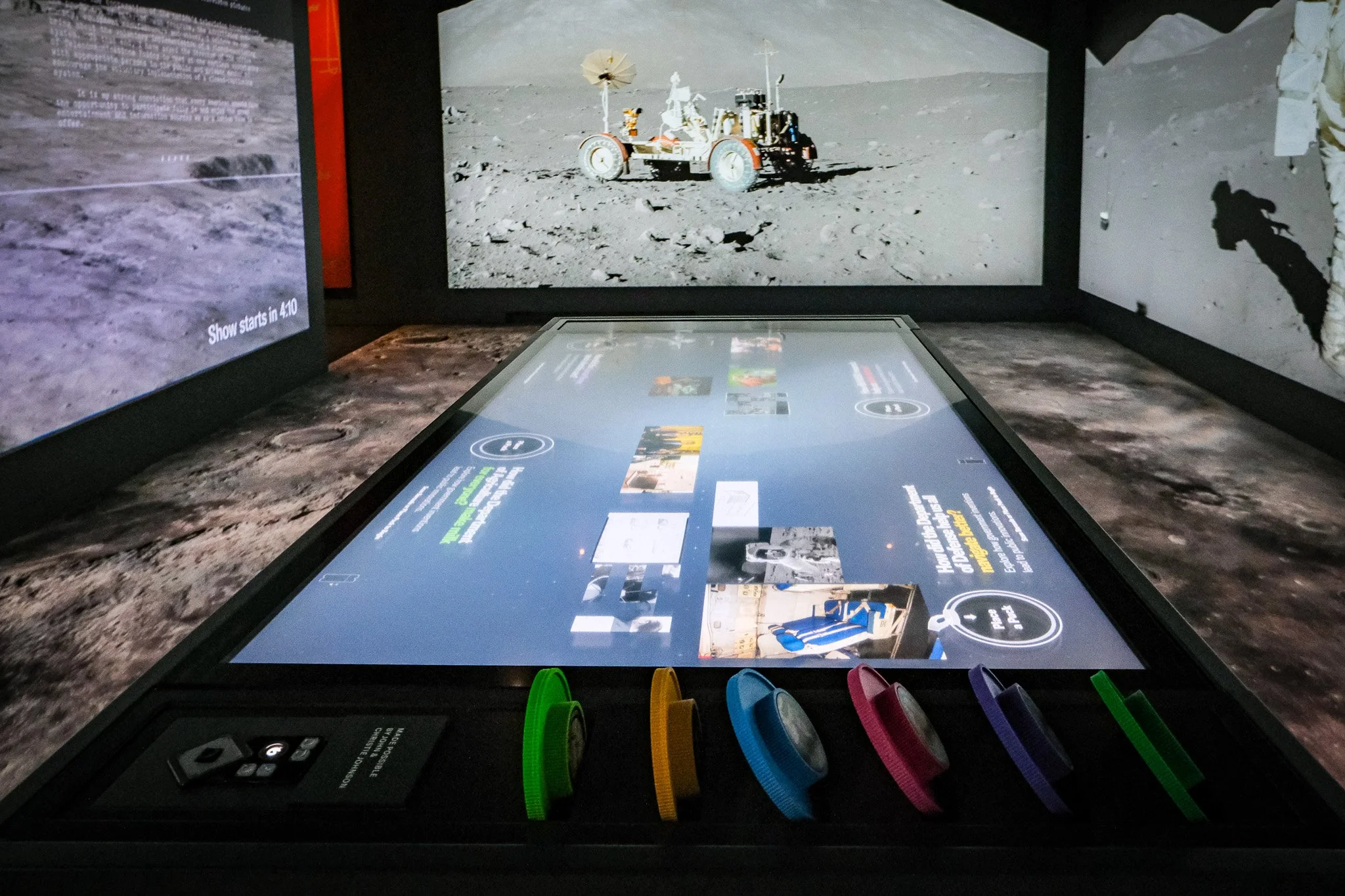
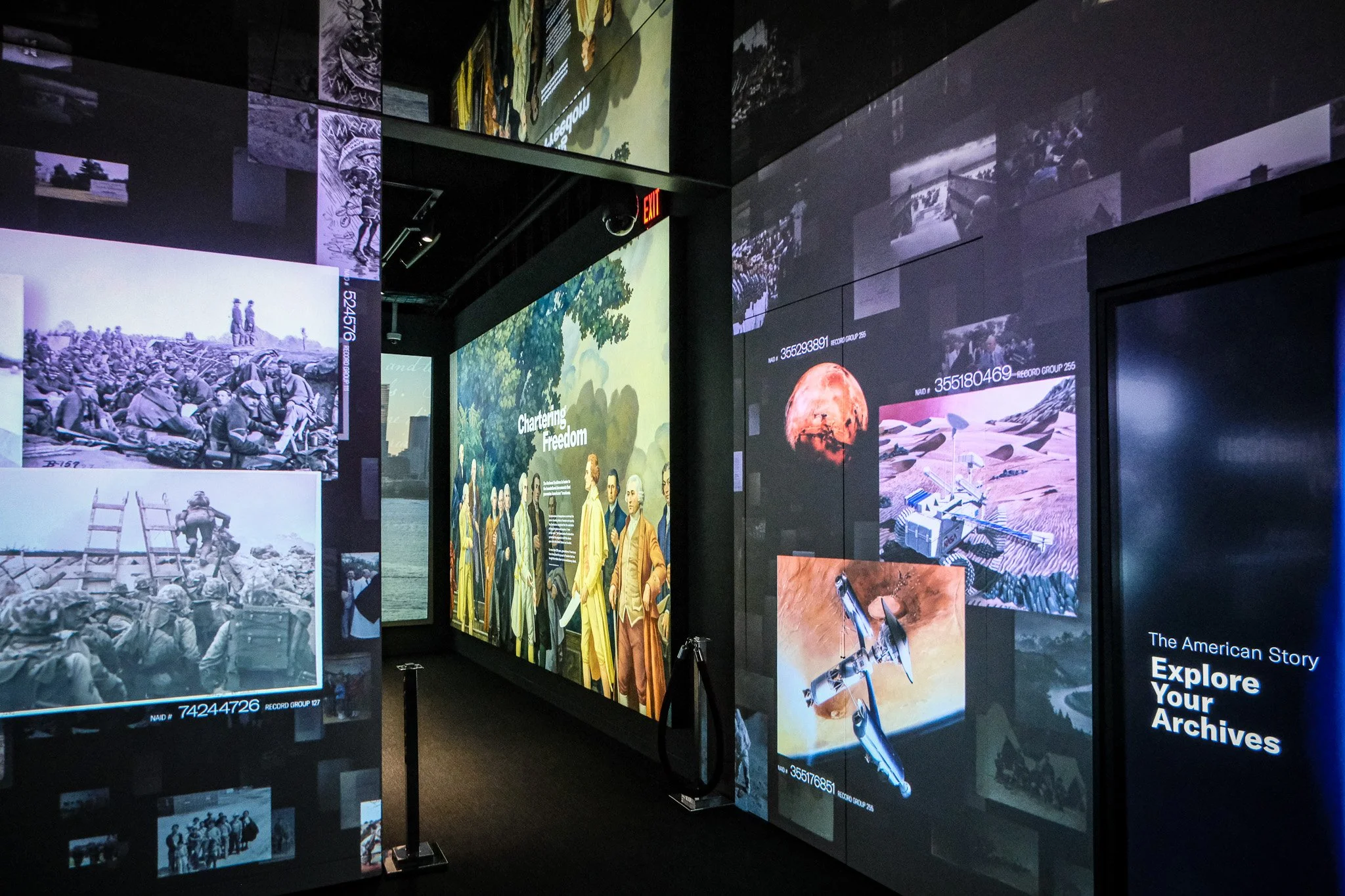
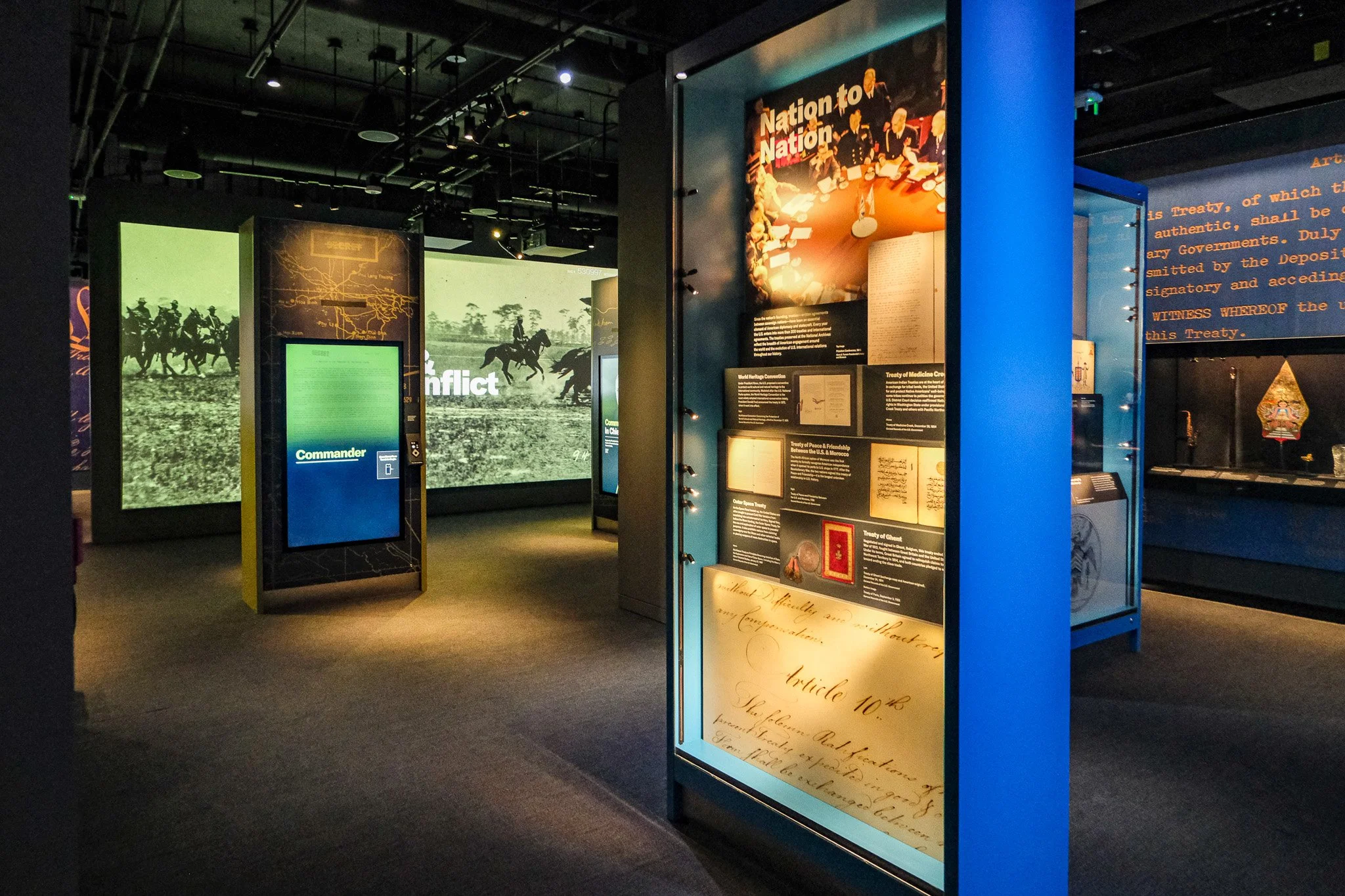
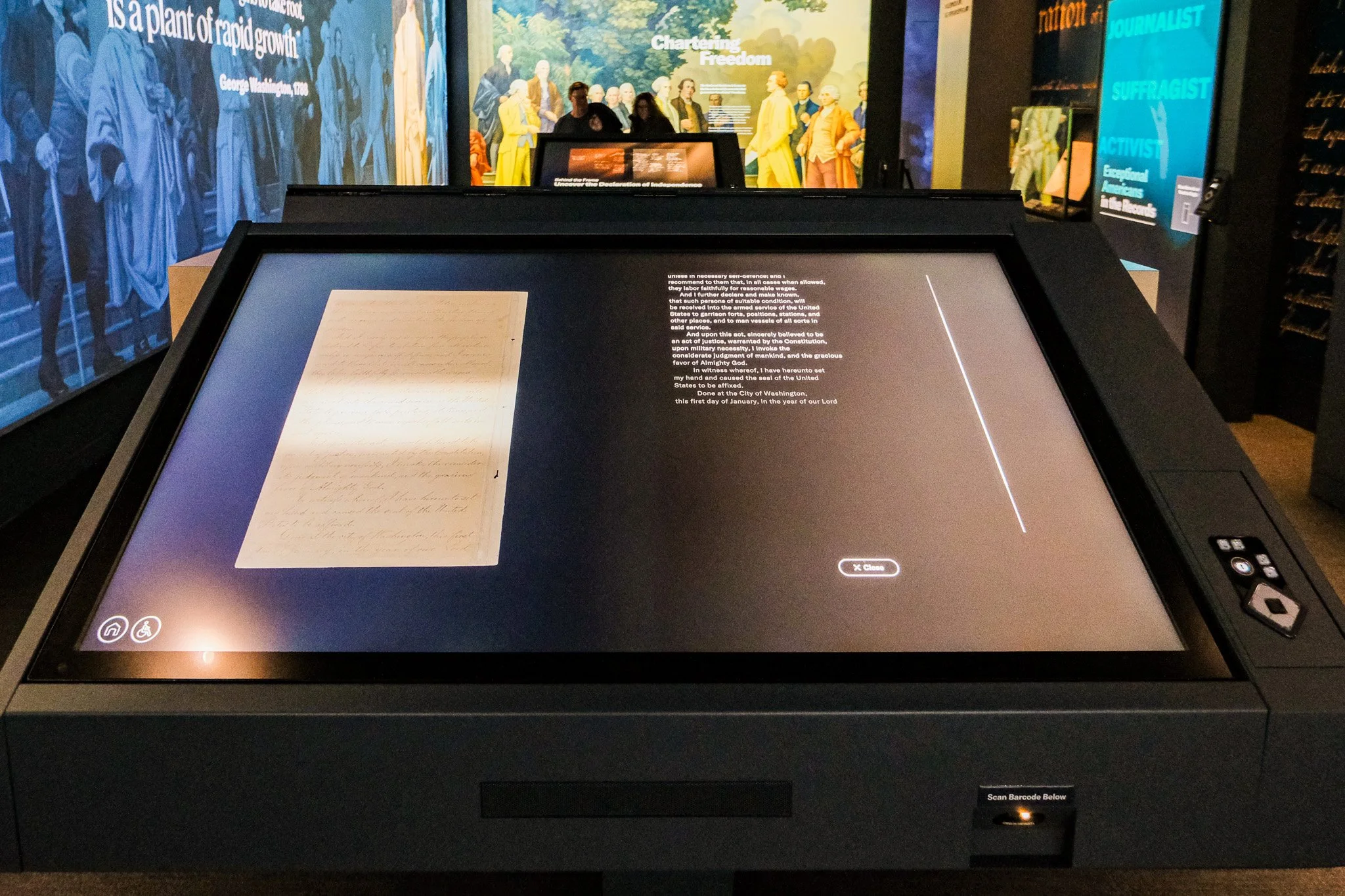
The newest exhibition, “The American Story” is the most forward attempt by the Archives to connect the visiting public to the vast amount of documents it oversees. Using what the Archives themselves have described as an Artificial Intelligence interactive, the main interface in this exhibition is a network screens that suggest documents for you to explore based on a combination of interests that you choose at the start of the exhibition and either the document you’re exploring at that particular station or the theme of the room you are in at the time.
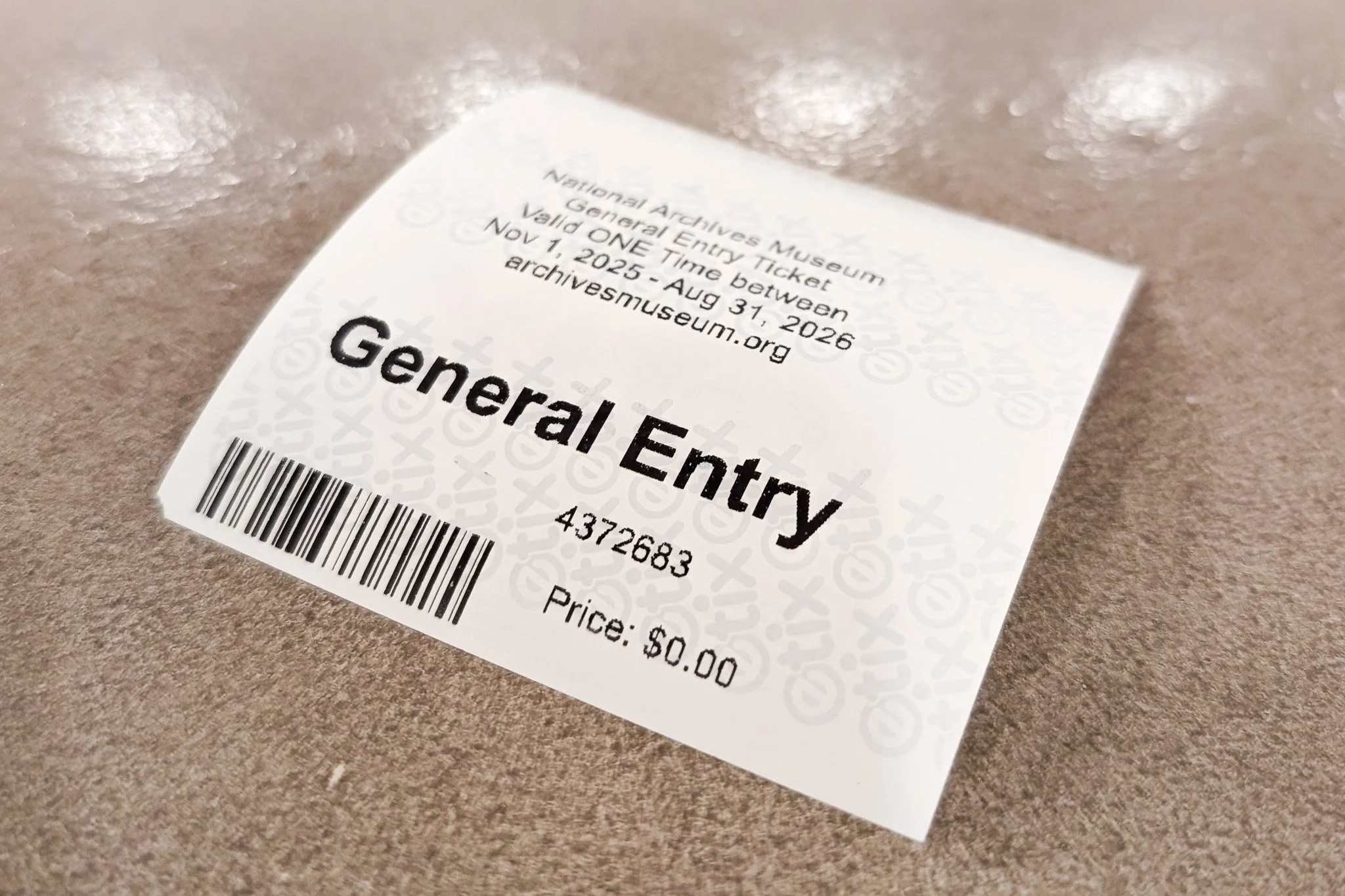
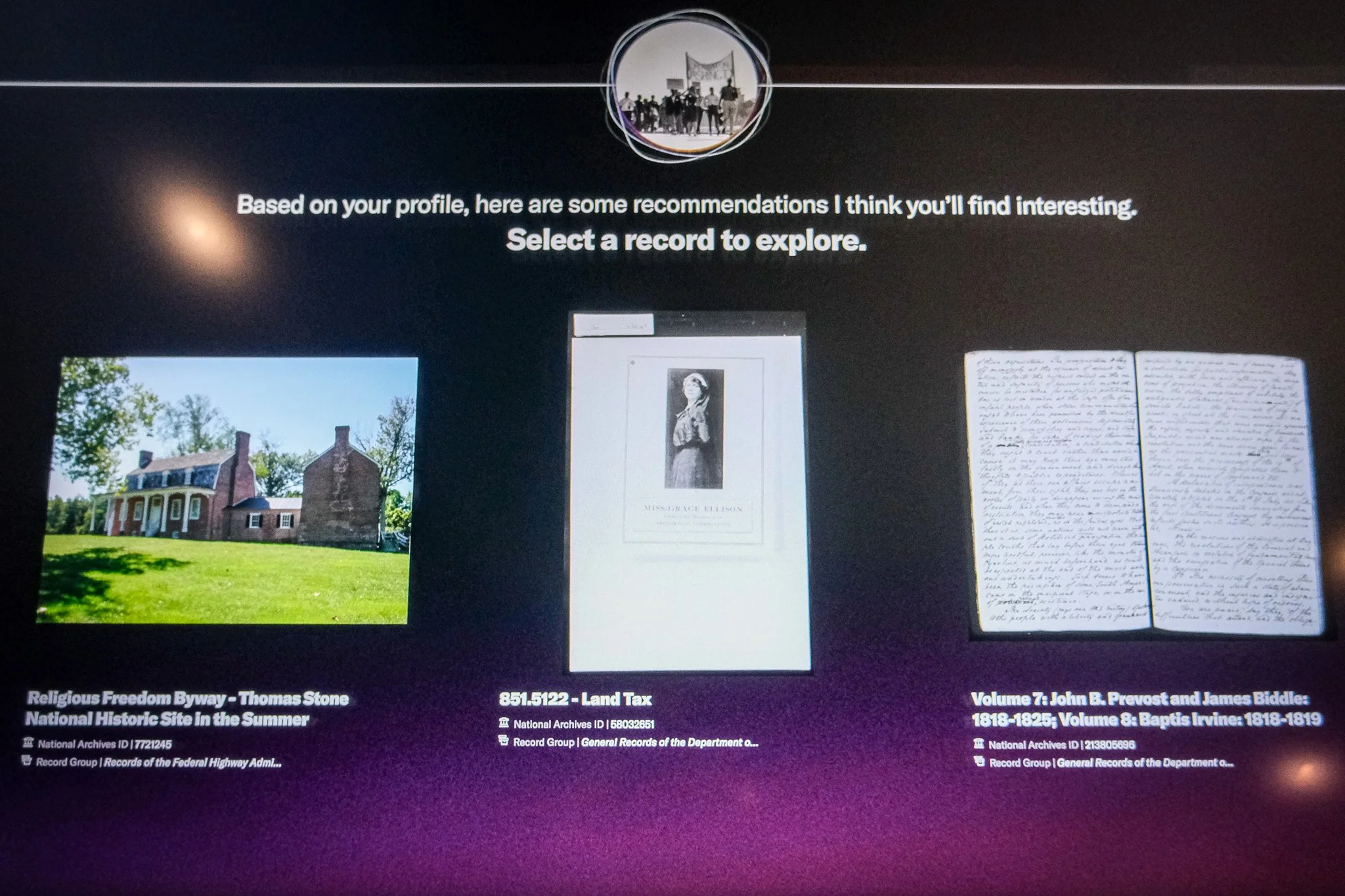
If you wish to keep track of the documents, you can grab a general entry ticket at the desk as you enter the Archives, after exciting security. You then scan that ticket at each touch screen kiosk in the exhibition as you interact along the way. At the exhibition exit, after your last scan, you have the option of navigation to a QR code linked to your personal ticket. There you can bookmark a unique web page on your phone in order to look in detail at all of your saved documents later. Hold on to the ticket! It’s good for the next year and you can return to add more documents to your unique web page. 

Here’s the web page for my last visit: https://archivesmuseum.org/14312293451. You can see which documents I saved in the exhibition in order to look more closely at them later at home.

For example, I saved this annotated draft copy of the Constitution that belonged to George Washington. You are able to see his hand-written notes in the margins! Now I can examine high quality digital files of this and other documents while I am at home. It’s not just an experience to be had inside the museum. 

How did I discover this George Washington related document? When I created my initial profile attached to my ticket, along with basic topical interests like founding documents, I indicated that I wanted to be offered associated items in the form of paper documents, photographs, and maps. These are all digitized of course. So at some point looking through the exhibition, the “AI Archives" program suggested that I save this document, which I did. Now I can bookmark this page in my browser for research purposes or just to relive the experience. Exploring further, I can also see where the actual paper document lives within the Archives system (actually in this same building!). Overall, on this visit I saved 34 documents which live across 6 different archive facilities and 2 presidential libraries. 

It is somewhat random, as many of the suggested documents were not at all linked to the content I was viewing or had very tenuous links to my purported interests. I’m not sure how this “AI” suggestion system is any different than an associated keyword search or metadata match.
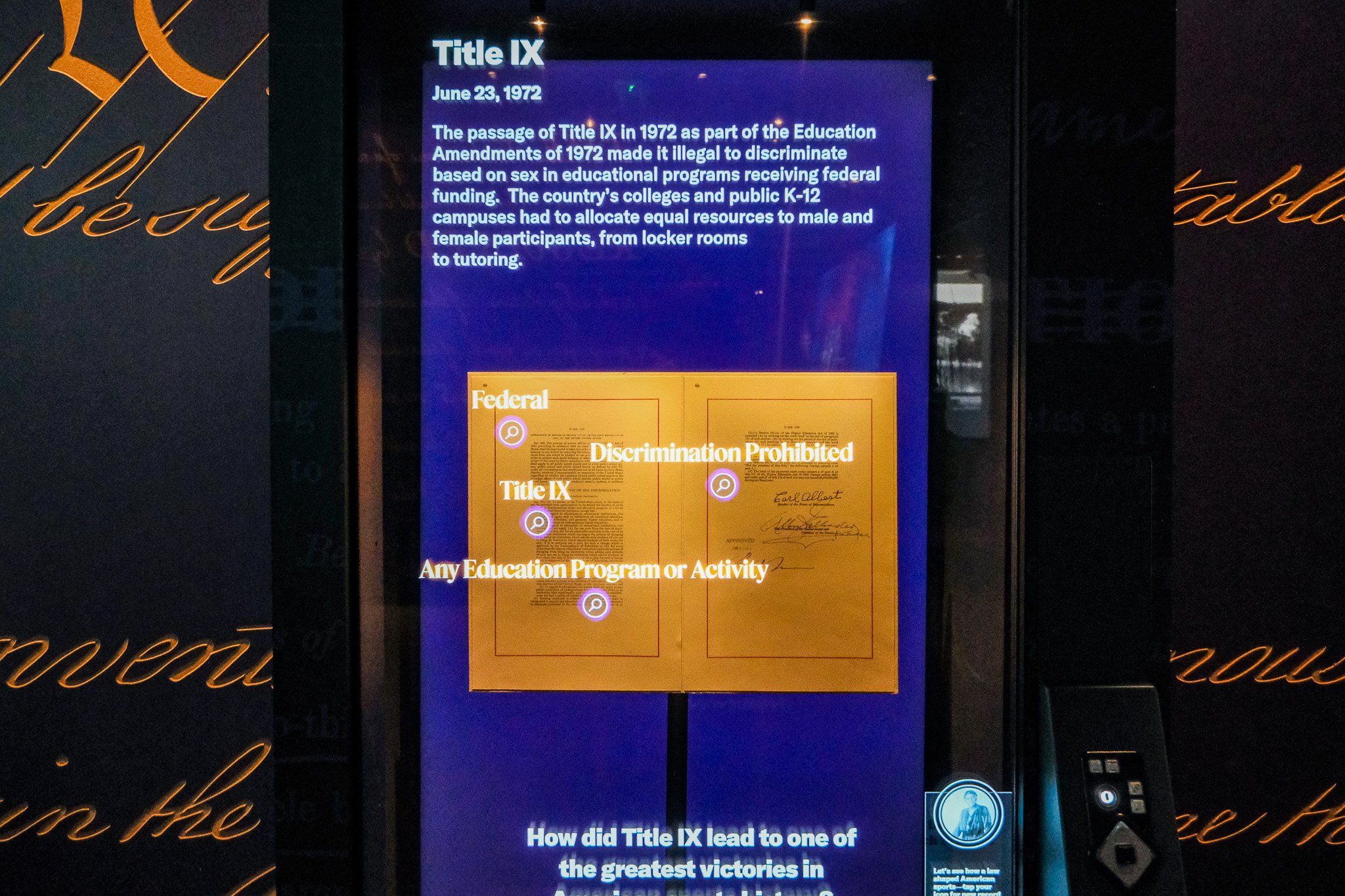
Immersive technology lets you read a document while using an overlying touch screen to learn more.

On a separate, more personal ticket, I saved some of my personal family information from a century-old Census record. You can begin basic genealogical research in this exhibition, too. There are privacy safeguards. Visitors are forced to link any saved ancestral/genealogical information accessed in the exhibition to a personal email address. This prevents that information from showing up to anyone who might find a lost ticket or randomly link to your Archives page online.

Along with a strong start featuring a deep dive into key documents like the Declaration, Emancipation Proclamation, and Louisiana Purchase (featuring mostly facsimile documents however), the exhibition branches out with a smattering of other topical deep dives including presidential gifts (received by), interesting patent history, genealogy, a thematic rotating photo gallery (currently featuring Ansel Adams), and a kids & family focused discovery center with "gamified" research and fun-fact stations.
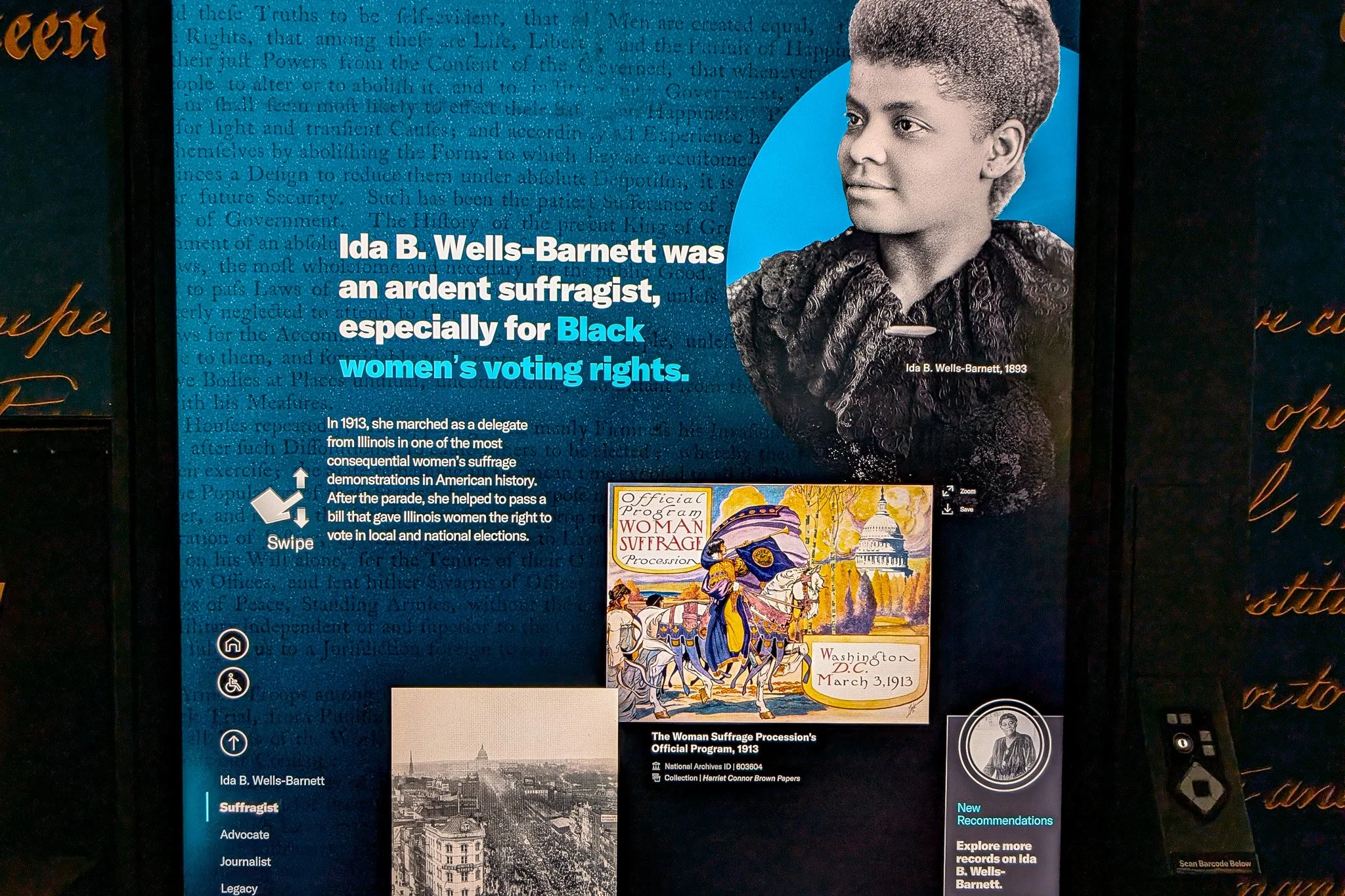
Profile of journalist and suffragist Ida B. Wells.
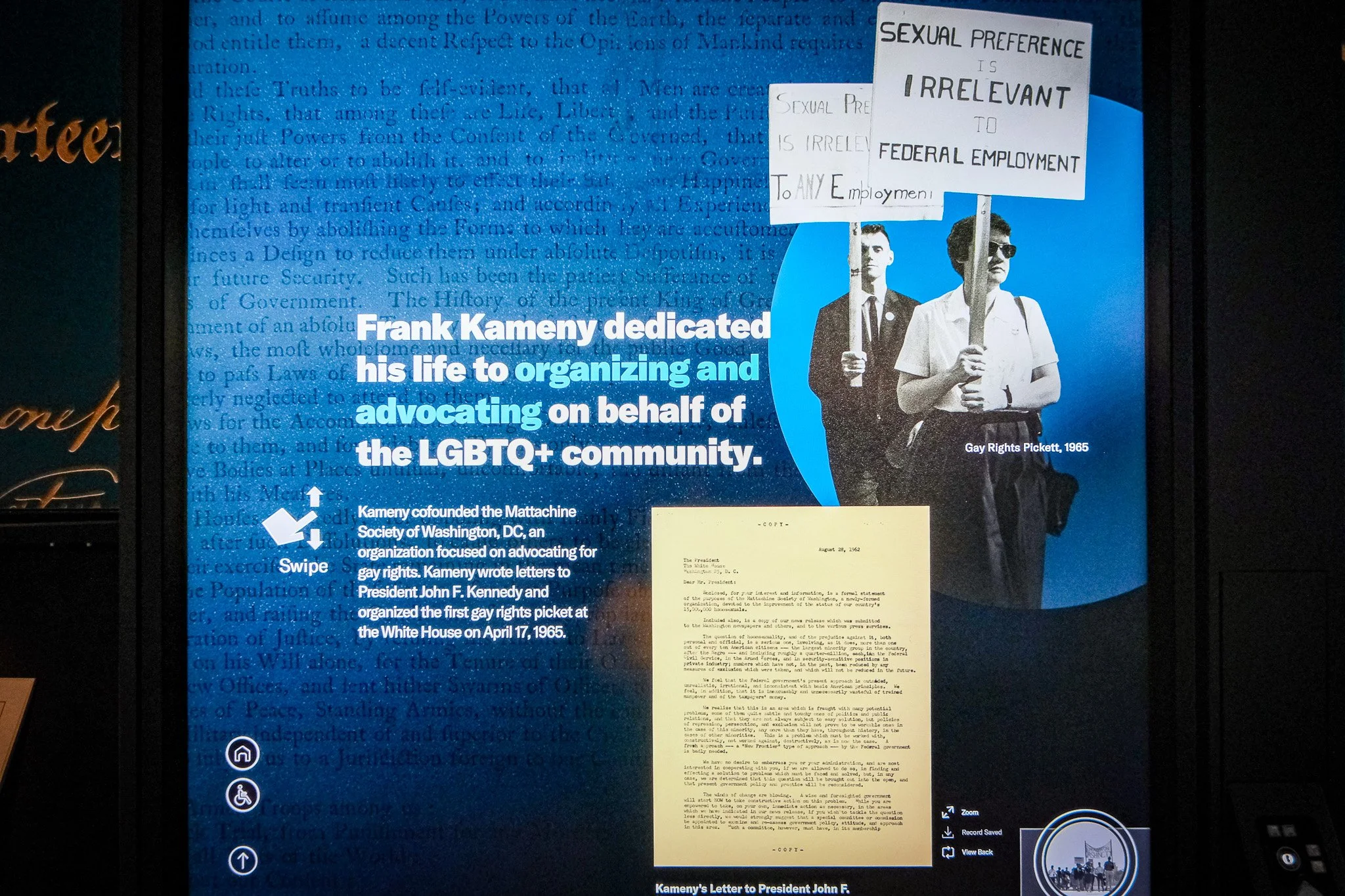
Profile of Frank Kameny and a letter he personally sent to President Kennedy.

One key attention grabbing aspect of select kiosks is the highlighting of personal profiles. The profiles are of influential or compelling change makers from American history that are related to the section of the exhibition you happen to be in or nearby documents to the kiosk. At the very first kiosk I was shown profiles of Ida B. Wells and Frank Kamany, two Americans I was immensely glad to see included in the exhibition. Linked to each profile are related government documents, of course – docs related to each person’s activism, struggle, or occasionally mundane government paperwork that became symbols of those struggles. I thought this was an extremely effective way to give a certain document meaning. We’re used to recognizing the importance of the written words on a few sheets of lined paper that make up the Emancipation Proclamation, for example. But, the links to other, lesser known documents or government paperwork along with the profile of the person who wrote or filled it out, AND the context as to why that mundane submission might have importance, kept me at the kiosk looking up various individuals and their related docs. Especially folks I have never read or learned about before. 

Overall, “The American Story" is a success, insofar as it provides a new, clever, and mostly accessible way to interact with the documents held in the Archives. And even though the “AI” is somewhat of a gimmicky idea to me in this case, the system does result in delivering suggestive documents in a way meaningful to one’s interests. I will also give points for the opportunity to discover transformative individual Americans at each station, relative to the documents on view in that section. On the other hand, the whole exhibition doesn’t come nearly as close to telling any one version of “THE” or even “AN” American story. The exhibition is just too scattered to weave a solid overall narrative. There are solid pocket narratives related to presidential decision making, westward expansion, innovation, and founding documents. And I can’t offer too many demerits outside of picking a slightly misleading name to the exhibition. If one is looking for a more cohesive and comprehensive national narrative, I  would visit any number of exhibitions in the nearby National Museum of American History or even NMAI or NMAAHC for that type of experience. 

The American Story is a permanent exhibition at the Archives and as such, has no closing date. It’s open 10am to 5:30pm daily with the rest of the Archives. The exhibition is located on the same floor as the Rotunda and Charters of Freedom.
Honoring the Builders of the Arboretum

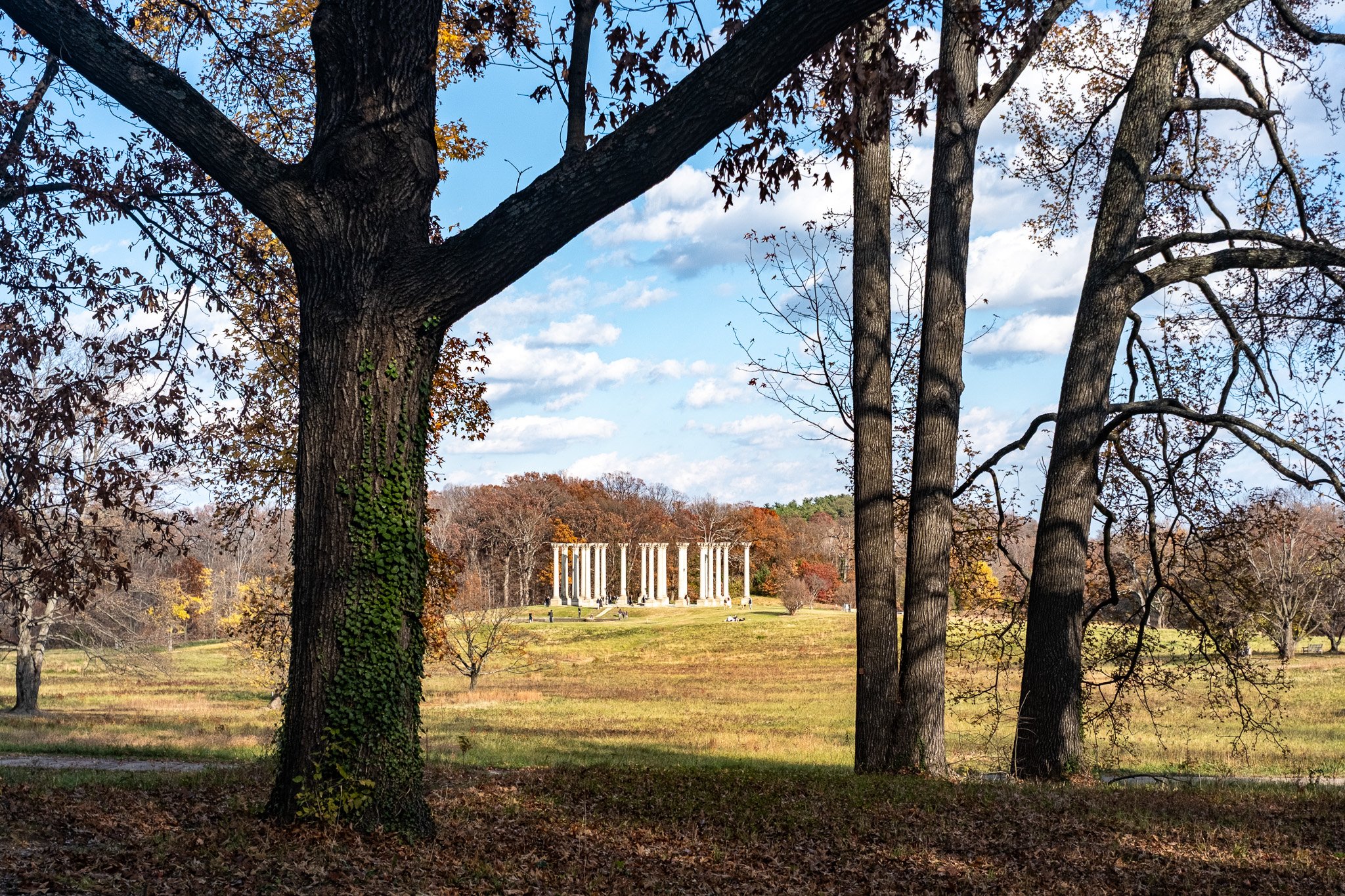
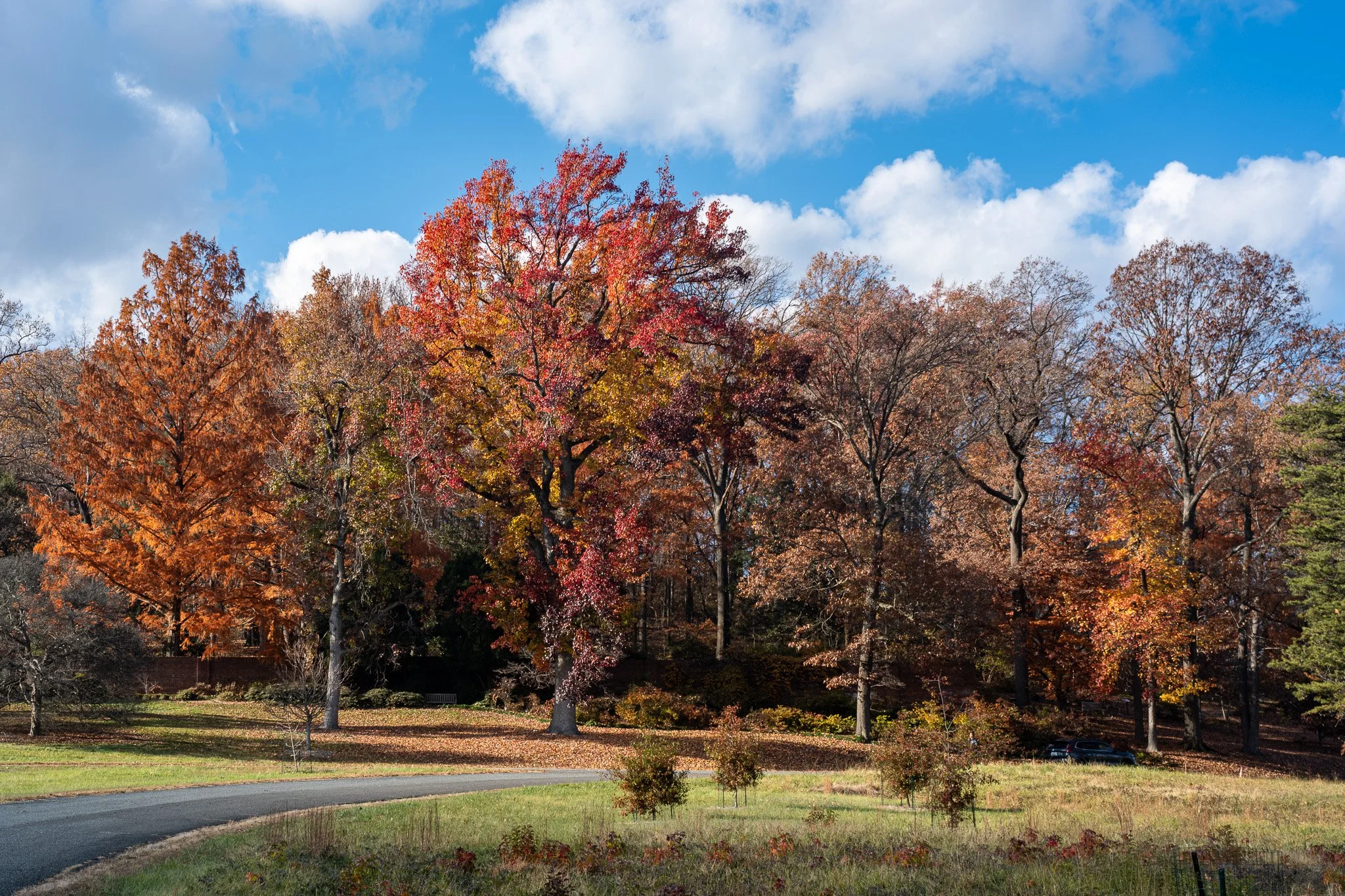
The U.S. National Arboretum is often called a "hidden gem" in DC, but there are plenty of visitors -- 700,000 yearly according to Friends of the National Arboretum. The Arboretum is a 451 acre facility in the northeast quadrant of Washington, DC. Technically, it is part of the United States Department of Agriculture, nested in the USDA's Agricultural Research Service.

While research and conservation are a part of the Arboretum's mission, so is education. It doubly serves as a research facility and a publicly available green space for visitors — in the form of a huge park. Most of those 700,000 visitors are not there for formal research, but there to take in the gardens and vast Arboretum collections including dogwoods, azaleas, bonsai, ferns, herbs, perennials, conifers, and so many others.

Created by the National Arboretum Act in 1927, the goal of the initial public gardens was to elevate plant groups important to American landscapes. The current mission statement indicated that the Arboretum "enhances the economic, environmental, and aesthetic value of ornamental and landscape plants through long-term, multi-disciplinary research, conservation of genetic resources, and interpretative gardens and exhibits." Perhaps slightly verbose, but you get an idea of what the purpose of the facility actually is, although most visitors interact with the 451 acres as a public park.

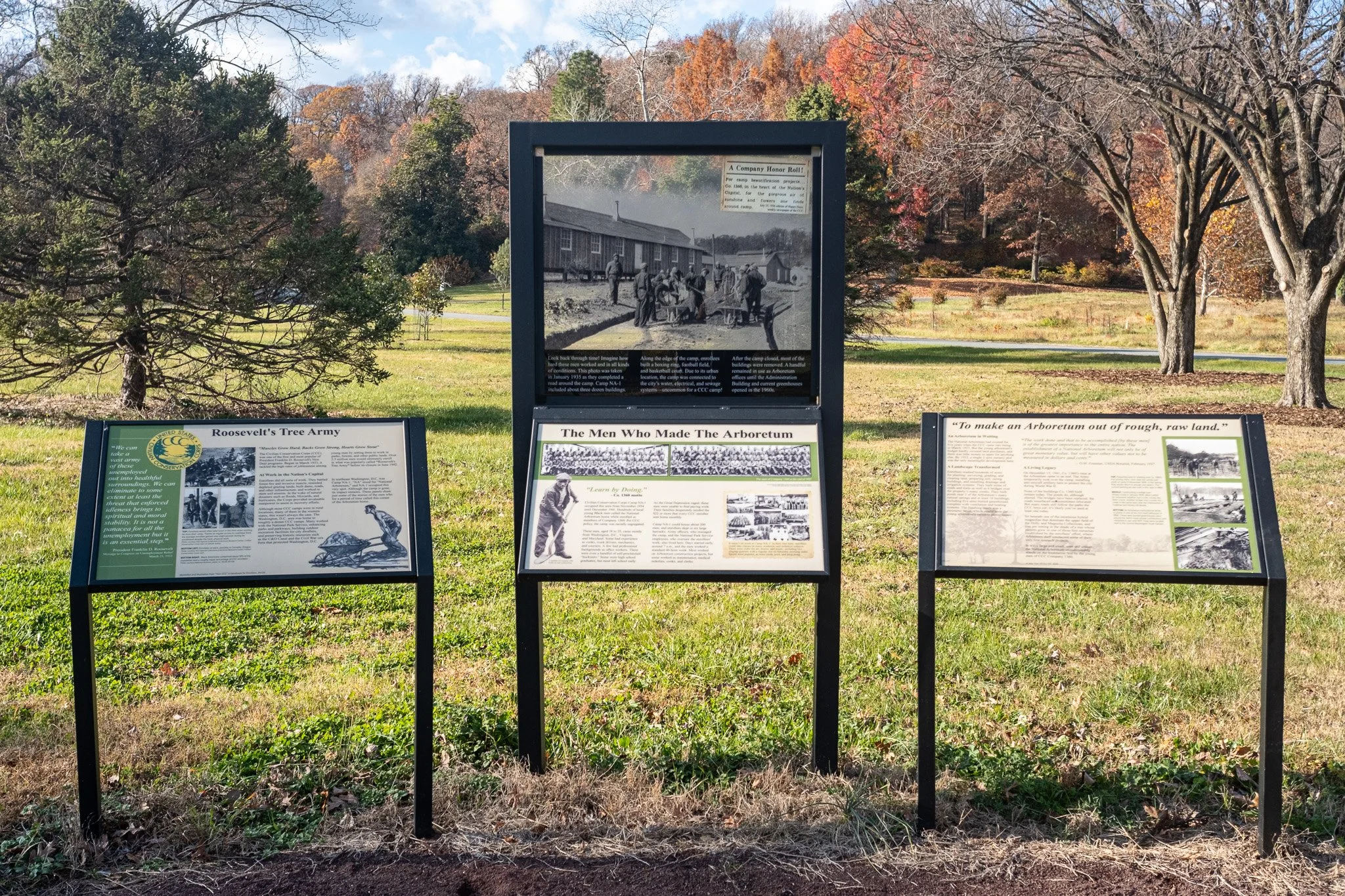
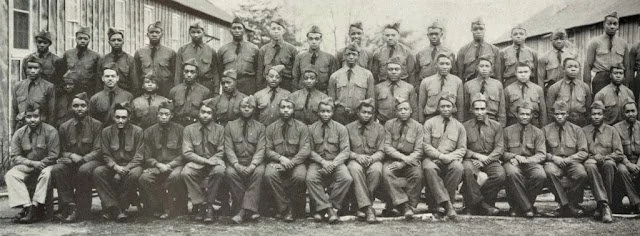
Recently the Arboretum created a display that honors some of the people that built the facility as it existed in infancy. In a small, four panel display near the old State Grove of Trees, visitors can learn a little about Company 1360.

Company 1360 was a DC-based company in the Civilian Conservation Corp (CCC), a Roosevelt era federal work relief program that employed mostly young men (18-25) on environmental and conversation projects across the country. Since the United States government was still segregated at the time, Company 1360 was initially an all Black unit, and remained so for the duration of their work program. It was the first all-Black CCC encampment in the National Capital Parks area. Over the nine year duration of the CCC, about 10% of CCC enrollees were Black. However quotas capped the number of Black enrollees as well as leadership advancement opportunities within CCC, even as under-employment in the Black community exceeded the national average. All CCC enrollees were paid equally regardless of race, including Company 1360, and enrollees individually received $30 per month. They were typically required to send $25 back their families to stimulate the economy (we were still in the Great Depression) and allowed to keep $5 for themselves. All enrollees received housing, food, uniforms, enrichment, and health care.

Company 1360 at their camp on the grounds of National Arboretum. c. 1937

Company 1360 worked from 1934 to 1941 to reshape the existing farmland and forest into what we now know as the National Arboretum. They lived on-site at "Camp NA-1," off of what was an extended M Street NE, at the southern end of the Arboretum; not far from the Anacostia River flats as they exist today. Camp NA-1 was one of the 4,500 CCC camps that existed over the course of the program, which ended in 1942. It probably doesn't come as a surprise that the CCC ended as a result of World War II as U.S. government funds and attention were diverted the war effort and young men diverted into military service away form programs like the CCC.

Members of Company 1360 came from DC, Maryland, and Virginia, with the vast majority being DC residents, according to early records. The cohort was tasked with building roads, constructing bridges, grading walk paths, clearing underbrush, creating manmade ponds, seeding grass, landscaping, building offices & tool houses, moving topsoil, cutting endless cords of wood, and generally transforming the land the Arboretum existed on into the form we now experience in the present day.

Present day visitors to the property owe a small debt to the original builders of the Arboretum and I was glad to see the four panel display out in the open, although it is a decent walk from the R Street and New York Avenue entrances. The exhibition will be available for the foreseeable future and has no end date.

This post was made possible by supporters of Attucks Adams on Patreon. Join our Patreon for weekly DC history posts, additional photographs of the Arboretum, and more. NEW: Gift a Patreon membership to the history buff in your life (even if that’s you). Thanks everyone for your continued support.

DC's Alternative Art Spaces, Past & Present

DIY -- Do It Yourself. As applied to music and the arts, DIY usually signifies the show, project, or venue is produced by the artists themselves. Even though not always not-for-profit on paper, usually DIY spaces are run without being part of, or subject to direct oversight of a typical corporation, government agency, or overarching bureaucratic framework. Nor would shareholder be profit the main motive.

The idea of having multiple DIY arts spaces in downtown DC is somewhat of an anomaly today. Many of those arts spaces are located outside the downtown core in group houses, places of worship, or underutilized retail spaces.

A new exhibition (D.I.Y. in the District) located on the first floor of the MLK Library highlights alternative DIY arts spaces in DC from the 1970s to the present. From Rhizome (located in a residential setting way uptown), to d.c. space (formerly located in the heart of downtown DC), the exhibition uses venue ephemera, archival photos, and audiovisuals to show how these venues helped shape the usually unrecognized arts culture embodied in DC's local population. That is to say, the arts outside of national or international museums and organizations.

Perhaps a partial "victim of their own success," dc. space closed in 1991 as downtown DC was about to see a 30 year boom of redevelopment and new construction that continues today. That redevelopment boom transformed downtown culture to favor retail and entertainment, but much of the DIY arts scene was left out. There are art galleries, theatres, and entertainment venues downtown, but the cultural scene is dominated by larger entities such as the Smithsonian (SAAM and NPG) and the 20,000 Capital One Arena which is primarily a sports venue. But, smaller artist-run galleries such as Touchstone (1976) do still exist.

MLK Library has grown over the past decade to be a place for so many diverse resources and I'm glad these great hall exhibitions have been a part of that growth.

D.I.Y. in the District is open through December 7, 2025. 901 G St NW, Washington, DC 20001.

Support us on Patreon to receive all posts, and early!

Power & Light: Exhibition Spotlight

A stunning moment-in-time photography show is open for a few more months at the National Archives. "Power & Light: Russell Lee's Coal Survey" is a show made up entirely of survey photography focused on coal mining communities in the U.S. The survey was commissioned by the federal government in an effort to stunt 1946 coal miner strikes across the nation.

The exhibition displays just a fraction of Lee's 4,000 total photos and depicts workers in the coal mines, at home with their families, doing every day tasks like going to the doctor, attending church, or just existing in their communities. Essentially, life as a miner-- the good, the bad, and the ugly.

This honestly broke a lot of my pre-conceived notions of the coal industry and the workers themselves. Worth a visit. Closes December 7th.

LGBTJews in the Federal City: Exhibition Spotlight

When exploring museums in this city, it does feel special when curators & designers set out to represent District culture and history, specifically. Even within those exhibitions, it’s perhaps more rare that curators intentionally and skillfully juxtapose DC history with national history in the same room at the same time.

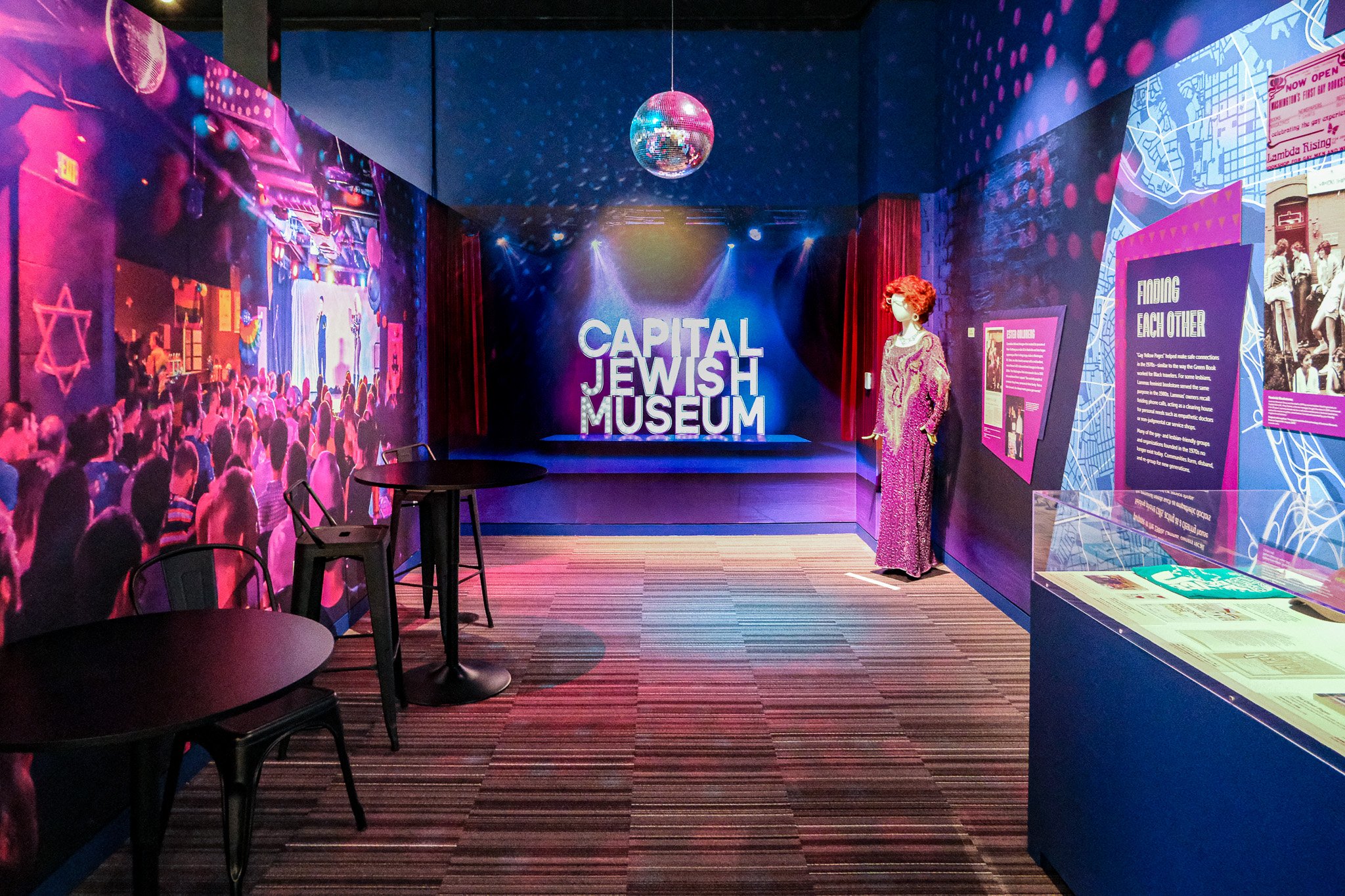
This is precisely what I experienced at the newest exhibition by the Capital Jewish Museum, “LGBTJews in the Federal City.” I had been in this exhibition space before, most recently for JewCE: The Jewish Comics Experience. Perhaps due to the layout, or perhaps due to the spatial organization of this new exhibition – either way – this space felt more expansive than ever, and the museum uses that space well.

A timely show that will be with us for quite a while (closes January 4) LGBTJews in the Federal City overachieves in an exploration of Queerness + Jewish Washington, across various perspectives, while offering multiple thematic entry points. Here were some of my favorite aspects:

  • Timelines. You probably know this about me at this point (or if not, now you do): I love timelines. One event can be a significant turning point in a struggle or campaign, but unless I understand the context, I’m not fully grasping the full narrative. In what might seem overwhelming to some, I absolutely loved the detailed timelines, from the late 18th century to essentially, the present day. They are cleverly paced and broken down with contextual subheadings for added focus.

  • Defining the narrative. This is something I have come to expect from the Capital Jewish Museum and as an historian who is keenly aware that what I don’t know exponentially dwarfs my actual knowledge of the human experience, I like to learn the definitions of terms referenced in an exhibition. This exhibition actually greets visitors with clear and understandable explanations of symbols we may have all seen, but perhaps didn't understand the origin of like the Lambda symbol, Pink Triangles, or Red Ribbons. Later, a text panel sharing Jewish values and concepts referenced within, or important to the understanding of, the material in the exhibition. Wall space and floor space are precious in exhibition bays and I appreciate that some of that was used to, essentially, set the table for basic understanding for visitors.

  • Treating DC like a real place. What do I mean by this? In national museums or outside presentations of DC, the District is often presented exclusively as the capital of the United States containing the federal government. What’s not always acknowledged are the ways decisions made on the federal level elevate or challenge District history, its people, and their cultural values and practices. This exhibition presents a perfect example of how to integrate a national timeline of events alongside the local timeline of events with the added context of why each timeline matters to the other. Three examples that shone through for me were:

    • The founding of Bet Mishpachah (a congregation for LGBT & queer Jews) here in Washington DC reverberated in Jewish communities across the U.S. It may not have been the first or largest congregation of its kind, but since we are the capital, what happens locally often lands in the spotlight of communities nationwide.

    • Of course federal policy handed down in the form of laws, executive orders, or Supreme Court decisions apply to DC and Washington area residents, too. The exhibition does a Civics 101 level explanation of how recent federal precedents affects the LGBTQ population, but expertly juxtaposes, in the same exhibition bay, how the DC area Jewish community has participated in the national story of evolution of LGBTQ rights and challenges. From simply being acknowledged in the history books to present day activism over life & death issues that captivate traditional and social media today.

    • I love maps. I was pleased to see a visual representation of past and present Navy Yard neighborhood represented in a walking tour map. In a sort of built environment cultural archaeology, this one map helps contextualize the loss of safer places for queer Jews including bars & clubs that used to exist in the neighborhood. Many, if not all of the clubs were displaced over the course of the last 20 years of real estate development re: gentrification in the neighborhood.

  • Interactive. Truly a hallmark of exhibitions at the Capital Jewish Museum, visitors can make the choice to react to, reflect on, and generally immerse themselves while engaging the material. A tri-fold exhibition guide prompts readers to ask themselves questions such as “What do you feel?”, “Does anything inspire you to act?”, or “Did anything offer you a new perspective?” In another example, near the end of the exhibition is a clever word matching game to learn a bit of non-binary Hebrew vocabulary not far from a wall panel about present day queer positive movements within Judaism regarding language. This exhibition is deep without being overwhelming. 

World Pride just concluded in Washington, DC. Pride month continues through June. And the LGBTJews exhibition has been open for a little less than a month as of this writing. Even beyond this month the exhibition will stand as another great companion to the permanent exhibitions at the Capital Jewish Museum. On view through January 4, 2026. General admission to the museum is free (with a $10 suggested donation). Special exhibitions, including this exhibition, are $12. Check the calendar of events for Community Days this summer when all visitors are able to enter for free. The Capital Jewish Museum is open Wednesday through Sunday.

THANK YOU to all Patreon members who made this Exhibition Spotlight post possible. The Attucks Adams Patreon page features early access to all Looking Blog posts, behind the scenes access to all tour building & writing, street & landscape photography, and regular DC history posts not available anywhere else. Join the free tier for limited access, or support our work with a paid tier for full access to 300+ archived entires. Check it out here!