neighborhoods

True Reformers: From Alabama to U Street

Even before Industrial Bank or Southern Aid Society provided capital, financial services, and insurance plans for Black businesses on U Street, a fraternal organization by the name of True Reformers arrived from Richmond, Virginia to help lay the foundation of what would become Black Broadway.

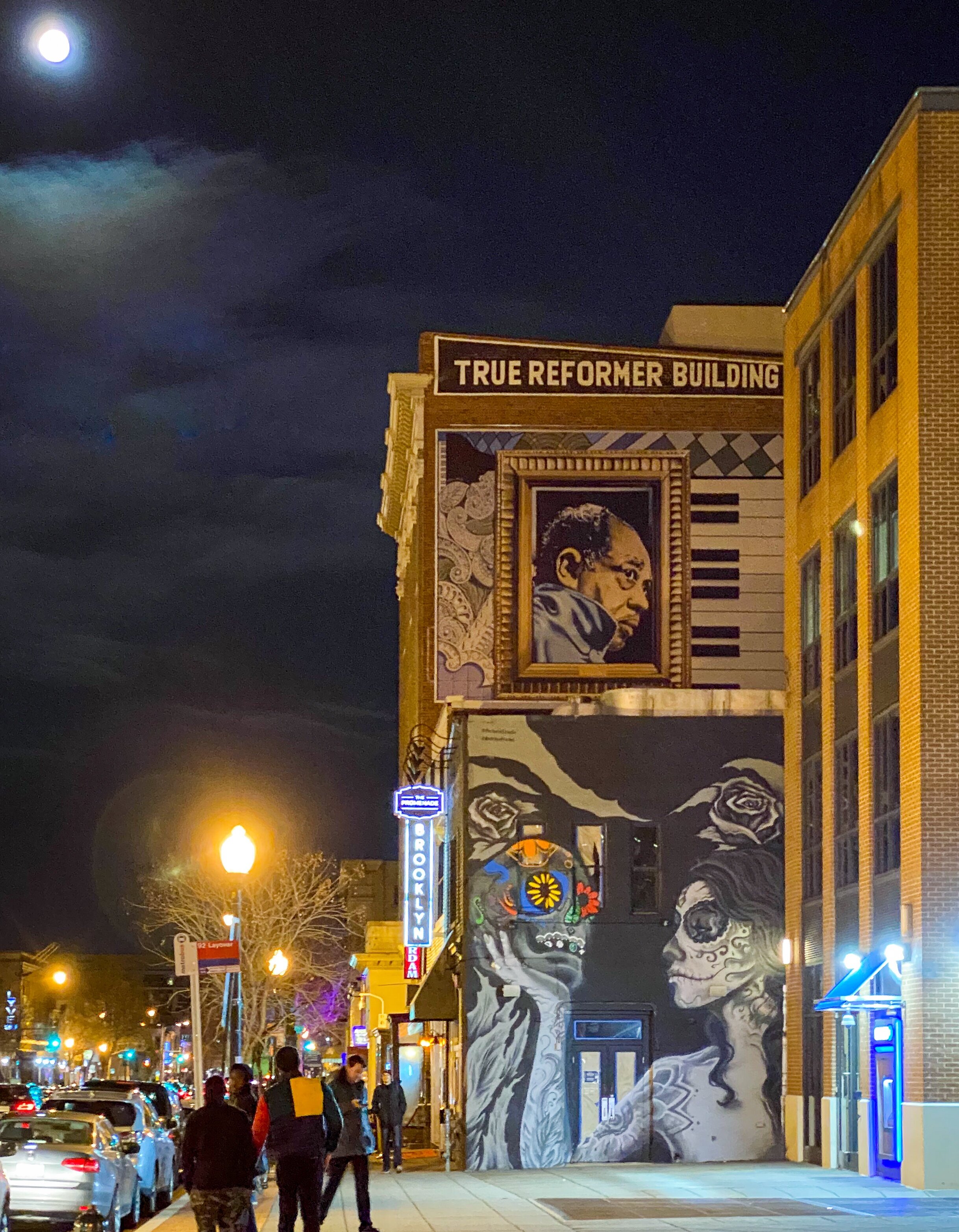
By the time this building at 1200 U Street NW was dedicated in 1903, the Grand Fountain of the United Order of True Reformers was already one of the most successful Black owned enterprises in the United States.

The origins of the Three Reformers date back to temperance and William Washington Browne. Browne born as an enslaved person in Georgia. During the Civil War, he fought for the Union and after the war became a teacher. He grew to believe that alcohol was the great hindrance to Black wealth and vitality. Not surprisingly, even temperance organizations were segregated. Browne attempted to join the all white Alabama temperance society, Good Templars in 1874. They refused, but helped Browne charter Black chapters across the state under the name Grand Fountain. Browne became the leader of Grand Fountain and grew the chapters throughout and then beyond Alabama, fairly quickly.

Browne was invited to start a similar group in Richmond, Virginia in 1876. There, the mission evolved and expanded. By 1880, the Reformers group in Richmond had become much more than a temperance society. It had evolved into a self-help and mutual benefit organization with the goal of enabling Black members to live without help from the White community. That meant creating Black-focused services such as banking, insurance, and others restricted, segregated industries.

The Savings Bank of the Grand Fountain of the United Order of True Reformers opened in 1888 and was the first Black owned and Black operated financial institution to be chartered in the nation. It was so successful that during the Panic of 1893, they were the only Richmond bank that continued to honor checks. From there, Grand Fountain expanded their financial services offerings over the next quarter century to become arguably the most influential institution for Black commerce nationwide. Browne passed away of cancer in 1897, but by then the True Reformers was a self-sustaining organization with membership in the thousands.

In 1903 the True Reformers’ newly opened structure in Washington at 1200 U Street NW was America’s first to be solely owned by, financed by, designed by, and constructed by African Americans since Reconstruction. They offered a multitude of amenities and services to Black people in DC. Conference rooms, leased office space, a performance hall, and street level retail were all part of the vast offerings beyond financial services.

One of the first businesses to lease space on the ground level was Fountain Pharmacy, opening in 1905. For 12 years, the Fountain was operated by Dr. Amanda Gray who started her own business after graduating from Howard University and working as a pharmacist at the Woman’s Clinic, a care facility located, at the time, near 13th and T Streets NW.

Medical directory produced by Fountain Pharmacy. (Library of Congress)

Article about Dr. Gray in Pharmaceutical Era journal c. 1912. (Library of Congress)

Dr. Gray is thought to have been the first Black woman to own and operate a pharmacy in the city. Her store in the True Reformer building offered additional services such as laundry, mail, and even housed a telegraph office. Dr. Gray also produced a directory of emergency medical services in the city. Dr. Gray ran the Fountain Pharmacy until the death of her husband and fellow pharmacist Arthur in 1917.

During the fledgling first few years of what would become the “Black Broadway” era on U Street, the True Reformer building became known for hosting jazz concerts popular with both youth and adults.

In 1916 a young Duke Ellington played some of his first shows for money inside the rooms of True Reformer Hall, as it was colloquially known, thereby making him a professional musician. Just a year later in 1917, the True Reformers sold the building to the Knights of Pythias, who officially renamed it Pythias Hall, but the old name persists to this day.

Somewhat fittingly, the building is now home to the Public Welfare Foundation, a grant-making organization focused on social justice issues in the United States.

For more weekly DC history posts, photos, inside access to tour development, and more, support us on Patreon. Plans start at just $3/mo.

True Reformer building c. 1990s with its sole tenant, a Duron Paints store. (Library of Congress)
True Reformer building c. 1990s with its sole tenant, a Duron Paints store. (Library of Congress)

Busy U Street in late 2019.

Busy U Street in late 2019.

A Story in a Photograph [Patreon Preview]

During these initial few weeks of establishing content on Patreon, we will share a few of the posts usually only available to Patrons. You can support our work and become a Patron here: Attucks Adams on Patreon

Enjoy!
-Tim

turkish embassy_1940s_2.jpg

Converting a live, in-person walking tour into an online "virtual tour" or "virtual field trip" experience wasn't as straightforward as I initially imagined. The lesson planning, the presentation, even the content have all required drastic change. I've been forced to rethink what themes and important messages I want to get across, and what media I need to illustrate those narratives.

Of course, photographs are key to illustrating an historical narrative, especially when I can't just point to a building and reference history against it in real time. On the flip side, being forced to rethink how I present information has allowed me to even further back up some of the stories I have used on tour with even more nuance.

Looking at the first photograph here: What do you see?

What is the setting? Who are these guests? What are they doing?

As part of the U Street tour (Art & Soul of Black Broadway), I tell a story about Ahmet Ertegun. Ahmet was son of the Turkish Ambassador to the United States. As such, he lived in the Turkish Embassy with his family. Ertegun and his brother Nesuhi were heavy into jazz music and became nuanced fans of the genre. They spent time on 7th Street NW, the "Black Broadway" of Washington, DC at the time, including Howard Theatre and Waxie Maxie's record store.  

At the time (early 1940s) Washington, DC was severely segregated like much of the United States, and in most places jazz or any other musical performance would not be played publicly with black and white artists together.

However, the Erteguns had another vision. Ahmet and his brother Nesuhi often hosted salons and jazz concerts with the top artists of their time, specifically inviting Black artists into the embassy, so much so that their neighbors in the all white Sheridan Circle neighborhood questioned why Black folks were allowed to enter the embassy through the front door. Along with the performances and jazz sessions, the Etergun's had all the artists gather over a meal, usually lunch.

This photo is from one of the lunches in the 1940s. Included in the photo are Nesuhi Ertegun, Adele Girard, Joe Marsala, Zutty Singleton, Max Kaminsky, an unnamed person, Ahmet M. Ertegun, Sadi Coylin, and (likely) Benny Morton. 

Ahmet Ertegun went on to graduate studies at Georgetown University and while there, started a small record label for DC r&b and gospel artists. He later enlisted an investment and partnership from friend Herb Abramson. By 1947 they had incorporated Atlantic Records in New York City. Atlantic Records became one of the most influential labels in jazz, soul, pop, rock, and other genres.

Most of this information won't make it into the 90 minute tour, but on occasion I have guests who are big on Turkish history, American diplomatic history, long shuttered DC record stores, jazz in America, or any number of tangential topics to the tour. Being able to go just one level deeper into the narrative creates value for guests, and opens a door to further learning for me as the storyteller.

I'll continue to post photos, images, and objects that won't ever make it into a tour, but that drive my research and tour building. I’m grateful for this new outlet!

The photo in this post is from the Library of Congress William P. Gottlieb Collection. 

District Wharf: DC's Newest Entertainment District

The Maine Avenue Fish Market has been operating in some form since 1805. That makes it the longest continually operating open air fish market in the United States. For 200 years, this waterfront market in DC's Southwest quadrant has been a main feature of Washington Channel, just off of the Potomac River. The fish market was one of the defining river features for 19th century Washington along with Washington Navy Yard on the Anacostia, and the port at Georgetown on the Potomac.

The municipal market has seen plenty of changes over the years, but the latest change is the most significant. The market's surrounding area is being transformed into Washington, DC's newest entertainment district, aptly called "The District Wharf."

Existing vendors at the Maine Avenue Market will remain and will be joined by a few new businesses.

Existing vendors at the Maine Avenue Market will remain and will be joined by a few new businesses.

The Wharf is a mixed-use development with commercial, residential, and industrial uses, with some open/public space. It consists largely of new construction, but incorporates existing structures including the Maine Avenue market. New office buildings and residential towers abut a pedestrian promenade and the Washington Channel with slips for hundreds of boats. Phase I of the project opened in October 2017.

Some highlights for visitors to DC include a 6,000 capacity music venue, a dock for water taxis to Georgetown and Alexandria, several hotels, waterfront restaurants from casual to fine, a public fire pit, walkable piers into the Washington Channel, shops (clothing, books, furniture, more), and water sporting activities such as kayaking. The area is sure to adapt and evolve over time, but the mix of a historic base and new mixed-use density instantly make The Wharf a great option for visitors and are residents alike.

Ask about adding a stop at the Wharf as part of our day-long, private Discover DC van tours. If your DC accommodations are at the Wharf we're also happy to start a walking or van tour direct from your hotel. We'll come to you. Call to learn more 202-681-0046.

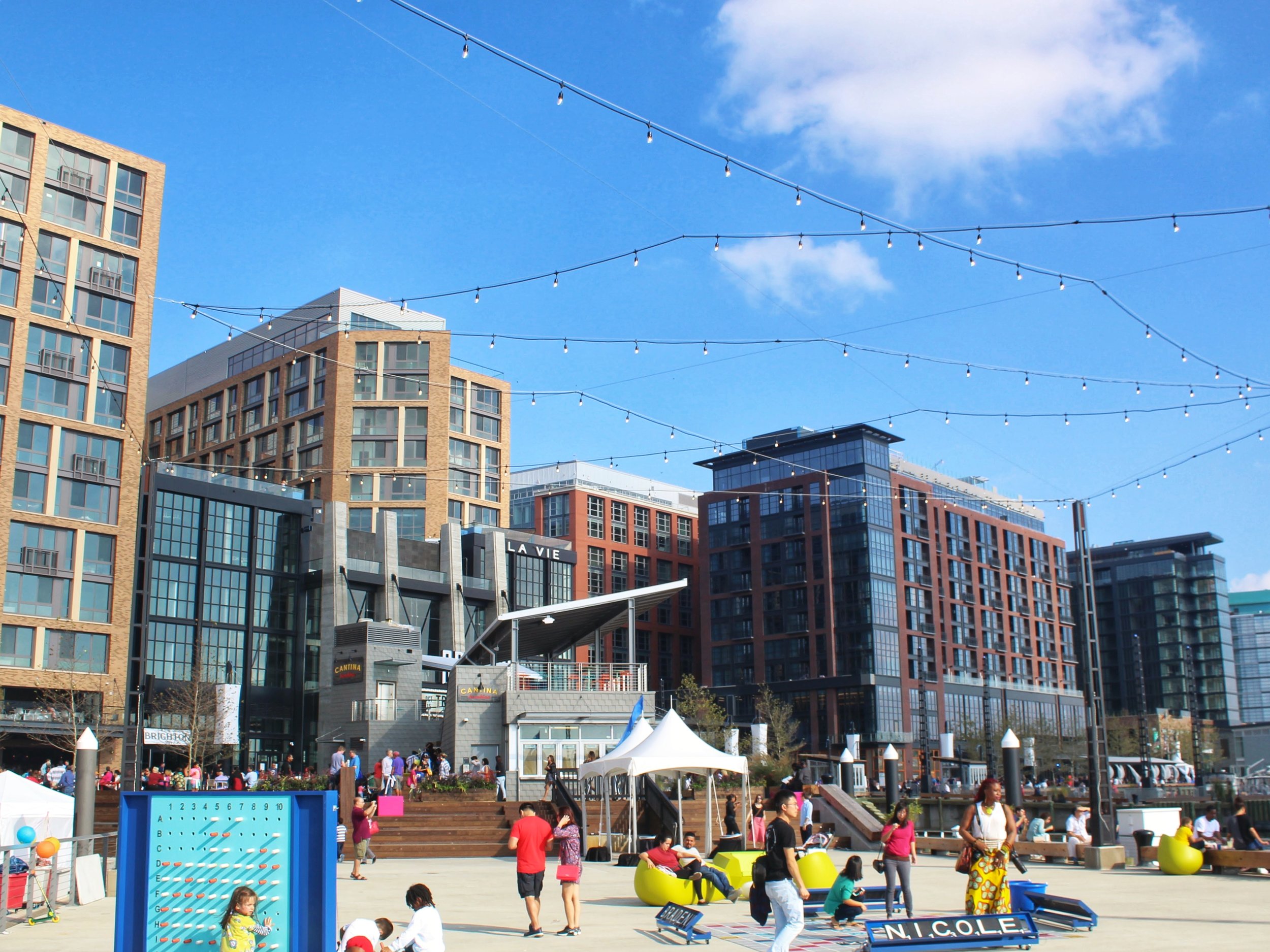
The District Wharf development features a mix of entertainment venues, restaurants, retail shops, office space, apartments, and food markets.

The District Wharf development features a mix of entertainment venues, restaurants, retail shops, office space, apartments, and food markets.

IMG_2585-01.jpeg
Seating for diners located between the pedestrian walkway and Washington Channel.

Seating for diners located between the pedestrian walkway and Washington Channel.

Life-sized board games at the water taxi landing.

Life-sized board games at the water taxi landing.

IMG_2499-01.jpeg
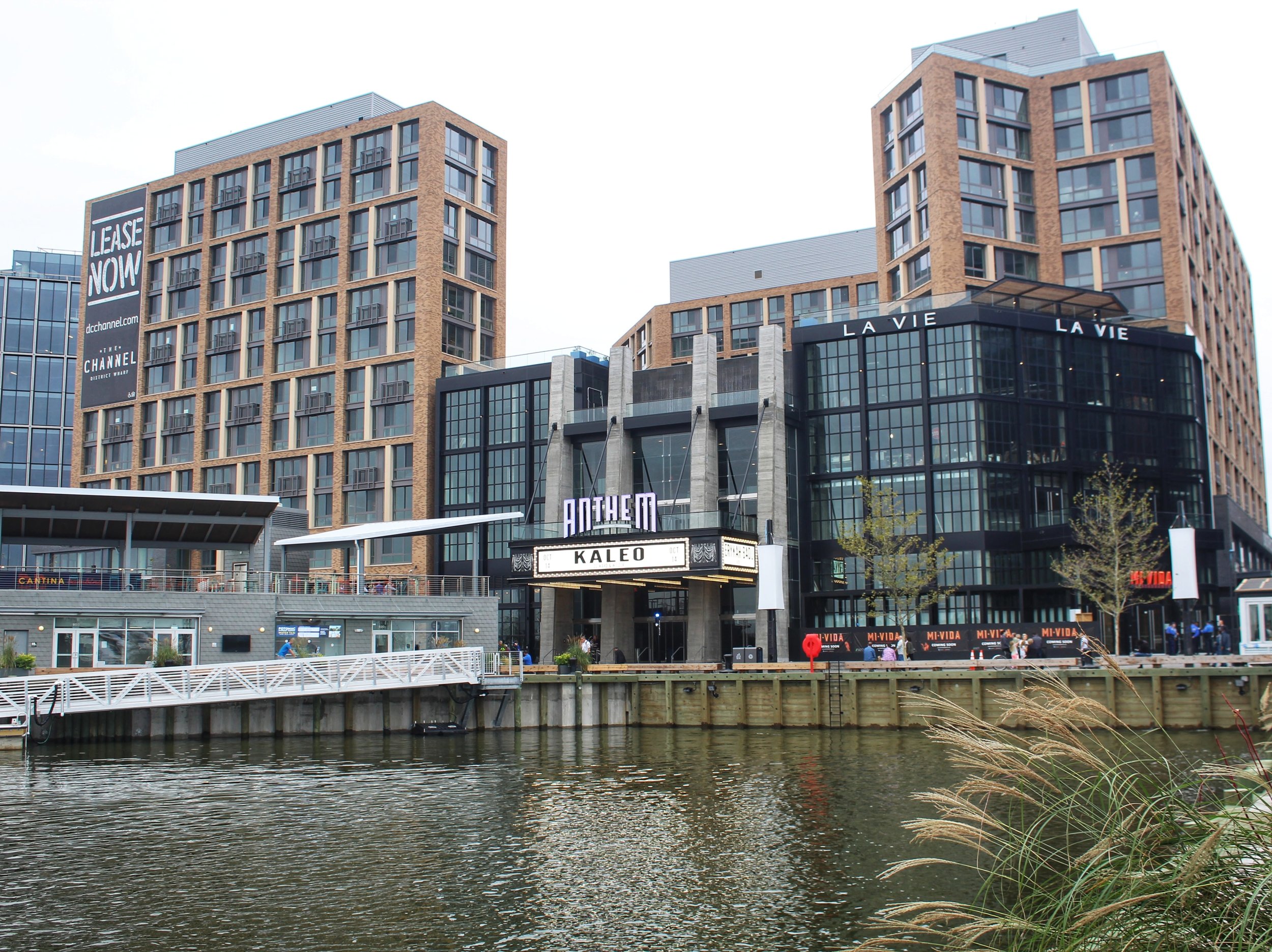
Anthem is a 6,000 capacity music venue from the owners of DCs famed 9:30 Club.

Anthem is a 6,000 capacity music venue from the owners of DCs famed 9:30 Club.

The Wharf is located at 1100 Maine Ave SW. It is accessible from L'Enfant Plaza or Waterfront Metro stations and has stations for Capital Bikeshare nearby. There is also a free shuttle bus that circulates from the development to the National Mall, to L'Enfant Plaza station, and back to the development. 

Read more:
District Wharf (official site)
Destination Wharf (five part news series)
Evolution of Washington DC's Southwest Waterfront (Destination DC)
The Problem With 'Fast-Casual Architecture' (architectural review)

When "Reality" Hit Dupont Circle

"The Real World" cast inhabited this beautiful c. 1890s Dupont mansion for the 2009 edition of the MTV groundbreaking reality show. Months of speculation surrounded the potential location of the group house. Many residents wondered which of DC's his…

"The Real World" cast inhabited this beautiful c. 1890s Dupont mansion for the 2009 edition of the MTV groundbreaking reality show. Months of speculation surrounded the potential location of the group house. Many residents wondered which of DC's historic and lively neighborhoods would act as the setting for the show, and therefore the lens through which the audience expreienced the city.

Producers settled on this stately 10,000 square foot home near 20th and S Streets NW. The block is quiet enough to be a great residential location, but close to restaurants, retail, bus routes, and the Metro subway system. For better or worse, the show managed to capture the city's attention for the better part of a year despite achieving less than stellar television ratings nationwide.